Reviewed · BUCHAREST TOURS
Sacred Monasteries Private Tour: Snagov, Țigănești & Căldărușani
Snagov’s little island monastery is the star here. A narrow bridge leads across the lake to a church tied to the long-running story of Vlad Țepeș, the ruler later linked with Dracula. The tour also brings you to Tiganesti Monastery, a peaceful convent in the woods, and Căldărușani Monastery, an important center of Orthodox life.
I like the ease of a private car and hotel pickup, especially since these sites sit outside Bucharest and public transport would make the route awkward. I also like the human scale: Toni, Marius, or another English-speaking guide can adjust the pace, answer questions, and add local context. The main caution is that church services can limit sightseeing on Sundays, and entrance fees are not included.
Key points at a glance
- Vlad Țepeș connection: See the tombstone traditionally linked with the burial of Vlad the Impaler at Snagov.
- A quiet convent in the forest: Tiganesti offers gardens, a renovated church interior, nuns, and a fragment of the Holy Cross.
- Orthodox art at Căldărușani: Visit a fortified monastery with frescoes, manuscripts, and an Icons Museum.
- Private transport matters: Your guide picks you up and returns you to your Bucharest hotel in an air-conditioned sedan or minivan.
- Flexible half-day format: The outing takes about four to five hours, making it easy to fit around other Bucharest plans.
- Possible palace stop: Mogosoaia Palace and its gardens are part of the advertised highlights, but confirm the exact schedule and interior access before booking.
Why this half-day trip works beyond Bucharest
Bucharest has grand avenues, ornate churches, museums, and layers of twentieth-century history. Yet Romania’s Orthodox tradition is easier to understand once you leave the city. This route takes you through wooded roads, village surroundings, lakeside settings, and working religious communities.
The appeal is not only architectural. These monasteries are living places of worship. You may see candles burning, priests moving through services, nuns tending gardens, or local families arriving for prayer. That gives the visit a different feel from a museum stop. You need to dress and behave accordingly, with modest clothing and a quiet manner inside the churches.
The tour costs about $110.53 per person. That is not the cheapest way to see the area, but the price covers private transport, an English-speaking guide and driver, hotel pickup, hotel drop-off, air conditioning, and onboard Wi-Fi. For one to four people, transport is by sedan. Groups of five to eight use a minivan. Split among several people, the private format can offer fair value, especially when you consider the distance between the sites and the limited public transport options.
The advertised duration is four to five hours. A recent outing took just over four hours, though traffic, church services, time spent at each stop, and any palace visit can affect the total. I would treat this as a flexible half-day rather than a precise four-hour appointment.
A few more Bucharest day trips to weigh up
- Bucharest: Dracula’s Castle, Peles Castle, & Brasov Old Town
★ 4.5 · 17,858 reviews - Bucharest: Dracula Castle, Peles Castle & Brasov Old Town
★ 4.6 · 10,891 reviews - Bucharest: Dracula’s Castle, Peleș Castle & Brașov Day Trip
★ 4.5 · 5,919 reviews
Tiganesti Monastery, a convent surrounded by trees
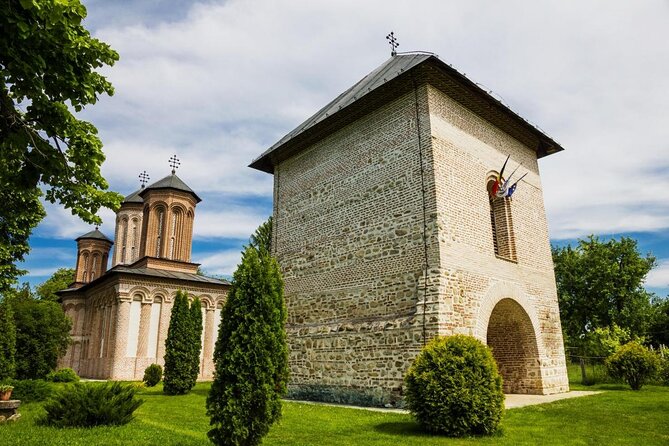
Tiganesti is a gentle start to the day. Founded in 1840, it is regarded as an important example of Orthodox architecture and functions as a convent community for nuns. The setting is especially pleasant: forest surrounds the monastery, and the grounds are maintained with care.
The first thing you notice is the calm. This is not a dramatic castle arrival or a crowded urban church. The monastery feels connected to a small settlement built around religious life. Gardens soften the stone and plaster buildings, and the church interior has been nicely restored.
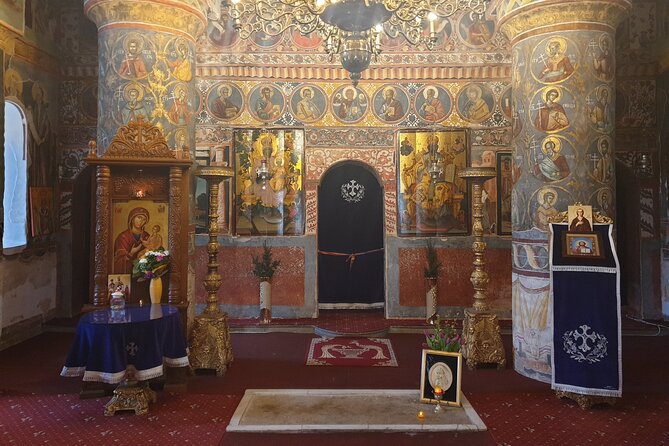
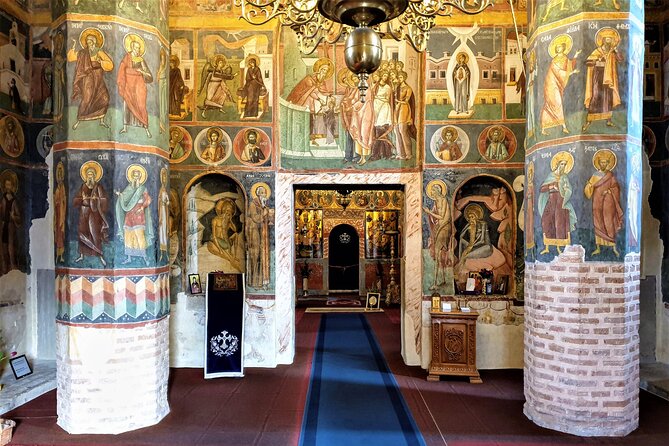
Inside, you can expect Orthodox decoration, icons, and the familiar atmosphere of a place still used for prayer. One special object associated with the monastery is a fragment of the Holy Cross. The visit is scheduled for about 45 minutes, which gives you enough time to look around without turning the stop into a rushed photo break.
I would pay attention to the contrast between the neat gardens and the simplicity of convent life. The site offers a useful introduction to the route because it focuses less on famous legends and more on the continuing religious community.
Photography rules can vary in active churches. Ask your guide before taking pictures, and avoid photographing worshippers without permission. If you arrive during a service, stand quietly at the back and follow local cues.
Snagov Island and the Vlad Țepeș story
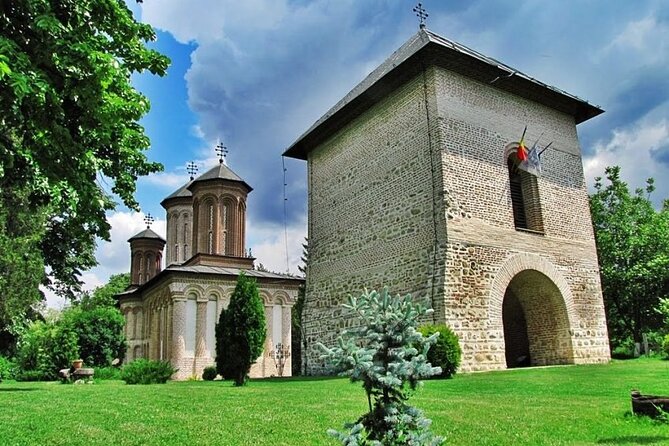
Snagov Monastery provides the most memorable setting. The church sits on a small island in the northern part of Lake Snagov, reached by a narrow bridge. That approach alone gives the stop a sense of occasion, though the bridge may feel tight for anyone uncomfortable with narrow crossings.
The monastery dates to around 1408 and combines Byzantine design with Romanian features. During the reign of Vlad Țepeș, the complex received further defenses, including a stone wall and the bridge linking it with the mainland. The surviving arrangement helps explain why a religious foundation in this region also needed protection.
Vlad Țepeș, known historically as Vlad the Impaler, is the reason many people choose this tour. After his death in a battle near the Codrii Vlasiei, some historians have argued that his body was brought to Snagov and secretly buried according to Orthodox custom. The claim has never lost its pull, even though the identification remains uncertain.
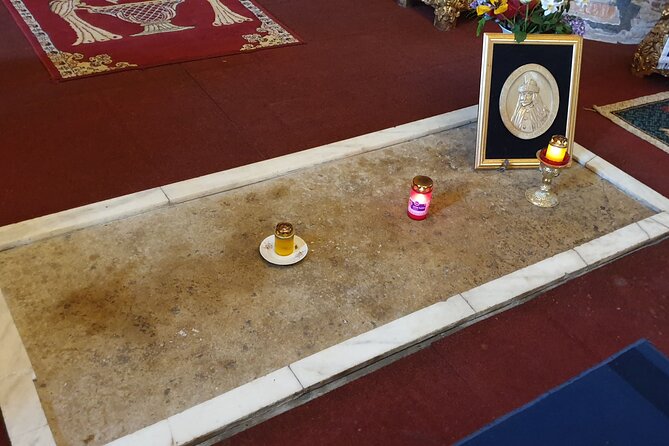
At the church, you can see a funeral stone in front of the altar traditionally identified as Vlad’s resting place. It is best to approach this as a historical mystery, not a confirmed Dracula attraction. Vlad Țepeș was a real fifteenth-century ruler. The Dracula connection was developed later through literature and popular culture.
Snagov also has an important place in Romanian religious and literary history. Antim Ivireanul, a leading scholar and churchman of his time, published some of the first Romanian books using Latin letters here. That detail adds weight to the stop. Snagov was not simply a hiding place for a prince or a picturesque island church. It was also a center of Orthodox learning and printing.
The scheduled visit lasts about 45 minutes. That is enough to cross the bridge, enter the church if open, see the tombstone, and hear the main stories. It may not be enough for a long, unhurried architectural study, especially if a service is underway.
You should also know that the admission fee is not included. The amount is not supplied in the tour details, so ask your guide about the current charge. Entrance arrangements may change, and religious sites sometimes have different rules during services or holidays.
Căldărușani, fortified walls and Orthodox art
Căldărușani Monastery shifts the focus from Vlad’s legend to the long life of Orthodox scholarship and art. The foundation dates to the seventeenth century and is linked with Matei Basarab, a Wallachian ruler who supported religious and cultural works.
The monastery sits beside a quiet lake and has a fortified character. That combination of water, walls, and church buildings gives it a strong sense of place. The monastery served as a center of monastic life and Orthodox learning, and monks continue religious traditions here.
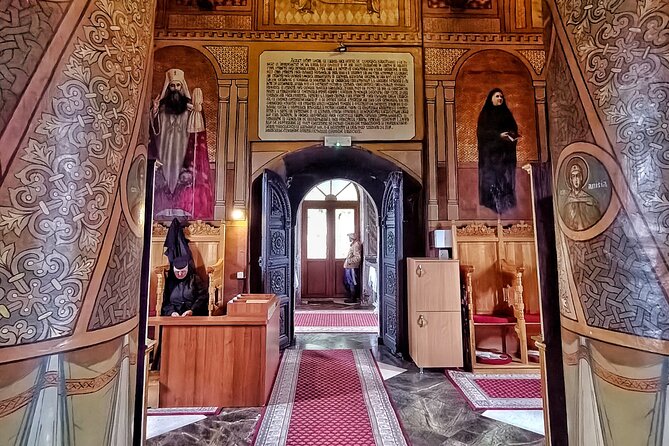
The interior details are a key reason to include this stop. Historic frescoes, old manuscripts, and religious objects point to the importance of monasteries as places where art and books were preserved. In the Icons Museum, you can see a collection of Orthodox religious works that reflects Romania’s artistic tradition.
Allow about 45 minutes. Use the time to look closely rather than simply walking through. Notice the way icons function as both works of art and objects of worship. Frescoes may show familiar scenes from the Bible and the lives of saints, but the guide can help explain their place in Orthodox practice.
Admission is not included here either. As at Snagov, ask about the current ticket arrangements. Since this is an active monastery, some rooms or displays may have restricted access at certain times.
Căldărușani may be the best stop for someone who wants more than a Dracula story. It gives the outing a broader purpose by showing how Romanian religious life continued across centuries, from the age of Matei Basarab to the present.
Same corner of the country, a completely different day out:
- Bucharest: Palace of Parliament Tickets and Guide
★ 4.3 · 3,182 reviews - Bucharest: Day Trip to Dracula Castle, Peles Castle & Brașov
★ 4.4 · 3,049 reviews - Bucharest to Dracula Castle, Peles Castle and Brasov Guided Tour
★ 4.5 · 2,933 reviews - Bucharest: Palace of Parliament Tickets and Guided Tour
★ 4.4 · 1,877 reviews
Mogosoaia Palace and the route’s one point to clarify
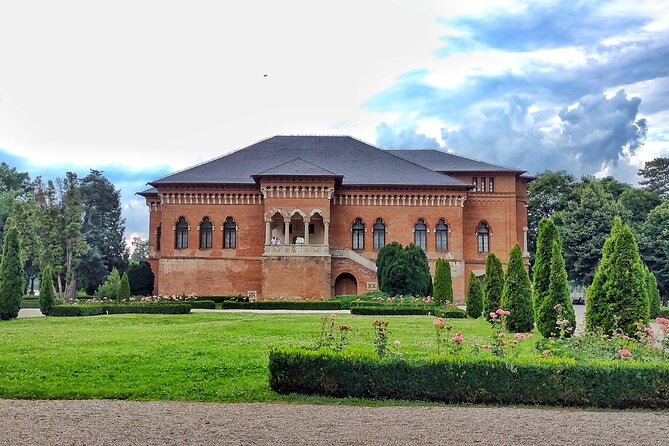
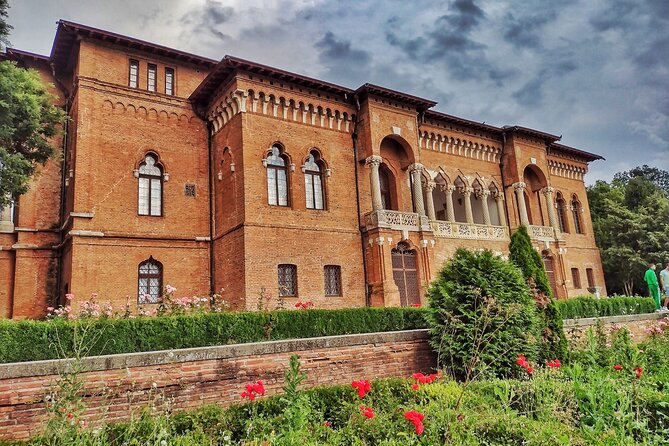
Mogosoaia Palace appears among the experience highlights and is also mentioned in the descriptions of the day. It is a beautiful setting by a lake, with impressive gardens and a palace associated with Romanian aristocratic history.
The available schedule gives 45 minutes to each of the three monasteries, but it does not provide a separate time block for Mogosoaia Palace. Some outings include the palace as an additional stop, while the amount of time and interior access may vary. One account specifically notes that the gardens were beautiful but the palace interior could not be visited.
This is the one detail I would confirm before paying. Ask whether Mogosoaia is included on your chosen departure, whether you will go inside, and how much time is planned there. If the palace is a firm priority, you do not want to assume that a brief exterior or garden stop means a full palace visit.
Even with that uncertainty, Mogosoaia can add a pleasant change of pace. The monasteries are places of worship and quiet reflection. The palace offers formal gardens, secular architecture, and a more aristocratic setting. Together, they give you a wider view of the Bucharest area.
What the private vehicle adds
The private format is more than a luxury label. These sites are spread outside Bucharest, and the route is difficult to manage efficiently by public transport. You would need to coordinate local connections, wait between departures, and risk losing time at a monastery if the next vehicle does not line up.
With this experience, the guide meets you in front of your hotel at the requested time. The ride is in an air-conditioned sedan for one to four people or a minivan for five to eight. Wi-Fi is available onboard, and the vehicle is described as modern, clean, and comfortable.
That matters on a hot day. One outing also included refreshments, and umbrellas were available when rain arrived, though these extras are not listed as guaranteed inclusions. Treat them as possible practical touches, not promises.
The strongest part of the private format is control over pace. If you want more time at the Icons Museum, fewer photographs, or a slower look at the church grounds, you can discuss that with the guide. Toni has been praised for confirming the pickup the day before, arriving on time, and letting the group set the rhythm. Marius is also described as professional and attentive, while Andriy has been associated with a relaxed approach.
Guide assignment can vary, so do not book on the assumption that one named guide is guaranteed. What you can expect is an English-speaking guide and driver for the whole outing.
Timing, Sunday services, and practical dress
Morning or afternoon departures are possible, making this useful near the beginning or end of a Bucharest stay. The half-day length works well if you want to keep the evening free or have a flight, though I would not schedule it too close to an airport departure.
Sunday requires special thought. Services may be taking place during the visit, which can reduce access to the interior and make it harder to examine the sites as historic monuments. At the same time, attending briefly and respectfully can show you the monasteries as working religious places. If your priority is detailed sightseeing, choose another day if the schedule allows.
Wear clothing that covers shoulders and knees. Comfortable shoes are sensible because you will walk across the bridge at Snagov and around monastery grounds. The tour requires good weather, and poor conditions can lead to a new date or a full refund.
Meals are not included. The tour lasts only four to five hours, so you may not need a full meal during the outing, but plan breakfast or lunch around your departure. Entrance tickets are also separate from the tour price.
Free cancellation is available up to 24 hours before the start time. Changes or cancellations inside that window are not accepted for a refund.
Who will get the most from this tour
I would recommend this experience to you if you want to:
- See several important religious sites without renting a car.
- Explore outside Bucharest in a compact half-day.
- Follow the Vlad Țepeș burial story while keeping the legend in historical perspective.
- Visit active monasteries rather than only formal museums.
- Ask questions and adjust the pace to suit your interests.
- Combine religious architecture with a possible palace and garden stop.
It is also a good choice for couples, families, and small groups who value privacy. The sedan or minivan keeps the day personal, and hotel pickup removes much of the planning work.
You may want a different outing if you want a long, detailed visit inside each site. Three monasteries, plus a possible palace, in four to five hours means each stop is relatively short. You should also think twice if your main goal is a guaranteed indoor tour of Mogosoaia Palace, since access and timing need confirmation.
Is $110.53 per person fair value?
At $110.53 per person, the price sits above a basic shared bus excursion. But you are paying for a private vehicle, hotel-to-hotel service, an English-speaking guide, and a route that would be inconvenient to reproduce independently.
The value improves when two or more people share the booking. A private car also saves time, which is important on a short Bucharest visit. You are not just buying admission to three churches. You are buying a practical way to connect sites that sit outside the city, with someone available to explain the religious customs and historical background.
The separate entrance fees are a small but important budget note. Since they are not included, ask for the current amounts before departure. Meals are also your responsibility.
The public score is 4.9 out of 5 from 32 ratings, with 97 percent recommending the experience. That points to a consistently strong experience, though the lower rating provides a useful warning: guide involvement inside the sites and Sunday access can affect the day.
My verdict on the sacred monasteries route
I would book this tour if you want a calm, history-focused break from Bucharest and prefer a private ride over a complicated self-guided route. Snagov gives you the famous Vlad connection, Tiganesti supplies quiet convent life, and Căldărușani adds serious Orthodox art and learning. The possible Mogosoaia stop makes the day more varied, but confirm its exact treatment first.
Book with realistic expectations. This is not a Dracula theme park, not a full-day academic study, and not a guaranteed palace interior tour. It is a compact introduction to Romania’s religious heritage, delivered at a flexible pace by a local English-speaking guide. For most visitors with half a day to spare, that is a worthwhile use of time.
FAQ
How long does the Sacred Monasteries Private Tour take?
The experience lasts approximately four to five hours. A particular outing may run slightly shorter or longer depending on traffic, services, time at each site, and the treatment of Mogosoaia Palace.
Which monasteries are included?
The route includes Tiganesti Monastery, Snagov Monastery, and Căldărușani Monastery. Mogosoaia Palace is also included among the advertised highlights, but you should confirm the exact schedule and access details before departure.
Is hotel pickup available in Bucharest?
Yes. The guide meets you in front of your hotel at the time you request and returns you to the hotel after the tour.
What type of vehicle is used?
Groups of one to four people travel by sedan. Groups of five to eight use a minivan. The vehicle is air-conditioned and has Wi-Fi onboard.
Is the tour private?
Yes. Only your group participates in the activity.
Is the tour offered in English?
Yes. An English-speaking guide and driver accompany you for the entire tour.
Are entrance fees included?
No. Admission tickets and entrance fees are paid separately. Meals are also not included.
Can I visit Vlad Țepeș’s tomb at Snagov?
You can see the funeral stone in front of the altar that is traditionally identified with Vlad Țepeș’s burial place. The burial claim remains disputed, so the site should be viewed as part of a historical legend rather than a confirmed Dracula grave.
Can I cancel for a full refund?
You can cancel at least 24 hours before the experience starts for a full refund. Cancellations or changes made less than 24 hours before the start time are not accepted for a refund. If poor weather causes the tour to be canceled, you will be offered another date or a full refund.
Just added around Bucharest
- Private Full Day Tour of Bucharest★ 5.0 · 3 reviews
- Veliko Tarnovo and Medieval Bulgaria Private Day Trip from Bucharest★ 5.0 · 3 reviews
- Bucharest VIP Bar Crawl in Lipscani ‘Old Town’★ 5.0 · 3 reviews
- Muddy Volcanoes and Salt Mine Private Tour★ 5.0 · 3 reviews
- Bucharest Private City Tour★ 5.0 · 3 reviews
- Legends & Stories from Transylvania -2 Castles & Brasov Old Town★ 5.0 · 3 reviews
- Transfagarasan Private Tour from Bucharest – 2 Days★ 5.0 · 3 reviews
- 7-Day Dracula Tour in Romania from Bucharest including ‘The Ritual of Killing of a Living Dead’★ 5.0 · 3 reviews
Bucharest Tours, compared.
Dracula’s Castle, Peles Castle, & Brasov Old Town
Read our review →
Dracula Castle, Peles Castle & Brasov Old Town
Read our review →
Dracula’s Castle, Peleș Castle & Brașov Day Trip
Read our review →
Day Trip to Dracula Castle, Peles Castle & Brașov
Read our review →
Bucharest to Dracula Castle, Peles Castle and Brasov Guided Tour
Read our review →