Reviewed · 1-DAY TOURS
1-Day Bucovina Painted Monasteries tour from Suceava – English
Bucovina’s painted monasteries are not quick photo stops. Their walls carry whole scenes from the Bible in bold colors, set among wooded hills and old villages. This private day trip links four of the finest churches with a visit to Marginea, where black pottery is still part of the region’s identity.
I like the private vehicle, since you avoid waiting for strangers and can settle into a spacious, air-conditioned car. I also like the guides’ local connection. Bogdan, who was born and raised in Suceava and has a PhD in history, has guided this route, while Gabriel has been praised for combining careful driving with clear explanations.
The main drawback is cost: at $140.43 per person, this is not a budget bus excursion, and entrance fees and lunch are extra. The tour also packs four monasteries into one day, so you should expect a full schedule rather than a slow, unplanned wander.
Key points to know before you book
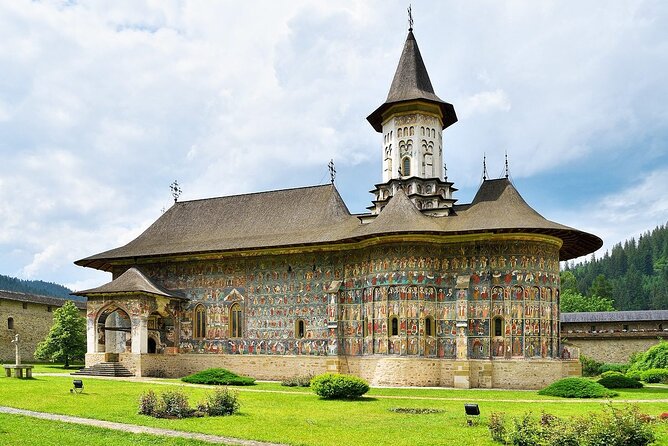
- Four painted monasteries in one day: See Humor, Voronet, Moldovita, and Sucevita, each with a different setting, design, and fresco program.
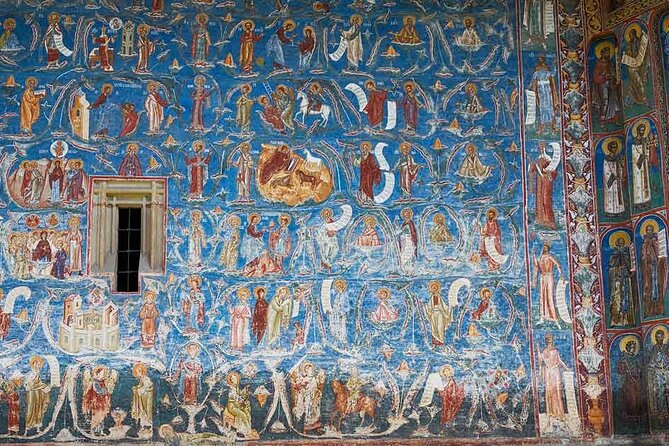
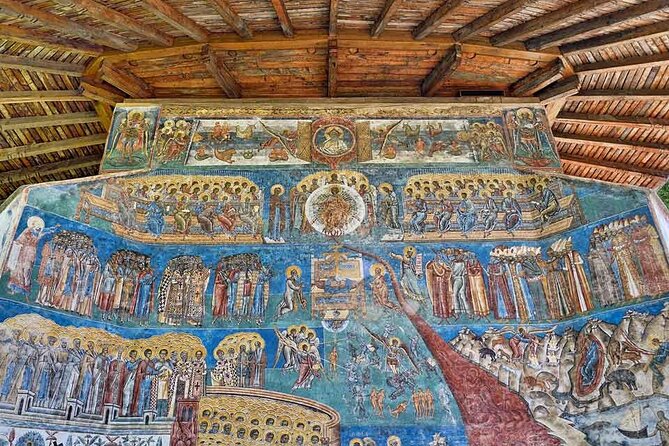
- Voronet’s famous blue frescoes: The western wall’s Last Judgment scene is the visual high point for many visitors.
- A private ride from Suceava: Only your own group travels in the vehicle, with parking included.
- A local pottery stop: Marginea adds a living craft tradition to a day otherwise focused on medieval churches.
- A relaxed 7 to 9 hour outing: Each monastery receives about an hour, with time for scenery and a possible Romanian lunch stop.
- Good guide support: You receive a live English-speaking guide, not just transport and a printed route.
Why these Bucovina churches are worth a full day
Bucovina’s churches are special because their decoration is not confined to the inside. Exterior walls are covered with painted scenes designed to teach religious stories to people who could not read. Weather, age, and sunlight have taken their toll, but the best-preserved colors remain striking.
You are not simply ticking off four similar monasteries. Each place has its own mood. Humor sits in a green rural setting, Voronet is famous for a particular blue, Moldovita feels fortified, and Sucevita presents the most complete surviving exterior painting of the group.
The route also gives you a good sense of northern Moldavia. Between the stops, you pass villages, forests, meadows, and Carpathian views. The drive is part of the day, not dead time between attractions.
The guide matters here. Without context, the painted walls can look like a mass of saints, angels, and bright borders. A good guide can explain the scenes, the patrons who paid for the churches, and the visual ideas behind the frescoes. Bogdan has been praised for giving both site explanations and a wider account of Romanian history. That sort of background makes the churches easier to read.
A few more Romania day trips to weigh up
- Bucharest: Dracula’s Castle, Peleș Castle & Brașov Day Trip
★ 4.5 · 5,919 reviews - Bucharest: Day Trip to Dracula Castle, Peles Castle & Brașov
★ 4.4 · 3,049 reviews - Dracula’s Castle, Peles Castle and Brasov Day Trip from Bucharest
★ 4.5 · 1,804 reviews
Starting from Suceava in a private car
Pickup begins at 9:00 am from your hotel or another address in Suceava. The tour lasts roughly 7 to 9 hours, depending on the pace of the day and stops along the route.
The private format is one of the strongest practical features. You are not sharing the vehicle with a large group, and only your party participates. That gives you more room, fewer delays, and a quieter ride through the countryside.
Air conditioning will be welcome during warmer months, especially when you are moving between outdoor walls and sunny monastery courtyards. Parking fees are included, which removes one small but annoying cost from a day built around several separate stops.
The vehicle is not the experience itself, but it shapes the experience. Four monasteries require plenty of road time. A private car makes that travel easier, particularly if you want to ask questions as you go or simply enjoy the view without a microphone and a crowd.
The tour is offered in English. Confirmation is subject to availability and is sent within 48 hours of booking. Since the average booking is made well ahead of departure, about 36 days in advance, reserving early is sensible if your dates in Suceava are fixed.
Humor Monastery: a quiet first look at Bucovina’s painted churches
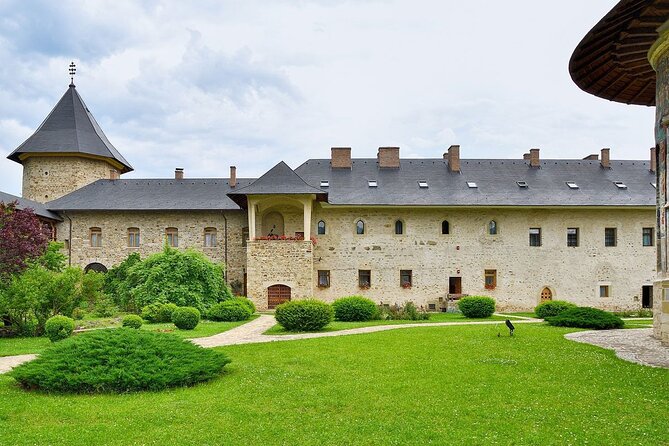
The first stop is Humor Monastery, located on a hilltop in the village of Manastirea Humorului. Trees, meadows, and open countryside give the site a calm start to the day.
The church was built in 1530 by Toader Bubuiog, a chancellor and member of the Moldavian Council. An inscription carved into rock near the entrance to the outer wall records this connection. It is a small detail, but it helps put a name and a political setting behind the building.
You have about an hour here. That is enough time to examine the church, walk around the grounds, and listen to the guide’s explanation without feeling trapped in a rushed photo stop.
Humor is a good introduction because it lets you become familiar with the basic features of the Bucovina churches. Look at how the building sits within its enclosure, how the painted surfaces relate to the architecture, and how the church feels within its setting rather than as an isolated monument.
Entrance fees are not included, so keep money aside for the four monasteries. The tour includes transportation and parking, but admission remains your responsibility.
Voronet: the day’s most famous blue
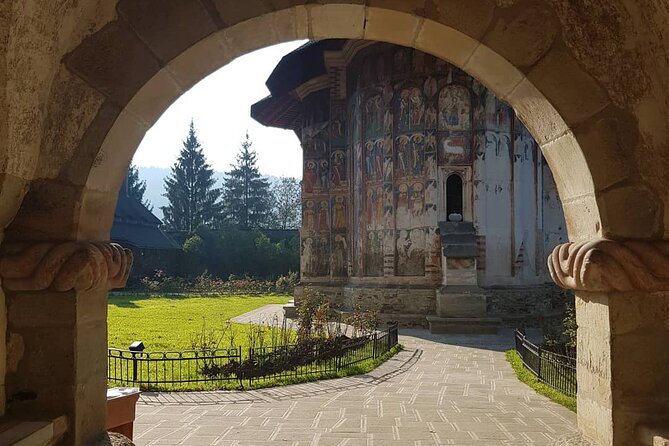
Voronet is often treated as the star of the route, and it is easy to see why. Specialists compare its architectural design with both Byzantine and Gothic traditions. The church has a white-clover-shaped foundation and a tower above the nave, while arches and columns add Gothic touches.
The exterior fresco on the western wall is the main event. It presents the Last Judgment on a grand scale, which is why Voronet is often called the Sistine Chapel of the Orient. That nickname is a little grand, but the wall does make a powerful impression.
The color known as Voronet blue is the detail you will hear about most. Specialists regard it as unique, in the same way that certain artists’ reds and greens are tied to a particular painter or school. The blue has survived with unusual force, though the exact appearance changes with light and weather.
Give yourself time to look past the overall color. The fresco is built from many individual scenes. Your guide can help explain the figures and the meaning of the arrangement, which is useful because a bare glance does not reveal the whole story.
You have one hour at Voronet, and that may feel short if you want both a detailed look at the frescoes and a relaxed walk around the grounds. Still, the private format helps. You are not forced to follow a large group at a fixed pace, and the guide can focus explanations on what interests you.
Same corner of the country, a completely different day out:
- Bucharest: Dracula’s Castle, Peles Castle, & Brasov Old Town
★ 4.5 · 17,858 reviews - Bucharest: Dracula Castle, Peles Castle & Brasov Old Town
★ 4.6 · 10,891 reviews - Bucharest: Palace of Parliament Tickets and Guide
★ 4.3 · 3,182 reviews - Bucharest to Dracula Castle, Peles Castle and Brasov Guided Tour
★ 4.5 · 2,933 reviews
Moldovita: a monastery built like a fortress
Moldovita changes the mood. The monastery is enclosed by thick walls about 1.20 meters wide, with tall towers and a strong gate tower. It feels less like an open church in the countryside and more like a protected religious compound.
Petru Rares founded the monastery in 1532. The church’s mural painting is considered one of the major achievements of old Romanian art, and the fortified form adds useful context. These were places of worship, but they were also built with defense in mind.
Spend part of your hour studying the relationship between the church and the walls. At the other monasteries, the frescoes may grab your attention first. At Moldovita, the enclosure is almost as important to the sense of place.
This is also a good stop for noticing how the route avoids repetition. You are still looking at painted churches, but the setting, architecture, and emphasis shift. If you enjoy buildings as much as pictures, Moldovita may be one of your favorite stops.
The guide’s role is especially helpful here. A knowledgeable guide, meaning someone who can explain the site rather than merely name it, can show you why the fortress-like plan matters and how it differs from the other monasteries.
Sucevita: the best-preserved exterior painting
Sucevita was built in the final decades of the 16th century at the expense of the Movila boyar family. Ieremia Movila ruled Moldavia from 1595 to 1606, placing the monastery within a period when powerful local families supported major religious buildings.
The exterior painting is the best preserved among the group. It is also the only one that still keeps its northern side, a detail that gives Sucevita unusual importance for anyone interested in mural art.
The most striking scene is the Ladder of Virtues. It presents the struggle between right and wrong, the effort to move toward perfection, and the danger of falling into sin. Angels and the forces of hell create a strong visual contrast, and the large scale of the scene gives it real force.
You receive about an hour here. Use some of it to walk around the exterior rather than staying only at the most famous wall. Sucevita rewards a slow circuit because its importance lies in the survival of the whole painted program, not just one isolated panel.
By this point in the day, the churches may begin to blur together if you rush. That is the strongest reason to pay attention to the guide and to take short pauses between explanations. Four sites are worthwhile, but they demand some concentration.
Marginea’s black pottery adds a living tradition
The final listed stop is Ceramica Neagra Marginea, the black pottery tradition of Marginea. The visit lasts about 10 minutes and admission is free, so this is a short but useful change of pace after several hours of church art.
Pottery in Marginea is traced to around 1500. Its early role was practical: people needed containers for storing food. The local setting helped the craft develop, with clay soil, the Sucevita River, and surrounding forests supplying the basic conditions for the triangle of clay, water, and fire.
Before the communist period, at least 60 families in Marginea worked as potters. That number gives you a sense of how central the craft once was to village life. One local potter even traveled as far as Munich to present the work.
Do not expect a long workshop session or a full craft class. Ten minutes is enough for a quick look, an explanation, and perhaps a purchase if one is available, but the stop is brief. Its value is cultural: it reminds you that Bucovina is not only a set of historic churches preserved for visitors. It also has working traditions tied to local materials and daily life.
Lunch, mountain views, and the right pace
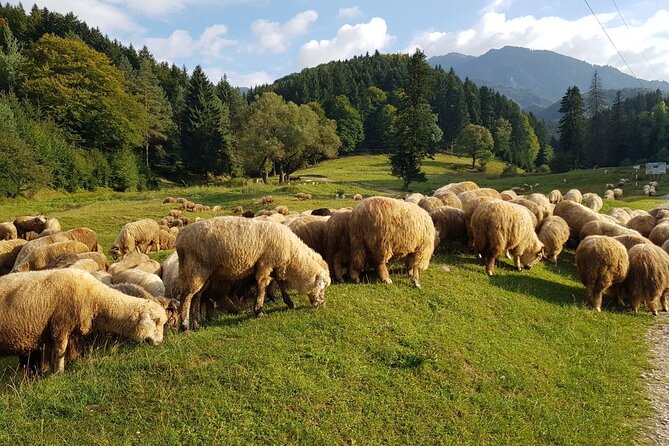
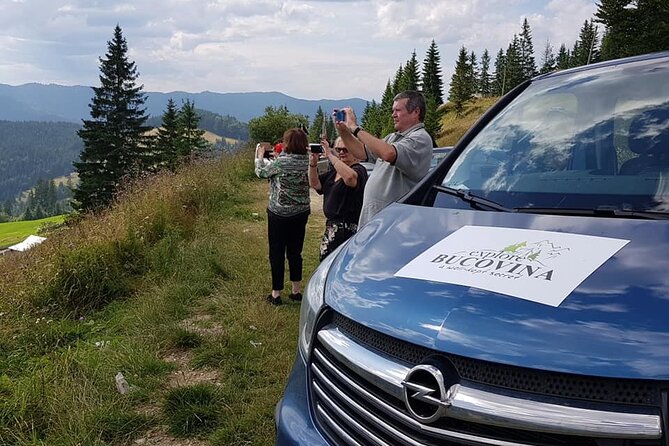
Lunch is not included, but the tour can include a stop at a traditional Romanian restaurant. A guide has also chosen a lunch venue at a high point with views over the Carpathian hills.
That break matters. A day of frescoes and architectural detail can become tiring, and a proper meal gives you time to reset. You can expect traditional Romanian dishes to be available, though the meal choice and price are not specified in the tour details.
Do not assume lunch is part of the $140.43 price. Budget separately for food and for the entrance fees at the monasteries. The included parking and private transport make the price easier to understand, but it is still a premium outing compared with a shared coach trip.
The pace has been described as balanced, with time to wander independently. That is important. A guide can explain the meaning of the frescoes, but you should also have quiet minutes to look without commentary, take in the courtyards, and notice the hills beyond the walls.
What $140.43 buys you
At $140.43 per person, the tour makes the most sense for couples, families, or small groups who value privacy and a local guide. You are paying for a full day of transport from Suceava, an air-conditioned vehicle, parking, and live English explanations at four major sites.
The private setup is particularly valuable when two or more people share the booking. You avoid the compromises of a large group, and the vehicle is used only by your party. If you are alone, the per-person cost is harder to justify, but the convenience remains strong.
The price does not cover lunch or entrance fees. That is not a minor footnote, since there are four monastery visits. Add those costs before comparing this experience with other ways to see Bucovina.
You should also consider what kind of day you want. If your priority is the lowest possible fare, a shared excursion may suit you better. If you want a guide who can explain iconography, answer questions, and adjust the conversation to your interests, this private trip offers better value.
The rating is 4.8 out of 5 from 33 ratings, with 97 percent recommending it. The strongest praise centers on the guides, the comfortable car, the scenery, and the chance to enjoy the monasteries without feeling hurried. One negative experience involved a location misunderstanding and a disputed refund, which is a useful warning: make sure you understand that pickup is from Suceava before paying.
Who should choose this monastery tour?
I would choose this outing if you are staying in Suceava and want the main Bucovina churches covered in one day. It suits you especially well if you prefer private transport, appreciate background on architecture and iconography, and do not want to arrange parking or navigate the route yourself.
It is also a good fit for anyone who wants more than a church checklist. The drive through villages and mountain scenery, the lunch possibility, and the Marginea pottery stop make the day broader than a sequence of religious monuments.
You may want another plan if you prefer very slow travel. One hour at each monastery is reasonable, but it does not allow unlimited time for photography, sketching, or close study of every painted panel. The whole day can last up to nine hours, so it is not a light half-day outing.
Most people can participate, and the activity is private. Pickup is free from a hotel or another address in Suceava at 9:00 am. Free cancellation is available up to 24 hours before the start time, but cancellations or changes inside that window are not accepted.
Should you book it?
Book this tour if you have one day for Bucovina and want a clear route, a private car, and an English-speaking guide who can explain why the churches matter. Voronet’s blue, Sucevita’s surviving northern wall, Moldovita’s fortress form, and Humor’s hilltop setting give you four distinct reasons to go.
I would be more cautious if the extra costs for meals and admissions stretch your budget, or if your booking is based on the assumption that pickup is available from Bucharest. This experience begins in Suceava, and that detail needs to be clear before you reserve.
For the right base and the right pace, it is a strong day trip. You get the essential monasteries, beautiful rural scenery, a local craft tradition, and the comfort of having the road handled for you.
FAQ
Where does the tour begin?
The tour begins with free pickup from your hotel or another address in Suceava.
What time does pickup start?
Pickup starts at 9:00 am.
How long does the tour last?
The experience lasts approximately 7 to 9 hours.
Is the tour private?
Yes. Only your group participates, and you are the only passengers in the vehicle.
Is the tour offered in English?
Yes. A professional English-speaking guide provides live explanations.
Are monastery entrance fees included?
No. Entrance fees are not included in the tour price.
Is lunch included?
No. Lunch is not included. A traditional Romanian lunch stop may be arranged during the day.
What is included in the price?
The price includes private transportation, an air-conditioned vehicle, parking fees, and a professional English-speaking guide.
Can I cancel for a full refund?
Yes. You can cancel at least 24 hours before the local start time for a full refund. Changes or cancellations made less than 24 hours before the start time are not accepted.
Just added around Romania
- Private Full Day Tour of Bucharest★ 5.0 · 3 reviews
- Bear Sanctuary Zarnesti,Bran Castle,Rasnov Fortres w/Hotel pickup★ 5.0 · 3 reviews
- Count Dracula & Peles Castle in One Day from Bucharest★ 5.0 · 3 reviews
- Veliko Tarnovo and Medieval Bulgaria Private Day Trip from Bucharest★ 5.0 · 3 reviews
- Private Transfagarasan&Balea Lake★ 5.0 · 3 reviews
- Bucharest VIP Bar Crawl in Lipscani ‘Old Town’★ 5.0 · 3 reviews
- Muddy Volcanoes and Salt Mine Private Tour★ 5.0 · 3 reviews
- Bucharest Private City Tour★ 5.0 · 3 reviews
1-Day Tours, compared.
Dracula’s Castle, Peleș Castle & Brașov Day Trip
Read our review →
Day Trip to Dracula Castle, Peles Castle & Brașov
Read our review →
Dracula’s Castle, Peles Castle and Brasov Day Trip from Bucharest
Read our review →
Small-Group Day Trip to Dracula’s Castle, Brasov and Peles Castle
Read our review →Dracula’s Castle, Peles Castle & Brasov Day Trip
Read our review →