
Reviewed · BUCHAREST TOURS
Private Bucharest: History & Food with Traditional Meal
Bucharest’s past is easiest to understand with a fork in hand. This private four-hour walk links Revolution Square, Victory Street, Old Town, and the People’s Palace with the foods that arrived through Romania’s many political and cultural connections. You start with a simple covrig, then finish with a three-course Romanian meal in a historic inn.
I like the way the tour joins history and food instead of treating them as separate subjects. I also like the private format: guides such as Elaina, Mara, Ioanna, Andra, Monica, and Dana have been praised for warm, patient explanations, with Andra especially good at including children and allowing time for photos.
The main thing to keep in mind is that the food tasting before lunch may be lighter than the description suggests. One past participant expected several more samples, though the final three-course meal was considered good. At $140 per person, this is a premium walking tour, so its value depends on how much you want personal guidance and a full introduction to Bucharest.
Key points at a glance
- Revolution Square sets the political stage: Begin where Ceausescu’s 1989 speech helped trigger the Romanian Revolution.
- A covrig starts the food story: This everyday salty snack connects Bucharest with medieval Hapsburg and German merchants.
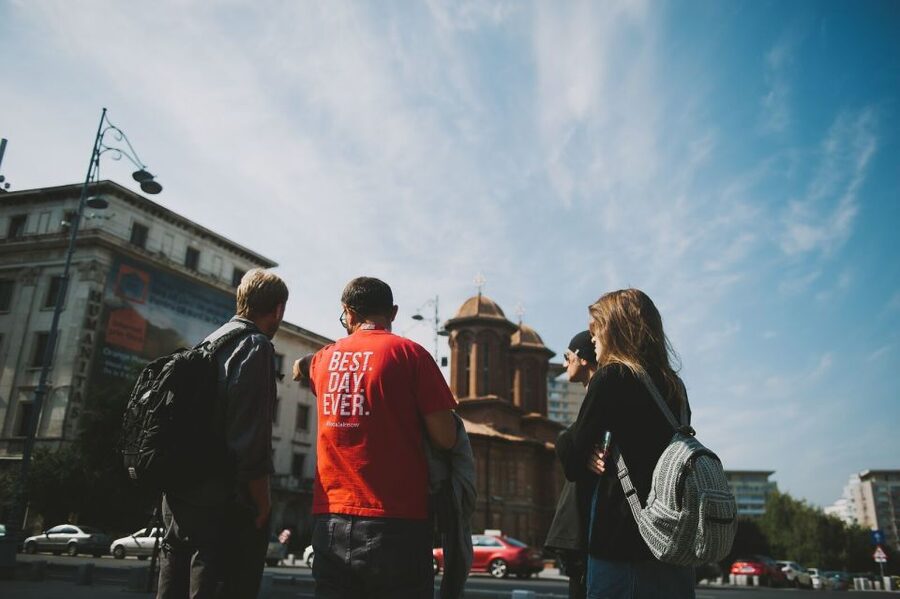
- Victory Street packs in architecture: See the Athenaeum, former Royal Palace, Athenee Palace, Telephone Palace, Military Circle, and Kretzulescu Church.
- Old Town explains Romania’s mixed cuisine: Mici, sarmale, sour soups, and schnitzel reflect Balkan, Ottoman, Russian, and Austro-Hungarian contacts.
- The meal is the tour’s main food event: End at a handsome traditional hanu with three courses and a house drink.
- Private guiding helps families: Children under six join free, and the walk can include questions, photo pauses, and a gentler pace.
Starting at Revolution Square

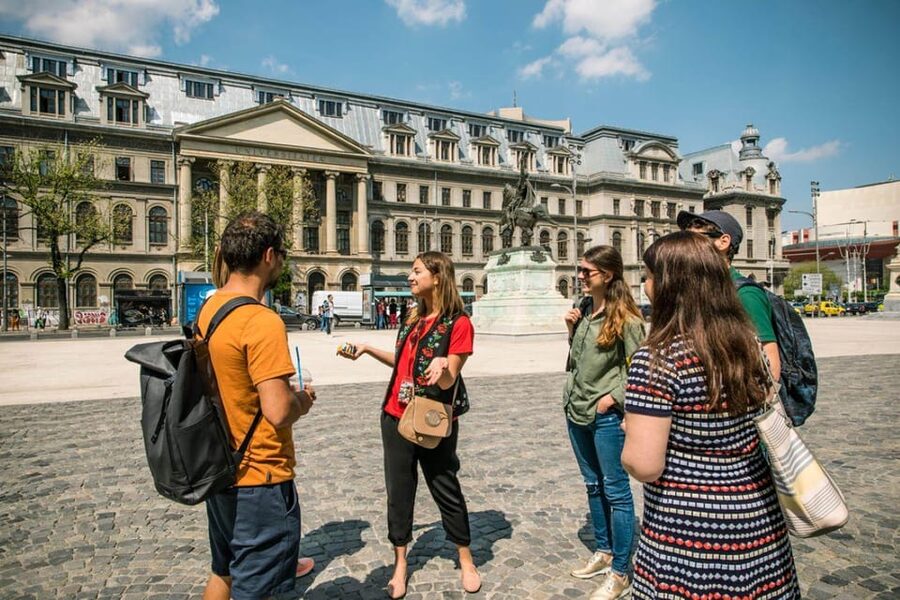
Meet at the Equestrian Statue of Carol I in Sector 1, at the northern end of the historic center. The location is useful for a first look at Bucharest because Revolution Square gathers royal, cultural, and political stories in one compact space.
The square was once called Palace Square. It faces the former Royal Palace and the Romanian Athenaeum, the city’s celebrated concert hall. Nearby, Athenee Palace became a focal point for espionage and political intrigue during the years between the two world wars. Your guide uses these buildings to show how Bucharest shifted from royal capital to Communist state and then to modern European city.
The 1989 Revolution gives the square its strongest emotional charge. Nicolae Ceausescu made a speech here expecting a loyal crowd. The audience turned against him, and the moment helped set the Romanian Revolution in motion. You will not simply be looking at a handsome plaza. You are standing where the old regime began to lose control in public.
This is also where the food theme begins. You receive a covrig, a salty baked snack eaten daily by many Romanians. Its likely connection to Hapsburg or German merchants offers a small but useful lesson: Romanian food is not isolated or fixed. It developed at a crossroads.
More History Tours in Bucharest
- Bucharest: 3-Hour Dark History Tour with a Local
★ 4.9 · 301 reviews - Bucharest: Small Group History, Art & Secrets Tour
★ 4.7 · 152 reviews - Guided Walking Tour of Historical Bucharest
★ 5.0 · 84 reviews
Walking Victory Street from royal power to modern Bucharest
From Revolution Square, the route heads south along Victory Street, one of Bucharest’s key historic avenues. Its name refers to Romania’s 1871 victory in the War of Independence. Full unification of the three Romanian principalities came later, in 1918, and that delay helps explain why Moldova, Transylvania, and Muntenia kept distinct customs and cooking styles.
Your guide may describe the regional food in broad terms: Moldova is associated with sweeter flavors, Transylvania with earthy dishes, and Muntenia with spicier food. This is a useful framework, not a strict rulebook. It gives you a way to understand why one national cuisine can contain so many different accents.
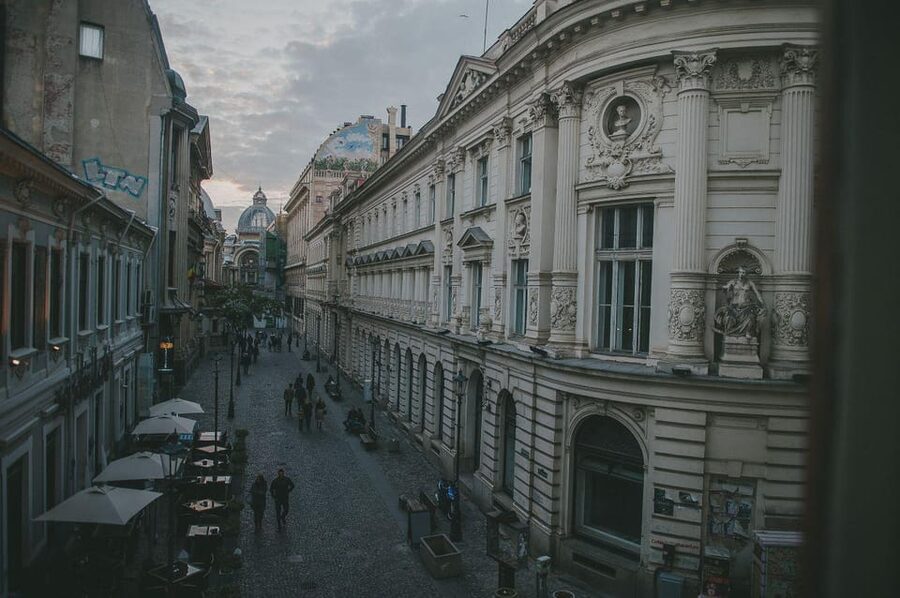
Victory Street also gives you a quick architectural lesson. The former National Theatre, Military Circle, and Telephone Palace reflect the city’s inter-war ambitions. Kretzulescu Church brings a very different note, with its Orthodox design and long place in Bucharest’s city center.
I like this part because the walk does not reduce Bucharest to one style. You see royal institutions, churches, grand public buildings, and the marks of a newer commercial city within a short stretch. The route is also practical for first-time visitors: after four hours, you should have a useful mental map of the central sights.
The tradeoff is time. You are seeing these landmarks from the street rather than touring every interior. If you want an in-depth visit to the Athenaeum, the former Royal Palace, or the People’s Palace, you would need separate time.
Old Town and the food of a crossroads
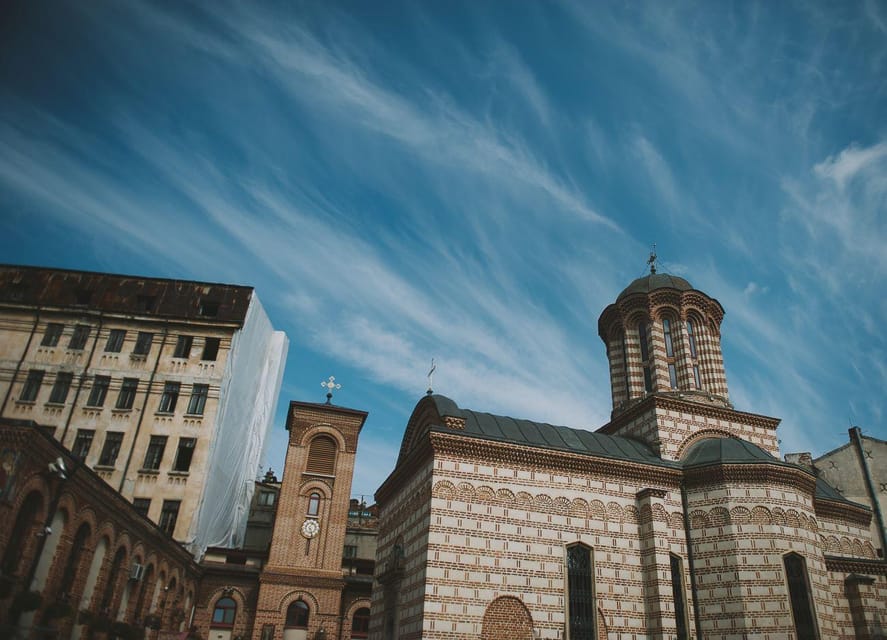
The route turns into Old Town, the medieval core of Bucharest. Here the story becomes more intimate. Narrow lanes and passages lead past princely courts, Orthodox religious buildings, old commercial spaces, and Hanul lui Manuc, the great wooden inn that remains one of the area’s best-known historic buildings.
Old Town represents Bucharest’s position between East and West. Ottoman officials, Transylvanian princes, merchants, religious communities, and local rulers all passed through this part of the city. The food followed the people.
You learn how several familiar dishes fit into that pattern:
- Mici: Balkan-style skinless sausages, usually associated with grilled meat and casual eating.
- Sarmale: Stuffed cabbage leaves linked to Ottoman culinary influence.
- Borscht and ciorba: Sour soups connected with Russian and wider regional food traditions.
- Schnitzel: A reminder of Austro-Hungarian influence.
The spelling and preparation of these dishes can vary, and the tour is not trying to turn every recipe into a single-origin story. Its value is showing you how food records movement, power, and trade more clearly than a list of rulers sometimes can.
Old Town is also where the contrast between Bucharest’s past and present becomes sharp. Quiet monasteries and old inns sit near nightlife venues and busy streets. The area’s evening character is part of the city’s newer capitalist life, but the older buildings still point to a time when Bucharest was a meeting place for merchants and political figures.
Your guide is especially important here. Several guides named in past tours, including Andra, Andrei, Monica, Dana, Ioanna, Mara, and Elaina, were praised for making the history personal and easy to follow. That matters in Old Town, where a quick walk can otherwise become a blur of pretty facades and crowded lanes.
The People’s Palace and the cost of Ceausescu’s vision
Before the meal, you get a look at the People’s Palace, also known as the Palace of the Parliament. It was the center of Ceausescu’s plan to reshape Bucharest on a huge scale and is described as the second-largest building in the world after the Pentagon.
The building is an important counterpoint to Revolution Square. At the square, you see where the regime faltered. At the People’s Palace, you see its ambition in stone, marble, and sheer size. The tour uses the building to explain how Communist power changed the city, not simply to point out a famous landmark.
The itinerary says you get a look at the building rather than a full interior visit. That distinction matters. If your main reason for booking is an inside tour of the Palace of Parliament, this experience is not a substitute for a dedicated entry ticket. If you want the building placed within Bucharest’s political story, the exterior view fits well into the four-hour route.
More food tours in Bucharest:
- Taste Bucharest: A Food Lover’s Tour of Markets & Neighbourhoods
★ 5.0 · 689 reviews - Street Food’n’Culture Tour
★ 5.0 · 209 reviews - Wine Tasting in Bucharest
★ 5.0 · 183 reviews - Discover Bucharest: Private Highlights and Traditional Food Tour
★ 5.0 · 86 reviews
Three courses at a traditional Bucharest hanu
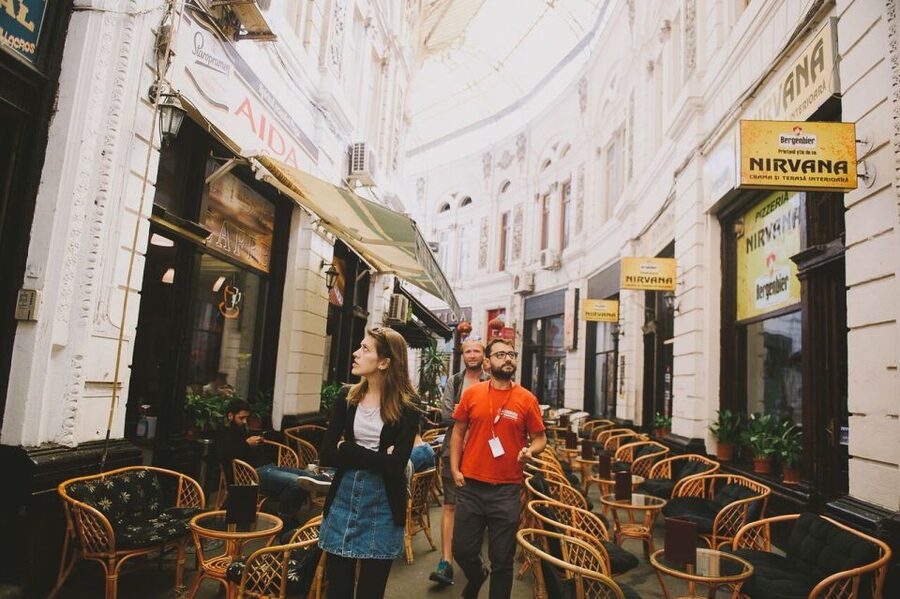
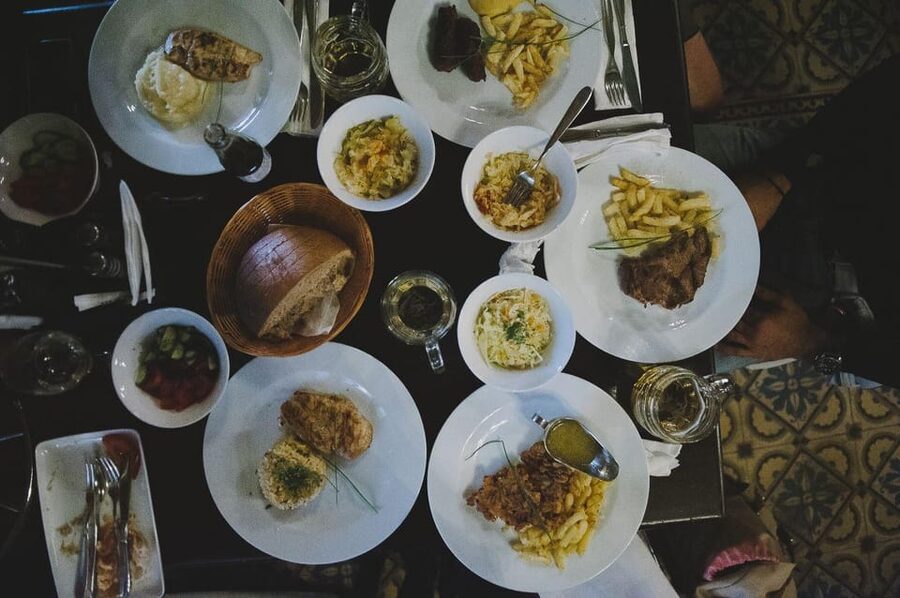
The walk ends at a traditional hanu, or inn, described as one of the city’s most beautiful. This is the point where the tour’s food promise becomes substantial. You sit down to a three-course Romanian meal served with a house beer, wine, or soft drink.
The meal is meant to function as a taste tour of Romania’s regions and past. Expect local delicacies rather than a generic international lunch. The exact dishes are not specified, so you should not book this expecting a fixed menu or a long series of small tastings.
That uncertainty is worth noting because one person wanted more food samples along the walking route. The final meal itself was still considered good, and several people singled out the food as delicious, plentiful, or fantastic. I would treat the included lunch as the main culinary event, with the covrig as the certain early taste.
The drink has its own bit of folklore. According to the story shared on the tour, the ancient Dacians drank so much wine that their leader Burebista banned its production. The Dacians then turned to brewing beer. You can raise a glass of Romanian wine or local beer and consider the matter settled, at least for lunch.
The restaurant setting adds value. A meal in a traditional inn gives you more sense of place than a quick snack stop. It also provides a calm finish after several hours on foot. One past participant specifically appreciated ending in a quiet restaurant away from the Old Town rush.
How the private format changes the experience
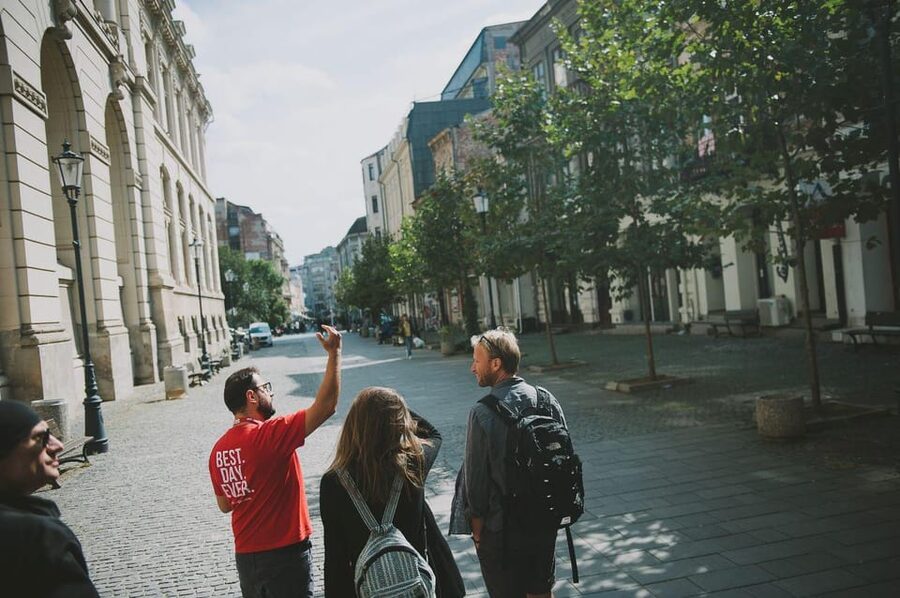
This is a private group tour with a live English-speaking guide. That usually matters more here than on a simple sightseeing loop because the subject is full of questions: How did the principalities differ? Why does Romanian food resemble dishes from so many neighboring cultures? What happened to the city under Communism?
You can ask those questions as they arise instead of waiting for a large group to catch up. The guide can also adjust the rhythm. Andra was praised for keeping an eight-year-old included, allowing photo breaks, and explaining the city at a manageable pace. Another parent appreciated Elaina’s patience with a jet-lagged child.
The tour is child-friendly, and children under six can join free of charge if you tell the supplier when booking. Casual clothing is suitable. Because the experience includes a four-hour walk and a full meal, I would plan it when your group has enough energy for both sightseeing and sitting down to eat.
The private format is also helpful for a first day in Bucharest. Several guides have offered practical city tips along with historical context. You can use the walk to get your bearings before exploring Old Town, the central boulevards, or other parts of the city on your own.
Price, timing, and what you receive
The price is $140 per person for four hours. Included are the private English-speaking guide, the three-course Romanian meal, and one house beer, wine, or soft drink. Extra food, extra drinks, souvenirs, and personal purchases cost more.
That price is not aimed at budget sightseeing. You are paying for a private guide, not merely admission to a landmark. The value improves if you are a couple, family, or small private party that wants a flexible conversation and a food-centered introduction rather than a standard group walk.
It is less convincing if you mainly want a cheap meal or a checklist of sights. The tour does not include a full interior visit to the People’s Palace, and the pre-meal food tasting appears limited to the covrig rather than many separate samples.
The experience lasts four hours, but starting times depend on availability. Free cancellation is offered up to 24 hours in advance, and you can reserve now and pay later. The tour is also carbon neutral and operated by a B Corp certified company that presents travel as a force for good. That will not change the route, but it may matter if you prefer operators with a stated environmental and social policy.
Who should book this Bucharest food walk

I would choose this tour for a first visit, especially if you want Bucharest explained rather than simply photographed. It suits people who enjoy architecture, political history, local food, and conversation in equal measure.
Families are a good match because the private setting allows questions and breaks. The child-friendly approach is not just a label: the tour has been led by guides who made a clear effort to include younger participants.
Food-focused visitors should book with realistic expectations. You will receive a full three-course Romanian meal and a drink, but the walk itself is not designed as a long progressive tasting tour. If you want numerous market samples, pastry stops, or a menu listing every dish in advance, you may prefer a tour built around that format.
The experience also works well for repeat visitors. The route may cover familiar central sights, but the links between architecture, foreign influence, regional identity, and cooking can show you a different side of Bucharest.
My take: a strong first-day choice with one food caveat
Book this tour if you want a personal introduction to Bucharest that connects the 1989 Revolution, royal ambition, Ottoman and Austro-Hungarian influence, Old Town, Communist planning, and Romanian cooking. The guides have been praised again and again for their warmth, clear explanations, and ability to make the walk work for both adults and children.
I would hesitate only if your priority is a large number of food samples or a low-cost tour. At $140 per person, the meal and the private guide need to matter to you. For the right group, this is a thoughtful way to get oriented, eat well, and see why Bucharest’s food is as mixed and surprising as its streets.
FAQ
Where does the tour meet?
The meeting point is the Equestrian Statue of Carol I in Sector 1, Bucharest 030167, Romania.
How long does the experience last?
The tour lasts four hours.
What language is the tour conducted in?
The live tour guide speaks English.
Is this a private tour?
Yes. The experience is offered for a private group.
What food is included?
You receive a three-course traditional Romanian meal and a covrig during the route.
Is a drink included with the meal?
Yes. The included drink is one house beer, wine, or soft drink.
Is the People’s Palace visited inside?
The itinerary includes a look at the People’s Palace. It does not state that an interior visit is included.
Are children allowed to join?
Yes. The tour is child-friendly, and children under six may join free of charge. You must inform the supplier when booking if you are bringing a child under six.
What should I wear?
Casual clothing is recommended.
Can I cancel the booking?
You can cancel up to 24 hours in advance for a full refund. You can also reserve now and pay later.
More Food in Bucharest
- Bucharest: Romanian Wine and Food Pairing Experience
★ 4.0 · 23 reviews - Cooking Class traditional food
★ 5.0 · 22 reviews - Bucharest: Street Food Tour with a Local Guide
★ 4.3 · 21 reviews - Bucharest Historical Food Tour in Old Center
★ 5.0 · 21 reviews
Just added around Bucharest
- Private Full Day Tour of Bucharest★ 5.0 · 3 reviews
- Veliko Tarnovo and Medieval Bulgaria Private Day Trip from Bucharest★ 5.0 · 3 reviews
- Bucharest VIP Bar Crawl in Lipscani ‘Old Town’★ 5.0 · 3 reviews
- Muddy Volcanoes and Salt Mine Private Tour★ 5.0 · 3 reviews
- Bucharest Private City Tour★ 5.0 · 3 reviews
- Legends & Stories from Transylvania -2 Castles & Brasov Old Town★ 5.0 · 3 reviews
- 7-Day Dracula Tour in Romania from Bucharest including ‘The Ritual of Killing of a Living Dead’★ 5.0 · 3 reviews
- Transfagarasan Private Tour from Bucharest – 2 Days★ 5.0 · 3 reviews
Bucharest Tours, compared.
Dracula’s Castle, Peles Castle, & Brasov Old Town
Read our review →
Dracula Castle, Peles Castle & Brasov Old Town
Read our review →
Dracula’s Castle, Peleș Castle & Brașov Day Trip
Read our review →
Day Trip to Dracula Castle, Peles Castle & Brașov
Read our review →
Bucharest to Dracula Castle, Peles Castle and Brasov Guided Tour
Read our review →
Dracula’s Castle, Peles Castle and Brasov Day Trip from Bucharest
Read our review →Browse the lists this tour appears in