Reviewed · BUCHAREST TOURS
Explore Bucharest Step by Step With A Local Guide
Bucharest’s story comes into sharp focus on this small-group walking tour from Revolution Square to Constitution Square. In about three hours, you move from the 1989 uprising through grand avenues, old inns, Orthodox architecture, and the vast Palace of Parliament.
I like the route’s strong sense of place, and I like the chance to hear local context from guides such as Doina and Dorin, who are described as friendly, enthusiastic, helpful, and willing to spend extra time with their groups. The main consideration is that this is a brisk walking tour with no included entrance tickets, so you are paying for guiding and orientation rather than interior visits.
Key points to know before booking
- The route follows Bucharest’s political and historic spine, beginning at Revolution Square and ending opposite the Palace of Parliament.
- You visit eight central landmarks, including Stavropoleos Monastery, Macca-Villacrosse Passage, Hanul cu Tei, and Manuc’s Inn.
- The group is capped at 10 people, a useful size for questions and street-side explanations.
- The price is $16.87 per person, strong value if you want a guided introduction without museum admissions.
- Doina and Dorin are praised for personal attention, clear explanations, and sometimes extending the outing beyond the advertised time.
- The 10 a.m. start and central route suit first-time visitors, while the lack of included indoor entry may disappoint anyone seeking a museum-focused tour.
Why this Bucharest route works so well
Bucharest can feel confusing at first. Its broad boulevards, grand nineteenth-century buildings, Communist-era blocks, quiet courtyards, and lively Old Town do not always seem to belong to the same city. This tour helps connect those pieces on foot.
The route begins with the 1989 revolution and ends at one of the most imposing buildings in modern Europe. Between those points, you see the city’s older commercial streets and religious landmarks. That progression gives the outing a useful shape: modern political change first, older urban life in the middle, and the Communist state’s grandest building at the finish.
You should think of this as a city orientation walk, not a full sightseeing program with long interior visits. The stops are short, generally 10 to 20 minutes, and the tour depends on the guide’s explanations as you move between them.
The advertised duration is about three hours. Some groups have spent four hours with the guide, especially when questions and extra sights extend the route. That flexibility is a real benefit, though you should not build a tight afternoon connection around the longer possibility.
A few more Bucharest day trips to weigh up
- Bucharest: Dracula’s Castle, Peles Castle, & Brasov Old Town
★ 4.5 · 17,858 reviews - Bucharest: Dracula Castle, Peles Castle & Brasov Old Town
★ 4.6 · 10,891 reviews - Bucharest: Dracula’s Castle, Peleș Castle & Brașov Day Trip
★ 4.5 · 5,919 reviews
Revolution Square and the end of Ceaușescu’s rule
The meeting point is Revolution Square, or Piața Revoluției, at 10 a.m. This is the right place to begin because the square helps explain one of Romania’s most important modern turning points.
On December 21, 1989, Nicolae Ceaușescu gave his final public speech here. What began as a public gathering erupted into revolt, leading to the end of Romania’s Communist regime. Your guide uses the square to explain that change and to place the surrounding buildings in their political setting.
Allow about 20 minutes at this first stop. Admission is free, but the value lies in the interpretation. Without context, a large city square can look like just another open space. With a guide, you can connect it to the demonstrations, the collapse of the old government, and the visible traces of Bucharest’s recent past.
I like beginning here rather than in the Old Town. It gives the rest of the walk a purpose. You are not simply collecting attractive buildings. You are following the city’s shift from royal and commercial Bucharest to Communist rule and then to the post-1989 period.
Calea Victoriei, Bucharest’s grand avenue
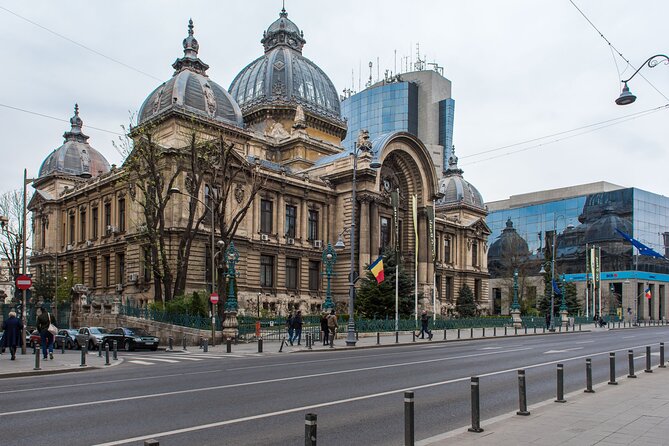
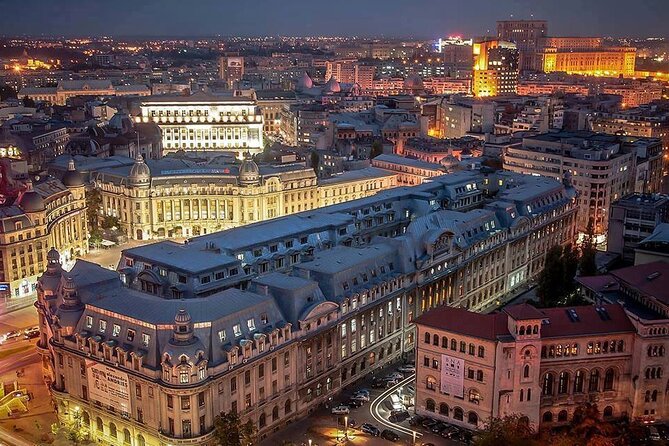
From Revolution Square, the route continues along Calea Victoriei, one of Bucharest’s oldest roads and one of its key avenues today. The street was also the first in Bucharest to be lit at night with candles, beginning in July 1814, an unusual detail that hints at the city’s gradual move toward a more modern urban life.
The stop lasts about 20 minutes and is another place where a local guide adds value. Calea Victoriei is not one isolated monument. It is a street made up of changing architectural periods, public buildings, shops, and landmarks. The guide can point out what deserves your attention rather than leaving you to look at façades without context.
This section is useful early in your Bucharest visit because it gives you a practical sense of the city center. You are close to public transportation, and the avenue links the political center with the Old Town. If you plan to return later for your own walk, you will already know how the central districts fit together.
The drawback is pace. Twenty minutes is enough for a guided introduction, not enough for a full architectural study or an unhurried stop at every building. Bring comfortable shoes and expect to keep moving.
The University of Bucharest in a 10-minute stop
The University of Bucharest is described as one of the city’s emblematic buildings. The scheduled visit lasts about 10 minutes, so the focus is on the building and its role in the city rather than an extended campus visit.
This short stop works as a bridge between Calea Victoriei and the Old Town. It adds another layer to Bucharest’s public life, following the political story of Revolution Square with an important academic institution.
You may find this stop more interesting if you enjoy seeing how a city’s institutions shape its identity. If your priority is only major landmark interiors, it may feel brief. The tour does not promise entry or a formal university visit, so treat it as an exterior sight with commentary.
Same corner of the country, a completely different day out:
- Bucharest: Palace of Parliament Tickets and Guide
★ 4.3 · 3,182 reviews - Bucharest: Day Trip to Dracula Castle, Peles Castle & Brașov
★ 4.4 · 3,049 reviews - Bucharest to Dracula Castle, Peles Castle and Brasov Guided Tour
★ 4.5 · 2,933 reviews - Bucharest: Palace of Parliament Tickets and Guided Tour
★ 4.4 · 1,877 reviews
Macca-Villacrosse Passage and the Old Town shift
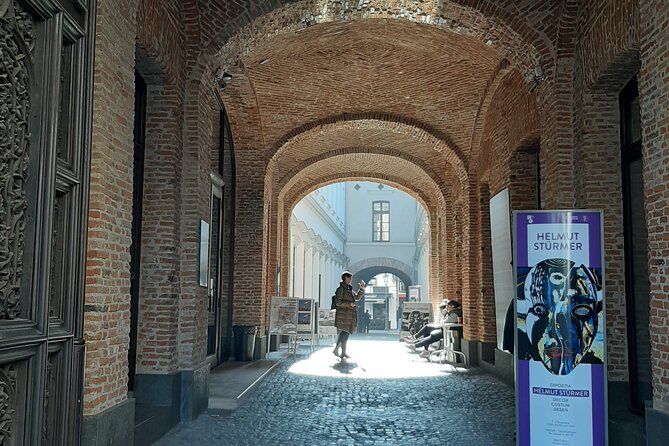
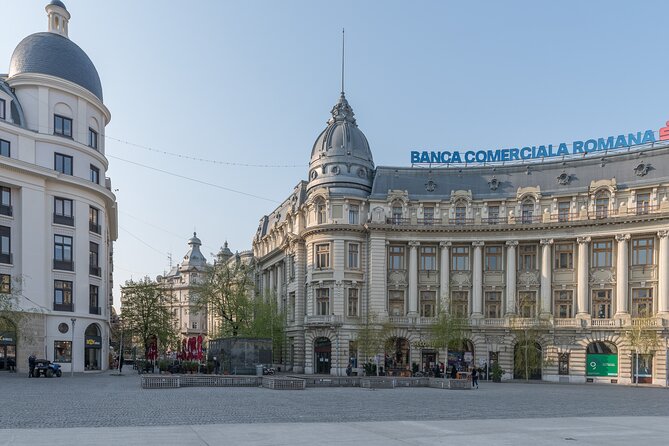
Macca-Villacrosse Passage is one of the route’s most photogenic changes of mood. This covered passage is compared with the Vittorio Emanuele gallery in Milan, though on a much smaller scale. It brings you into the Old Town through an elegant nineteenth-century commercial space.
The stop is about 10 minutes. That is enough to walk through, look up, take photographs, and hear why the passage matters. It also gives the tour a welcome change from broad avenues and major squares.
I like this part because it shows Bucharest at a more intimate scale. The city is not only about official buildings and monumental avenues. Passages, inns, courtyards, and small churches reveal how people moved, traded, worshiped, and met in earlier periods.
Expect the Old Town section to feel more compact and textured than the opening part of the route. Since the tour remains outdoors, weather and foot traffic can affect how comfortably you experience it.
Stavropoleos Monastery, a small Orthodox treasure
Stavropoleos Church, also called Stavropoleos Monastery, is an Eastern Orthodox monastery built in the eighteenth century by a Greek monk. The planned stop is 15 minutes, making it one of the more substantial visits on the walk.
This is an important pause because it introduces religious architecture and monastic life to a route otherwise filled with political, academic, and commercial landmarks. The church’s age and setting also help you picture the older Bucharest that existed before the city’s broad modern avenues took shape.
The tour information does not include an admission charge, but it also does not promise a private visit or guaranteed interior access. Your guide can explain the site and indicate what to look for, while the actual conditions may depend on opening arrangements and religious activity at the time.
Keep your expectations practical. This is a short stop within a larger walking route, not a dedicated church tour. Still, it is one of the places where the walk feels most connected to Bucharest’s older character.
Hanul cu Tei and the city’s old commercial life
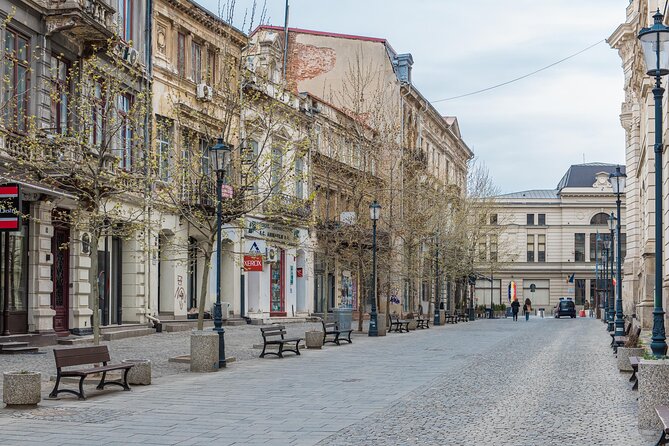
Hanul cu Tei is presented as the only historic inn in Bucharest to have preserved its original shape exactly. The stop lasts about 10 minutes.
Historic inns were more than places to sleep. They were commercial centers where merchants, goods, and news passed through the city. Hanul cu Tei helps explain that side of Bucharest, especially when paired with the next stop, Manuc’s Inn.
This part of the route is best appreciated with a guide who can point out the relationship between the building’s form and its original purpose. On your own, you might pass by without understanding why it matters.
Again, the stop is short. You will not receive a long architectural lecture or a full tour of every room. The advantage is variety: within a few minutes, you move from an Orthodox monastery to a historic inn and continue through the Old Town’s older commercial fabric.
Manuc’s Inn, from nineteenth-century commerce to a working hotel
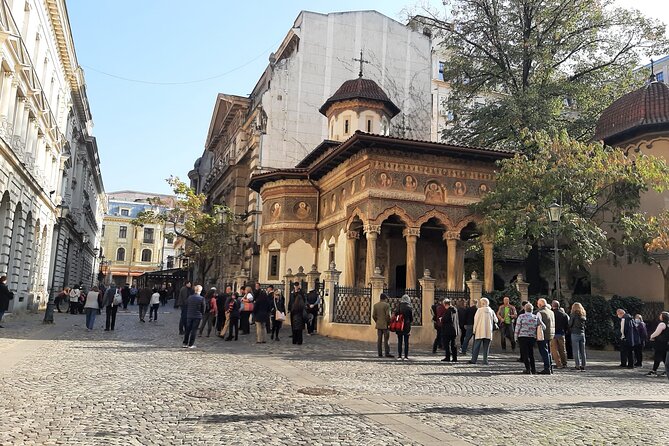
Manuc’s Inn, or Hanul lui Manuc, is described as the oldest operating hotel building in Bucharest and as the city’s most important commercial complex in the middle of the nineteenth century. The tour allows about 10 minutes here.
This is a strong stop for understanding how Bucharest functioned as a trade center. Its importance is not simply that the building is old. It represents the movement of merchants, travelers, and business through the city at a time when inns could serve as lodging, marketplace, meeting point, and social hub.
The word operating matters. This is not only a preserved shell viewed from the street. It remains part of Bucharest’s active urban life, although the tour does not specify what areas you will enter. Your guide’s explanation is especially useful because the building’s historical role may not be obvious from a quick look.
If you enjoy old commercial buildings, this may be one of the most memorable stops. If you prefer grand monuments, the Palace of Parliament at the end will likely make the bigger visual impression.
Constitution Square and the Palace of Parliament
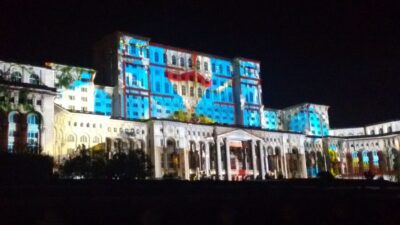
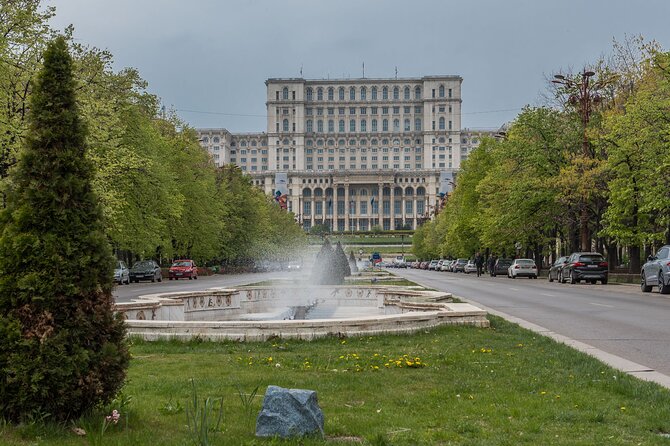
The final stop is Constitution Square, or Piața Constituției, about 15 minutes from the advertised schedule. It faces the Palace of Parliament, described here as the second-largest administrative building in the world.
The square gives you room to absorb the scale of the building. After the smaller passages, monasteries, and inns of the Old Town, the setting changes dramatically. The route ends with the physical expression of state power, a fitting counterpoint to the opening discussion of the 1989 revolution.
This is also a useful place to finish because you can leave with a clear sense of Bucharest’s modern political geography. The tour does not include a Palace of Parliament entry, so you should book a separate interior visit if that is high on your list. This walk gives you the outside view and the historical frame, not the full building experience.
The route ends here rather than returning to Revolution Square. That is convenient if you are continuing toward the Parliament area, but you should check your plans before booking. The ending point is Constitution Square, not the starting point.
What the guides add to the walk
The strongest part of this experience is the guiding. Doina is praised for warmth, enthusiasm, practical help, and answering questions well. One group with a small child in a stroller also found the walk manageable, with the guide helping them find a restroom through local contacts.
Dorin is also described as highly enthusiastic and eager to show as much of the city as possible. The guiding style appears to be generous with time and information, rather than rigidly ending at the advertised minute.
That can make a major difference in Bucharest. The route has many short stops, and the guide is the person who turns them into a connected story. You should feel free to ask questions, especially about buildings you notice between the official stops. The guides are described as willing to point out additional churches, buildings, and attractions during the walk.
The small maximum of 10 people supports that style. You are less likely to lose the guide’s voice or feel anonymous than on a large coach tour. It also makes it easier to ask about food, shops, restrooms, or what to see next.
The tradeoff is that the exact experience may depend on the individual guide and the group’s pace. Doina and Dorin are specifically associated with very positive feedback, but the supplied information does not guarantee which guide you will receive.
Price, timing, and practical value
At $16.87 per person, this is an inexpensive way to get a first reading of central Bucharest. You are not paying for admissions, transport, or a meal. You are paying for a local guide, a planned route, and explanations that help you use your own sightseeing time better.
That is good value if you are visiting Bucharest for the first time and want a compact introduction. It is less compelling if you already know the center or mainly want access to the Palace of Parliament and other interiors.
The start time is 10 a.m., and the experience is offered in English. A mobile ticket makes the booking simple, and the meeting point is near public transportation. Most people can participate, but remember that it is a walking experience over city streets and historic areas.
The tour requires good weather. If poor weather cancels it, you are offered another date or a full refund. You can also cancel for a full refund up to 24 hours before the local start time. Changes or cancellations made within 24 hours are not refunded.
Who should book this walk
I would recommend it to first-time Bucharest visitors, solo travelers who want a local introduction, couples, and small groups who prefer questions and conversation over a large scripted tour. It also suits anyone interested in the connection between Romania’s 1989 revolution, older city life, and Communist-era architecture.
Families may find it workable, since a stroller was used successfully on one outing. Still, the walk includes several stops rather than one contained attraction, so young children may need patience and breaks.
You should choose another experience if you want a museum-heavy day, a guaranteed Palace of Parliament interior visit, or a slow architectural photography tour. This is a broad introduction, not a deep examination of any one site.
Should you book Explore Bucharest Step by Step?
Book it if you want a low-cost, English-language orientation with a small group and a guide who may give you extra time. The route covers Bucharest’s central sights in a sensible order, and the contrast between Revolution Square, the Old Town, and Constitution Square gives the city a clear narrative.
Skip it if you already know the center or need guaranteed indoor access. For most first visits, though, the $16.87 price makes this an easy way to get your bearings, learn what you are looking at, and decide where to return for a longer visit.
FAQ
How long is the Bucharest walking tour?
The advertised duration is approximately three hours. Some outings have lasted closer to four hours when the guide spent extra time answering questions and showing additional sights.
Where does the tour begin?
The tour begins at Revolution Square, or Piața Revoluției, in Bucharest.
Where does the tour finish?
The tour ends at Constitution Square, or Piața Constituției, opposite the Palace of Parliament.
What time does the tour start?
The scheduled start time is 10 a.m.
Is the tour offered in English?
Yes. English is the listed language for the experience.
How many people can join the tour?
The activity has a maximum group size of 10 travelers.
Are entrance tickets included?
The listed stops have free admission, and the tour does not state that paid interior admissions are included. The experience focuses on walking between landmarks and receiving guiding and historical explanations.
Just added around Bucharest
- Private Full Day Tour of Bucharest★ 5.0 · 3 reviews
- Veliko Tarnovo and Medieval Bulgaria Private Day Trip from Bucharest★ 5.0 · 3 reviews
- Bucharest VIP Bar Crawl in Lipscani ‘Old Town’★ 5.0 · 3 reviews
- Muddy Volcanoes and Salt Mine Private Tour★ 5.0 · 3 reviews
- Bucharest Private City Tour★ 5.0 · 3 reviews
- Legends & Stories from Transylvania -2 Castles & Brasov Old Town★ 5.0 · 3 reviews
- 7-Day Dracula Tour in Romania from Bucharest including ‘The Ritual of Killing of a Living Dead’★ 5.0 · 3 reviews
- Transfagarasan Private Tour from Bucharest – 2 Days★ 5.0 · 3 reviews
Bucharest Tours, compared.
Dracula’s Castle, Peles Castle, & Brasov Old Town
Read our review →
Dracula Castle, Peles Castle & Brasov Old Town
Read our review →
Dracula’s Castle, Peleș Castle & Brașov Day Trip
Read our review →
Day Trip to Dracula Castle, Peles Castle & Brașov
Read our review →
Bucharest to Dracula Castle, Peles Castle and Brasov Guided Tour
Read our review →