
Reviewed · BRAN CASTLE & DRACULA TOURS
Real Dracula Princely Court and Real Dracula’s Fortress
Vlad the Impaler’s real story is more interesting than the Dracula label. This private 11-hour trip links his princely court at Târgoviște with Poienari Castle, the mountain fortress tied to his rule. I like that you get both the political center and the rough defensive stronghold, not just one castle dressed up for a quick photo.
I also like the flexibility of a private car and guide, especially on a long day with several stops. Nicolas is named as the guide on several bookings, and his strength is keeping the history moving without rushing the stops. The main drawback is simple: this is a demanding day, and Poienari Castle requires 1,480 stairs. Entrance fees and food are extra, too.
Key points at a glance
- Vlad’s two worlds: See the formal princely court at Târgoviște, then follow the road to the isolated Poienari fortress.
- A real climb: Poienari Castle involves 1,480 steps, so sturdy shoes and a fair level of fitness matter.
- Royal resting place: Visit Curtea de Argeș Monastery, connected with Romania’s royal family and the graves of Romanian kings.
- Big engineering stop: Pause at Vidraru Dam, the largest dam in Romania, with time for photos and a break.
- Private timing: Your own driver and guide can adjust the pace, with hotel pickup and drop-off in Bucharest.
- History beyond Dracula: The tour covers medieval Wallachia, churches, royal courts, fortifications, and the country’s former capitals.
Why this Dracula tour is different
Many Dracula-themed outings lean hard on fiction. This one takes a more grounded route. You visit places tied to Vlad Dracul and Vlad the Impaler, but the focus is on courts, churches, rulers, fortifications, and the political history of Wallachia.
That distinction matters. Târgoviște was not a spooky stage set. It was a princely residence used by important rulers of southern Romania, including Vlad the Impaler and Constantin Brâncoveanu. Poienari is not a polished fairy-tale castle, either. It is a mountain fortress reached by a steep stairway, which gives you a better feel for its defensive purpose.
I like the way the day connects these sites. At Târgoviște, you see the machinery of power: palaces, churches, and a symbolic tower. At Poienari, you see the harder side of medieval rule, with a fortress positioned high above the road. Curtea de Argeș adds another layer through royal burial places and religious monuments.
The private format helps here. You are not tied to a large group moving at one fixed speed. You can ask questions, spend more time taking pictures, or stop for lunch during the day. One booking described having enough time at each stop, including time to explore and eat without feeling pushed along.
More Bran Castle and Dracula trips:
- Bucharest: Dracula’s Castle, Peles Castle, & Brasov Old Town
★ 4.5 · 17,858 reviews - Bucharest: Dracula Castle, Peles Castle & Brasov Old Town
★ 4.6 · 10,891 reviews - Bucharest: Dracula’s Castle, Peleș Castle & Brașov Day Trip
★ 4.5 · 5,919 reviews
Târgoviște, where Vlad’s court took shape
The first major visit is the Royal Court of Târgoviște, usually reached after pickup in Bucharest. The historical record of the fortress goes back to 1417 or 1418, and the site later grew into a princely residence.
Your guide introduces Târgoviște as a place that developed from a small fortress into a seat of power. That makes the ruins easier to understand. You are not simply looking at scattered walls. You are seeing the remains of a court used by rulers who governed Wallachia.
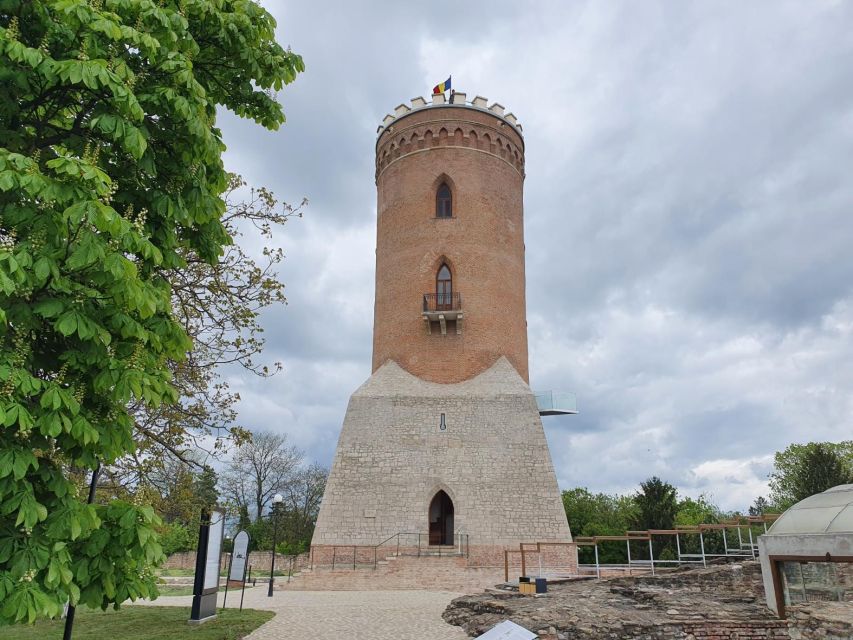
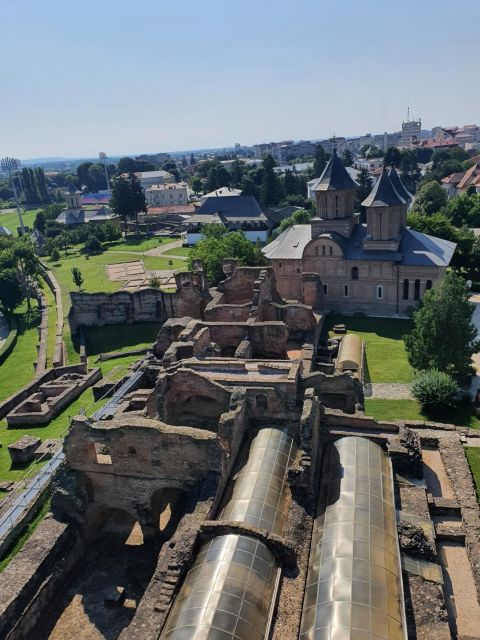
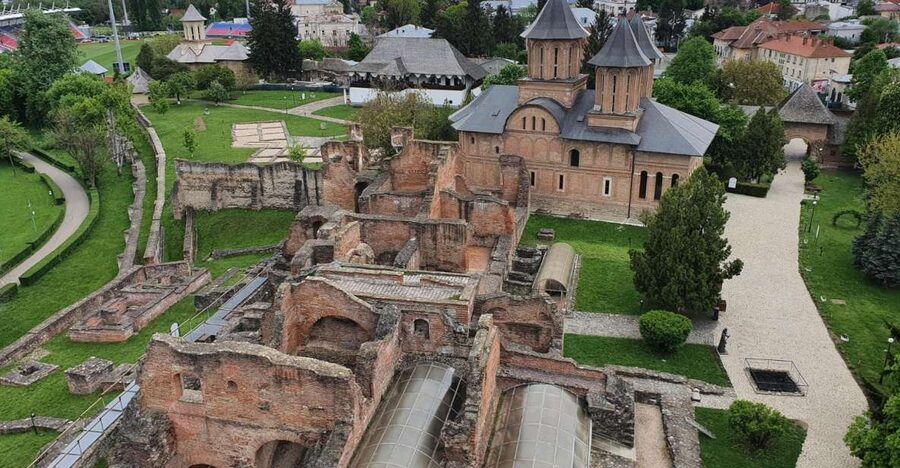
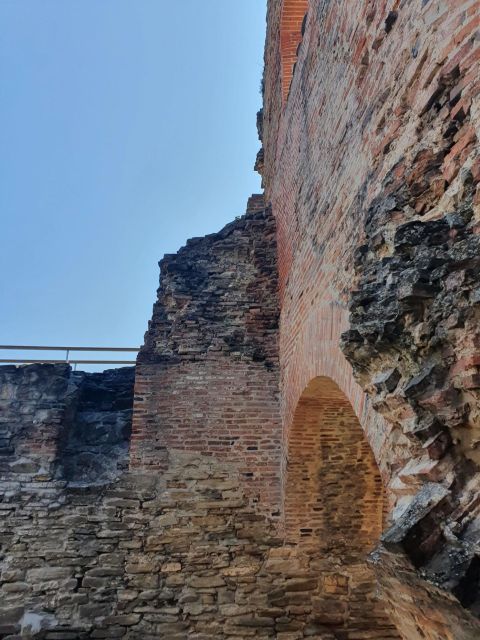
The site includes the famous Chindia Tower, built by Vlad the Impaler and now the symbol of the court. You can climb the tower and reach its balcony for a view across the former complex. From above, you can see the ruins of the two princely palaces and the outline of a church dated to 1415.
The tower visit is one of the strongest parts of the day. It gives you a sense of scale that is hard to get from ground level. Instead of viewing each ruin as a separate fragment, you can look across the court and picture how the buildings once worked together.
Allow about an hour and a half for the main visit, followed by additional time in Târgoviște for walking, pictures, and a break. The schedule gives you room to ask questions rather than treating the court as a quick stop between castles.
Churches and palace ruins at the princely court
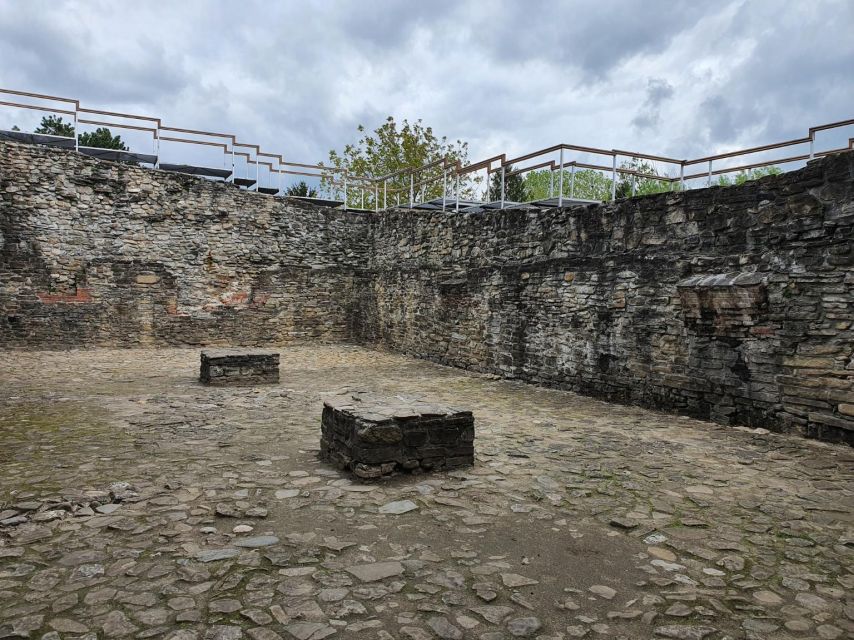
After Chindia Tower, you continue around the remains of the palace and visit two surviving churches. The small Holy Friday Church offers a quieter look at the religious side of the court.
The Great Princely Church is especially important. It is described as the only monument built in the 15th century in southern Romania that remains conserved in its original form. That gives the church a value beyond its appearance. It helps you connect the surviving architecture with the period when Târgoviște was an active seat of rule.
I would pay close attention to your guide here. Ruins can blur together when you visit several medieval sites in one day, but the story of how Târgoviște expanded from fortification to residence gives the place a clear shape.
The site is not a restored palace with furnished rooms. You should expect open ruins, historic churches, and views from the tower rather than a fully reconstructed royal compound. For me, that is part of its appeal, but visitors looking for an intact castle interior may find it more subdued.
Curtea de Argeș and Romania’s royal memory
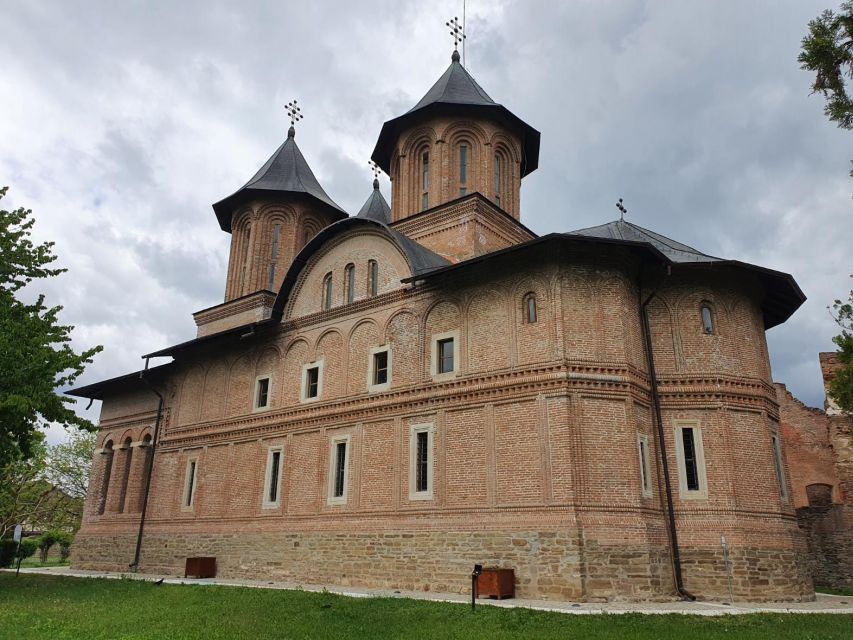
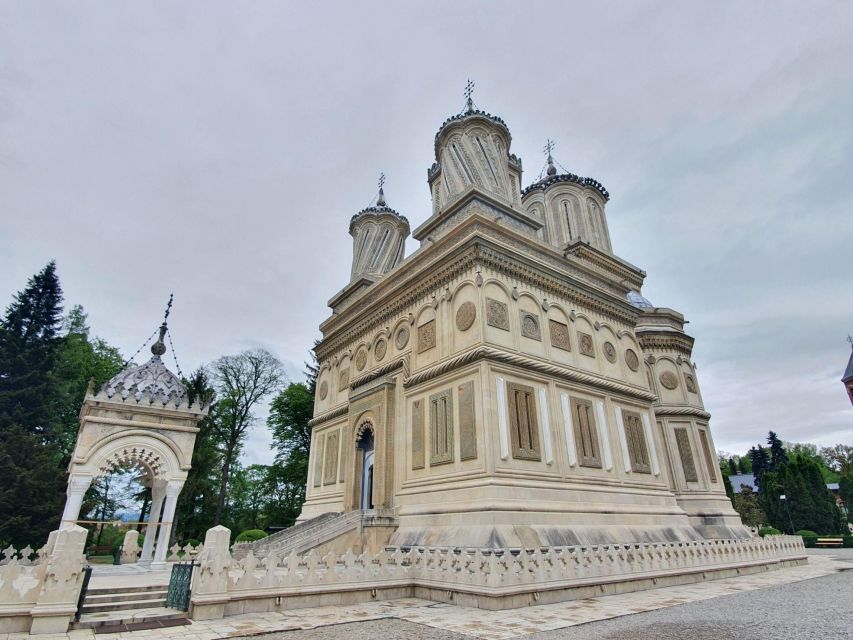
The route then continues to Curtea de Argeș, an old Wallachian center with its own royal court ruins. The visit includes the remains of the princely court, the 13th-century Royal Church, and the well-known Curtea de Argeș Monastery.
Curtea de Argeș was the first capital of Romania, according to the tour information, and the stop adds useful context to the country’s early political story. You are moving from one former center of power to another, rather than visiting unrelated sights.
The monastery is the main attraction for many people. It is tied to the Romanian royal family, and the graves of Romanian kings are located there. Your guide explains the often sad history connected with the church and the royal site, giving the visit more weight than a simple architectural stop.
You have about 45 minutes here, including time for pictures and some free time. That is enough for a focused visit, but it is not a long, leisurely monastery tour. If religious art or royal history matters greatly to you, ask your guide to help you use the available time well.
The contrast with Târgoviște is useful. Târgoviște shows a medieval princely court in ruins, while Curtea de Argeș links medieval Wallachia with Romania’s later royal period. Together, they make the day about more than Vlad alone.
Same corner of the country, a completely different day out:
- Bucharest: Palace of Parliament Tickets and Guide
★ 4.3 · 3,182 reviews - Bucharest: Day Trip to Dracula Castle, Peles Castle & Brașov
★ 4.4 · 3,049 reviews - Bucharest to Dracula Castle, Peles Castle and Brasov Guided Tour
★ 4.5 · 2,933 reviews - Bucharest: Palace of Parliament Tickets and Guided Tour
★ 4.4 · 1,877 reviews
Poienari Castle and the 1,480-step test
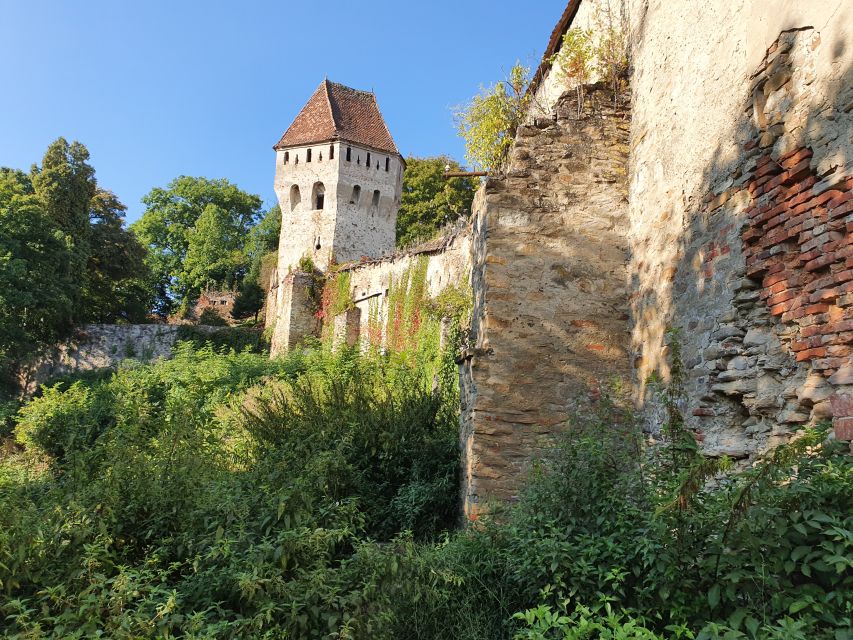
Poienari Castle is the most physically demanding stop. The route includes a walk of 1,480 stairs to reach the fortress, so this is not a casual roadside castle visit.
The climb is also what gives the place its character. Poienari was built in a mountain setting and associated with Vlad the Impaler. The fortress is presented as a place where Vlad hid the country’s gold, adding one more practical detail to the site’s legend.
You should plan for a serious uphill walk and wear shoes suited to stairs. The tour description does not give a specific accessibility rating, so you should not assume the climb will suit everyone. If you have mobility concerns, ask before booking.
The visit is listed at about an hour and a half, including the walk and time for pictures. Since you are already spending much of the day in the car, this stop gives you a chance to stretch your legs, but the stairs can make it tiring.
Poienari also brings the Dracula theme closest to its source. You are not visiting a fictional castle created for a novel or film. You are following the trail of a real Wallachian ruler through a fortress linked to his military life.
One important practical point is that conditions at historic sites can change. On one past booking, Poienari Castle was closed, and Nicolas used the time for other nearby places and traditional food. That kind of backup matters on a private tour. Still, you should confirm current access before the day if Poienari is the main reason you are booking.
Vidraru Dam, a sharp change of subject
After the medieval sites, Vidraru Dam offers a striking change of pace. It is described as the biggest dam in Romania, and the stop includes a visit, photos, a break, and time for shopping.
The dam is useful in the rhythm of the day. You have just spent time with churches, ruins, and a steep fortress climb. Here you can pause, take pictures, and look at a major piece of modern Romanian engineering.
The stop lasts about an hour. You should not expect it to feel like another medieval monument. Its value is in the scale, the views, and the chance to see a major national infrastructure project while traveling through the region.
The dam also helps break up the long return route. On a private tour, your guide can explain its history and point out what you are seeing instead of leaving you to make sense of the structure on your own.
The Wallachian setting between the stops
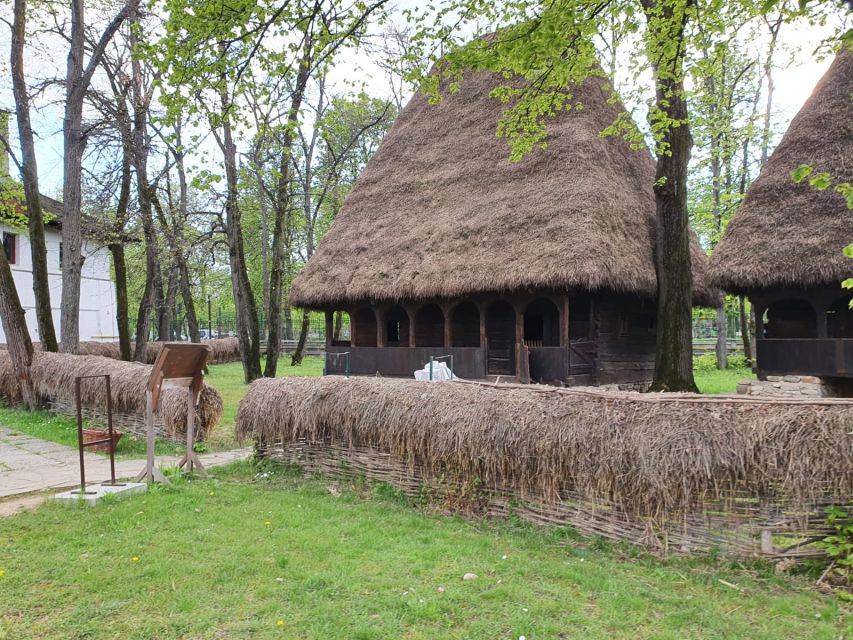
The final portion includes time in Wallachia and the route back toward Bucharest. Some of this is a pass-through rather than a formal attraction, but it gives the guide a chance to connect the sites.
That regional context is important. Vlad’s story makes little sense if you treat each fortress or church as an isolated stop. Wallachia was a principality shaped by rival powers, changing capitals, royal households, religious foundations, and defensive strongholds.
The drive is long, roughly 11 hours for the full experience, so you should be comfortable with a full day on the road. The benefit is that the tour reaches places that are difficult to combine efficiently without private transport.
What the private car and guide add
The tour includes a private driver and licensed guide, gasoline, parking, road tolls, and hotel pickup and drop-off in Bucharest. You wait in your hotel lobby five minutes before pickup, and the driver holds a sign with your last name.
A private vehicle matters because the route covers several sites spread across southern Romania. You avoid arranging separate transport and can ask for a pause when you need one. You also avoid the fixed pace of a large group.
The guide is a major part of the experience. Nicolas is specifically named in several bookings, and the strongest praise centers on his historical explanations, friendly conversation, professionalism, and attention to the pace of the day. He is also described as adapting well when Poienari was closed.
The available guide languages are English, Italian, Romanian, French, and Spanish. You should confirm your preferred language when reserving.
The flexible start time is another useful feature. The exact starting times depend on availability, but the private setup allows more room to shape the day than a standard group excursion. Do not read that as unlimited flexibility. With an 11-hour route, the main sites and return drive still require a full day.
Is $323 per person good value?
At $323 per person, this is a high-priced day trip. The value depends heavily on your group size and your priorities.
You are paying for a private car, a dedicated driver-guide, fuel, parking, tolls, hotel pickup, and a route that would be difficult to manage smoothly on your own. You also get several major historic sites in one day, including places beyond the usual Dracula circuit.
Entrance fees are not included, and food and drinks are extra. That means your final cost will be higher than the advertised price. Ask for the current entrance fees before you go, especially if you are working with a tight budget.
For a solo visitor, the price may feel steep. For a small private group that values personal commentary and flexible timing, it can make better sense because the private format spreads the cost across the group.
I would choose this tour for access and depth rather than for savings. If you only want one Dracula castle and a few quick pictures, a shorter trip may suit you better. If you want Vlad’s story placed alongside Wallachian and Romanian history, the route earns its price more convincingly.
Who should book this experience?
I would recommend it to you if you enjoy medieval history, royal architecture, churches, and long scenic drives with a guide who can explain the background.
It suits people who want a private experience and prefer asking questions as they go. It is also a good match for anyone who wants more than the usual Dracula mythology, especially the contrast between Târgoviște’s formal court and Poienari’s mountain fortress.
You should think twice if you dislike long days in a car, have trouble with steep stairways, or want a relaxed pace. The 1,480-step climb is the clearest physical challenge, but the full 11-hour schedule is the larger commitment.
Bring water, food money, and shoes that handle stairs. Since lunch is not included, use the flexible break time sensibly. The guide can help you fit in food without wrecking the timing of the main visits.
The tour offers free cancellation up to 24 hours before departure and a reserve-now, pay-later option. Those terms are useful when your Bucharest plans are still shifting, but they do not change the need to check current site access and entrance costs.
Should you book the Târgoviște and Poienari tour?
Book it if you want a serious, full-day look at Vlad the Impaler’s historical world, not a quick Dracula-themed photo stop. The best parts are the view from Chindia Tower, the royal setting at Curtea de Argeș, the demanding climb to Poienari, and the freedom of a private guide.
I would skip it if you want a short outing or cannot manage 1,480 stairs. For everyone else, this is one of the more useful ways to connect Wallachian power, royal memory, medieval fortifications, and the modern Vidraru Dam in a single day.
FAQ
Where does the tour begin and end?
The tour includes pickup and drop-off at your hotel in Bucharest.
How long does the experience last?
The full experience lasts 11 hours.
Is the tour private?
Yes. It is arranged for a private group with a private car and guide.
Which guide languages are available?
Guides are available in English, Italian, Romanian, French, and Spanish.
Who is the named guide?
Nicolas is named as the guide on several bookings. The provider is Nicolas Experience Tours SRL.
How many stairs are there to Poienari Castle?
The walk to Poienari Castle includes 1,480 stairs.
Are entrance fees included?
No. Entrance fees listed for the sites are not included in the tour price.
Are food and drinks included?
No. Food and drinks are not included.
What is included in the transport price?
The tour includes the private driver-guide, gasoline, parking, road tolls, and hotel pickup and drop-off.
Can I cancel for a full refund?
Yes. You can cancel up to 24 hours in advance for a full refund.
Just added around Romania
- Small-group day trip to the unique volcanic lake in Eastern Europe★ 5.0 · 4 reviews
- Brasov city of legends and good coffee★ 4.0 · 4 reviews
- Adventure trip to Transylvania in 3 days from Bucharest★ 5.0 · 4 reviews
- 3 Day Tour of Maramures★ 5.0 · 4 reviews
- From Bucharest: Sinaia Full-Day Tour★ 4.7 · 4 reviews
- Private Day Trip True Castles of Vlad Dracula and Transfagarasan Road★ 5.0 · 4 reviews
- Bucharest: private and exclusive Italian walking tour★ 5.0 · 4 reviews
- From Cluj: Mountain Bike around Lake Dragan★ 5.0 · 4 reviews
Bran Castle & Dracula Tours, compared.
Dracula’s Castle, Peles Castle, & Brasov Old Town
Read our review →
Dracula Castle, Peles Castle & Brasov Old Town
Read our review →
Dracula’s Castle, Peleș Castle & Brașov Day Trip
Read our review →
Day Trip to Dracula Castle, Peles Castle & Brașov
Read our review →
Bucharest to Dracula Castle, Peles Castle and Brasov Guided Tour
Read our review →
Dracula’s Castle, Peles Castle and Brasov Day Trip from Bucharest
Read our review →
Transylvania and Dracula Castle Full Day Tour from Bucharest
Read our review →
Browse the lists this tour appears in