
Reviewed · SIGHIȘOARA DAY TRIPS
4 Days Private Tour in Transylvania Brasov Sighisoara Sibiu
The best thing about this four-day private tour is its range. In one trip, you move from royal Peleș Castle and Dracula folklore to Saxon villages, fortified churches, medieval towns, and the high mountain road of Transfăgărășan. It gives you a broad look at Transylvania without making you change vehicles or keep pace with a large group.
I like the private format, since the schedule can be adjusted for your group. I also like the overnight stops in Brașov, Sighișoara, and Sibiu, which give you time to see these places beyond a quick photo stop. The main consideration is cost: the $872.67 per-person tour price does not include hotels, meals, or attraction tickets, so your final bill will be higher.
Key points to know before booking
- Peleș and Bran in one day: You see Romania’s finest royal castle and its famous Dracula-linked castle before spending the night in Brașov.
- Private transport throughout: Only your group takes part, with pickup offered and an air-conditioned vehicle.
- Three overnight bases: Brașov, Sighișoara, and Sibiu break up the driving and make the route easier to enjoy.
- Saxon Transylvania: Viscri and Biertan show the fortified churches and village traditions of the region.
- Mountain finale: Day four follows the Transfăgărășan Highway to Bâlea Lake, Vidraru Dam, and Curtea de Argeș.
- Extra costs matter: Allow about $70 per hotel night with breakfast, $15 to $20 per restaurant meal, and $35 to $40 for entrance fees.
What this private Transylvania route does well
This is not a single-theme castle trip. It is a moving tour through several chapters of Romanian history and geography, beginning near Bucharest and ending at Curtea de Argeș. You get royal architecture, medieval fortifications, mountain scenery, Orthodox religious art, and the old German-speaking Saxon culture of Transylvania.
The private setup is especially useful here. The route includes many stops, and a fixed large-group schedule can make a long day feel rushed. With only your own party, you can ask for a little more time in a town, adjust the pace, or shape the tour around your interests. The operator describes the itinerary as flexible and open to customization.
Guide Mircea, also called Frank for visitors who find the Romanian pronunciation difficult, is identified as the guide for this experience. Feedback about the tour gives particular weight to his historical and cultural explanations, as well as the comfortable car and relaxed pace. That combination matters on a route with long stretches between sights.
The tour starts at 9:00 a.m. and includes private transportation in an air-conditioned vehicle. The booking price is $872.67 per person, but you must add three nights of accommodation, food, and admission fees. The stated average hotel cost is $70 per night with breakfast, meals run about $15 to $20 each, and attraction tickets add roughly $35 to $40 per person.
That makes this a substantial purchase, but the value improves if you are splitting the private vehicle and guide costs among several people. It is also easier to justify if you want a single organized route rather than piecing together trains, buses, hotels, and day trips from Bucharest.
More Sighisoara day trips:
- 2-Day Medieval Transylvania with Brasov,Sibiu and Sighisoara Tour from Bucharest
★ 4.5 · 145 reviews - 2-Day Transylvania from Bucharest: Brasov, Bran, Sighisoara
★ 5.0 · 60 reviews - 4 Days Private Tour in Transylvania: Sibiu, Sighisoara and Brasov
★ 5.0 · 18 reviews
Day one: Peleș Castle, Bran, and Brașov
The first day brings together three very different stops. Peleș Castle is the polished royal opening, Bran Castle supplies the legend, and Brașov gives you a proper medieval city to explore.
Peleș Castle and the royal setting
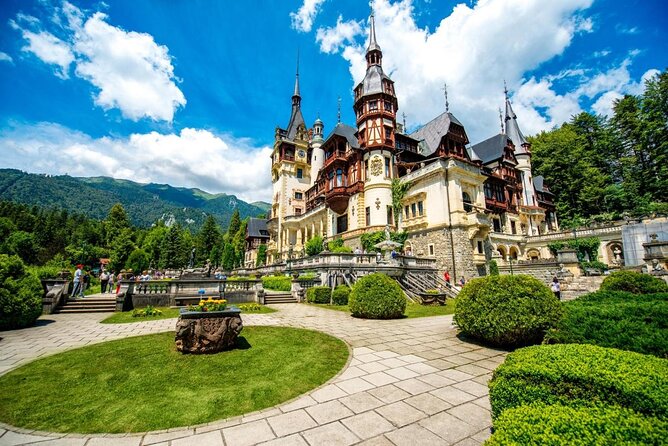
Peleș Castle sits in the Carpathian Mountains near Sinaia, along the old route between Wallachia and Transylvania. King Carol I ordered its construction, and work took place from 1873 to 1914. The castle was inaugurated in 1883.
The building’s Neo-Renaissance design makes it quite different from the rough defensive fortresses later in the trip. Your planned visit is about two hours, which should give you time to appreciate the exterior and the royal setting without turning the stop into a rushed walk-by.
Admission is not included, so budget for the separate ticket. Since the castle is one of the headline stops, check the day’s exact access arrangements when you book. The tour data lists the admission as excluded, despite the itinerary showing no ticket charge.
Bran Castle and the Dracula connection
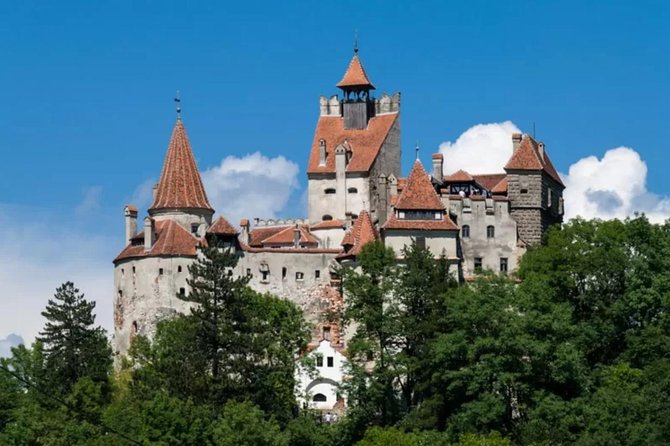
Bran Castle is marketed around its connection to Dracula, but the real appeal is the building itself. It rises on a high rock with towers and turrets, and its position once helped control movement through the mountain pass.
The castle was built on the site of a Teutonic Knights stronghold dating from 1212. A document from 1377 gave the Saxons of Kronstadt, now Brașov, permission to build the citadel. Bram Stoker’s Dracula later gave Bran a much larger place in popular culture, although the castle’s actual story belongs to border defense, trade routes, and regional power.
You have about two hours here. That is enough for a useful visit, but Bran can be crowded and commercial around the castle. Go for the architecture and the setting first, and treat the Dracula connection as folklore layered onto an older fortress.
More Transylvania day trips:
- Transylvania and Dracula Castle Full Day Tour from Bucharest
★ 4.5 · 1,589 reviews - Castles of Transylvania: Private Day Trip from Bucharest
★ 4.5 · 248 reviews - Transylvania: Cultural Full-Day Trip by Minivan
★ 4.8 · 57 reviews - 4-Day Private Tour in Transylvania from Bucharest
★ 5.0 · 48 reviews
Brașov’s old center
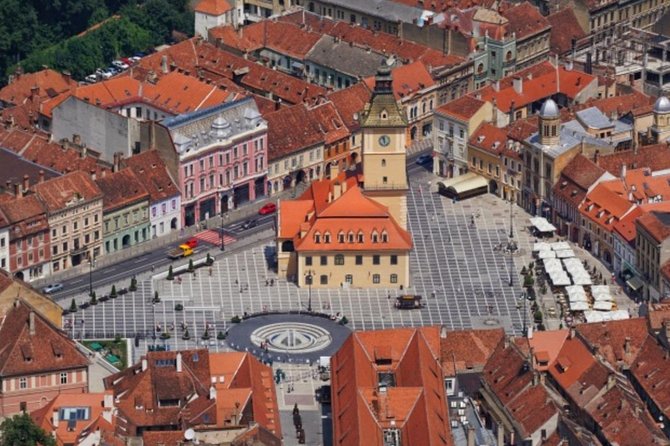
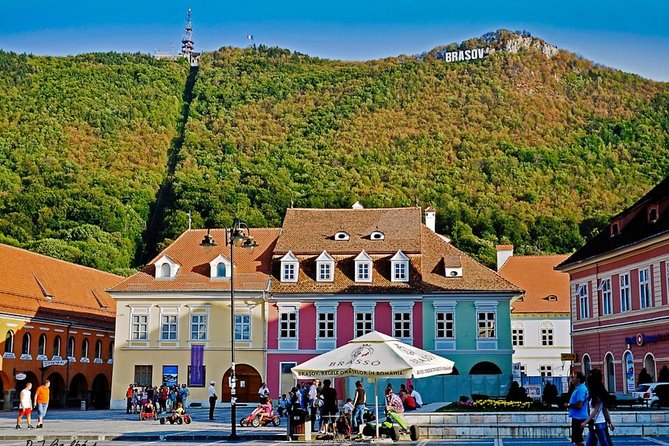
Brașov is a strong place to spend the first night. Its historic center combines medieval and Baroque buildings, narrow cobblestone lanes, and the Gothic Black Church. Council Square is the natural center for a walk, with colorful façades and cafés facing the surrounding Carpathians.
The two-hour stop gives you a taste of the old town, though it is not a full city visit. Staying overnight helps. You can return to the center after the organized sightseeing and experience Brașov with less pressure from the day’s driving.
Day two: Rupea, Viscri, and medieval Sighișoara
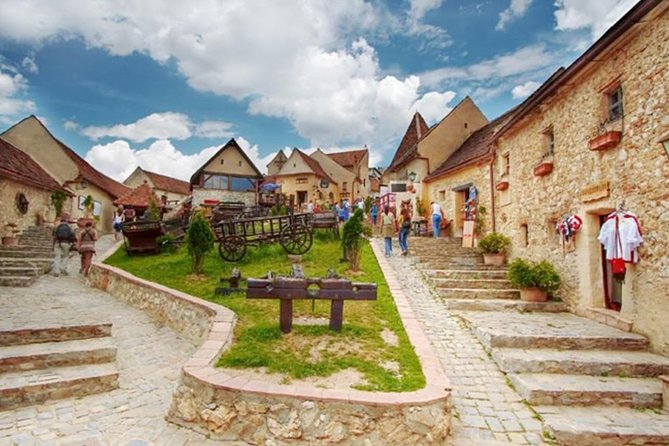
Day two shifts from famous castles to the fortified settlements that make rural Transylvania special. Rupea gives you a hilltop citadel, Viscri offers a Saxon village and church, and Sighișoara provides the most complete medieval town on the route.
Rupea Citadel and the old border country
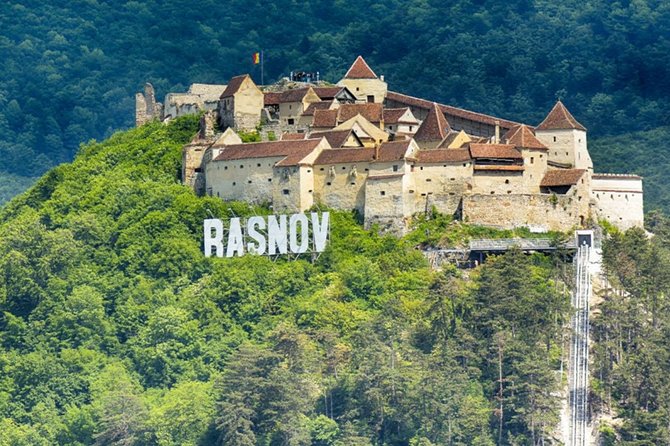
Rupea Citadel occupies a high position and has very old roots. Human settlement in the area reaches back to the Paleolithic and early Neolithic periods, while the citadel is first documented in 1324. Archaeologists connect the current fortification with an earlier Dacian defensive site later taken by the Romans.
The name comes from rupes, the Latin word for stone. From the tenth century onward, the fortress expanded, and by the fourteenth century it helped link Transylvania with Moldavia and Wallachia.
The visit lasts about an hour. This is a good short stop for views and fortification walls, but anyone expecting a large castle interior may find the visit more about the site and its position than furnished rooms.
Viscri and the Saxon fortified church
Viscri is one of the most valuable stops for seeing rural Transylvania. Its Lutheran fortified church was built by the Transylvanian Saxon community, first as a Roman Catholic church and later as a Lutheran one after the Reformation.
The church and village form part of the UNESCO World Heritage group of Transylvanian villages with fortified churches. The walls reflect a time when local communities had to protect themselves, their food, and their religious buildings during periods of conflict.
You have about an hour here. That is enough to understand the church and village, though not enough for a slow rural stay. Viscri is particularly worthwhile if you care about local architecture and the German-Saxon influence on Transylvania, not only the Dracula story.
Sighișoara after the tour buses leave
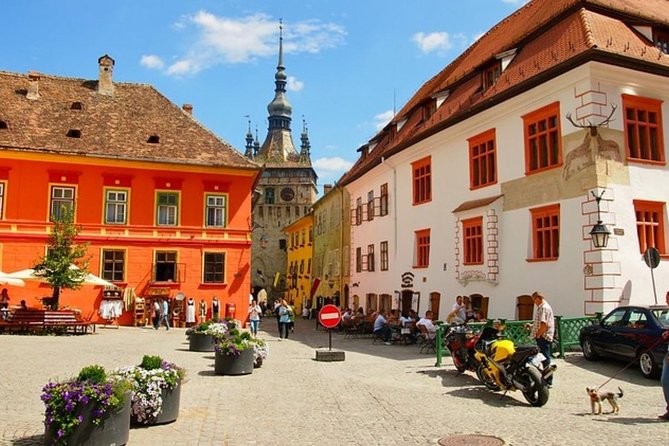
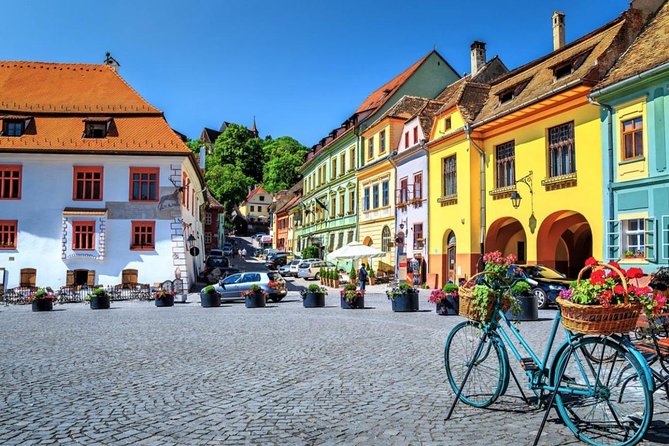
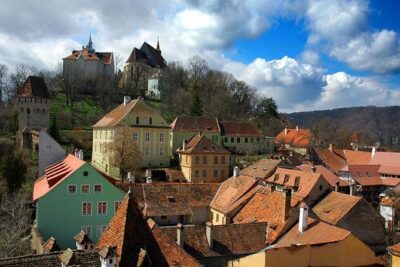
Sighișoara is the medieval centerpiece of the second day. Its UNESCO-listed historic center is enclosed by well-preserved walls, with colored houses, steep lanes, and the Clock Tower rising above the old town.
The three-hour visit is longer than the stops at Rupea and Viscri, and rightly so. You can walk through the old center, see the Clock Tower, and visit the house associated with Vlad Dracula’s birth. The town’s appeal comes from the mixture of real medieval fabric and later legend. It feels like a place to wander rather than simply photograph.
Sighișoara is your overnight base. That is a useful choice because the town rewards an unhurried walk. Still, remember that the old center has cobblestones and uphill sections, so comfortable shoes are sensible.
Day three: Biertan and Sibiu’s Saxon character
The third day continues through fortified church country before reaching Sibiu, one of Romania’s main cultural centers. The pace is lighter, with about one hour at Biertan and two hours in Sibiu.
Biertan’s three defensive walls
Biertan’s fortified church sits on a hill in the middle of the village, surrounded by vineyards and small streets. Its three levels of defensive walls rise about 35 feet and connect through towers and gates. In medieval times, this arrangement made the church complex extremely difficult to conquer.
The church dates from the fifteenth century and uses late-Gothic design. Inside, look for the large multi-panel wooden altar and the carefully made wooden sacristy door that once protected church treasures. Craftsmen from Vienna and Nuremberg worked on the altar, a reminder that these villages were tied to wider Central European trade and craft networks.
The one-hour stop is focused and worthwhile. You will not have time for a long village walk, but the church gives you a clear sense of why the fortified churches matter.
Sibiu, the former Transylvanian capital
Sibiu was once a major center of the Transylvanian Saxons and remains one of Romania’s key cultural cities. It was named European Capital of Culture in 2007, alongside Luxembourg.
The two-hour visit is enough to see the central old town and get a feel for Sibiu’s public squares and historic buildings. It is less compact in mood than Sighișoara, and it has a more active city character. I would use the time for a relaxed walk rather than trying to cover every church, museum, and square.
You spend the night in Sibiu, which makes the next morning’s departure toward the high mountains practical. The overnight arrangement also keeps the tour from becoming a string of exhausting day trips from Bucharest.
Day four: The Transfăgărășan and the road back south
The final day is the most dramatic in scenery, but it also depends most on road conditions. The route includes Bâlea Lake, the Transfăgărășan Highway, Vidraru Dam, and Curtea de Argeș Monastery before the journey returns toward Bucharest.
Bâlea Lake at 2,034 meters
Bâlea Lake is a glacial lake in the Făgăraș Mountains, at an altitude of 2,034 meters. It is reached by car on the Transfăgărășan during summer. At other times of year, access is by cable car from Bâlea Cascadă.
This is an important practical point. The lake is not equally accessible in every season, so ask about the planned route before booking. The area has two year-round chalets, a weather station, and a mountain rescue station. An ice hotel was first built near the lake in 2006, though the tour description does not promise that it will be operating during your visit.
The scheduled stop is one hour. Use it for the mountain views and the lake itself, and bring suitable clothing because high-altitude conditions can be cooler than in the towns.
The Transfăgărășan Highway
The Transfăgărășan, also called DN7C, crosses the southern Carpathians and links the historic regions of Transylvania and Wallachia. It was built in the early 1970s as a strategic military road and runs for about 90 kilometers between the Bascov area near Pitești and the junction with DN1 near Sibiu.
The listed visit is one hour, but this stop is really experienced from the vehicle as the road curves through the mountains. The appeal is the route itself, not a single monument. If you enjoy mountain driving and big views, this can be the high point of the tour.
The drawback is the same as the attraction: road access can be seasonal. The tour description specifically notes summer car access to Bâlea Lake and cable-car access during the rest of the year, so this day may need adjustment outside the main driving season.
Vidraru Dam and Curtea de Argeș
Vidraru Dam is a quick fifteen-minute stop. Completed in 1966 on the Argeș River, it is 166 meters high, has an arch length of 305 meters, and holds the large Lake Vidraru reservoir. Do not expect a long visit. This is a brief engineering and viewpoint stop that breaks up the drive.
Curtea de Argeș Monastery provides a more substantial final visit, with about an hour scheduled. Its cathedral dates from the early sixteenth century and is dedicated to the Dormition of the Mother of God. The exterior uses pale gray limestone, while the interior has frescoes over plaster and brick.
The cathedral belongs to the Romanian Orthodox tradition and serves as the seat of the Archdiocese of Argeș and Muscel. A nearby Moorish-style royal palace adds another architectural note. You will also hear the legend of Master Manole, the builder who could not finish the walls until a human sacrifice was made. It is a striking final story for a tour that has mixed documented history with folklore from the beginning.
What the price really covers
At $872.67 per person, this is not a low-cost sightseeing bus. The price covers private transportation and an air-conditioned vehicle, with pickup offered. It does not cover accommodation, food, or entry tickets.
For three nights, the stated average hotel cost is about $210 per person if two people share a room, assuming $70 per night. Add roughly $35 to $40 for admissions and $15 to $20 per restaurant meal. Your actual total will depend on room arrangements, dining choices, and which attractions you enter, but you should plan for several hundred dollars beyond the tour price.
The value is strongest for a small group that wants privacy, a flexible schedule, and one driver-guide for a demanding route. If you are traveling alone, the per-person cost is harder to justify. If you are traveling with family or friends, the ability to share the private vehicle can make the arrangement more appealing.
Who should choose this tour?
I would choose this trip if you want to see many major Transylvanian sights in four days without organizing the transport yourself. It suits people who enjoy castles but also want villages, churches, city walks, and mountain roads.
It is a good match for a group with mixed interests. Someone fascinated by Dracula gets Bran and Vlad-related sites. Someone interested in architecture gets Peleș, Biertan, Viscri, and Curtea de Argeș. Someone who prefers scenery gets the Carpathian route and Bâlea Lake.
You should think twice if you want long, quiet visits at every stop. The schedule covers a lot of ground, and some stops last only one hour. The private format helps with pacing, but it cannot remove the distances between destinations.
The tour is also less suitable if your travel dates fall outside the period when the Transfăgărășan is open to cars all the way to Bâlea Lake. Confirm the fourth-day plan before paying, especially if that mountain section is a main reason for booking.
Should you book the four-day Transylvania tour?
Book it if you value convenience, privacy, and a well-rounded route more than the lowest possible price. The strongest parts are the mix of major sights, the three overnight bases, and the chance to travel with a private guide such as Mircea, also known as Frank.
Skip it if your budget is tight or you prefer to spend several days in just one or two towns. For a small group that wants castles, Saxon villages, UNESCO sites, and the Transfăgărășan in one organized trip from Bucharest, this is a practical and full itinerary, provided you budget for the extra costs and confirm mountain access.
FAQ
Where does the tour start?
The tour is based in Bucharest, Romania, and pickup is offered. The scheduled start time is 9:00 a.m.
How long does the experience last?
The tour lasts approximately four days.
Is this a private tour?
Yes. Only your group participates, and the itinerary can be adjusted because the program is described as flexible and customizable.
What transportation is included?
Private transportation in an air-conditioned vehicle is included.
Are hotels included in the price?
No. Accommodation is separate. The stated average cost is about $70 per night for a hotel room with breakfast.
Are meals included?
No. Meals are not included. A restaurant meal is estimated at $15 to $20 per person.
Are entrance fees included?
No. Admission fees are separate and are estimated at a cumulative $35 to $40 per person.
Where do you stay during the route?
The planned overnight stops are Brașov after day one, Sighișoara after day two, and Sibiu after day three.
Can you visit Bâlea Lake by car all year?
No. The Transfăgărășan reaches Bâlea Lake by car during summer. During the rest of the year, the lake is accessed by cable car from Bâlea Cascadă.
What is the cancellation policy?
You can cancel at least 24 hours before the start time for a full refund. Cancellations or changes made less than 24 hours before the start time are not accepted for a refund.
More 4-Day Experiences in Bucharest
- Transylvania Castles 4-day tour from Bucharest
★ 5.0 · 31 reviews - 4-Day Private Tour of Transylvania from Bucharest
★ 5.0 · 16 reviews - Private Tour: 4-day Transylvania Famous Landmarks
★ 5.0 · 11 reviews - Private 4-Day Tour in Transylvania including Transfagarasan Road from Bucharest
★ 5.0 · 11 reviews
Just added around Bucharest
- The essence of Saxon Transylvania – 3-day tour of its citadels★ 5.0 · 3 reviews
- Discover Europe’s Deepest Mines & Peles Castle’s Royal Charm★ 5.0 · 3 reviews
- Full-Day Tour to the Black Sea, Constanta and Balchik from Bucharest★ 4.0 · 3 reviews
- Snagov Monastery, Ceaușescu Mansion, & Village Museum – 6h★ 5.0 · 3 reviews
- Winery touring & private wine tasting – one day private tour★ 5.0 · 3 reviews
- 2 Days Private Tour – The Romanian Caves from Bucharest★ 5.0 · 3 reviews
- 4 Days – Transylvania Private Tour★ 5.0 · 3 reviews
- Full day Bucharest Sightseeing Tour★ 5.0 · 3 reviews
Sighișoara Day Trips, compared.
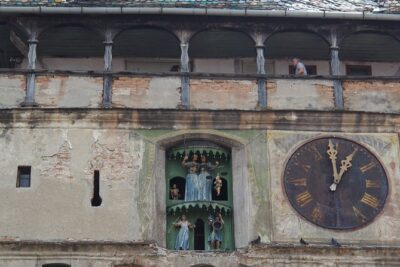
Small Group Tour to Viscri Church Sighisoara Town Rupea Fortress
Read our review →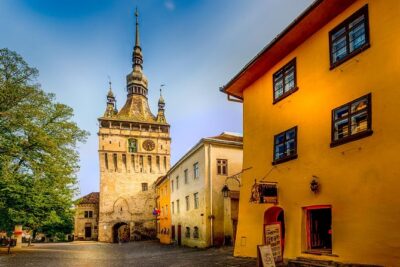
2-Day Medieval Transylvania with Brasov,Sibiu and Sighisoara Tour from Bucharest
Read our review →
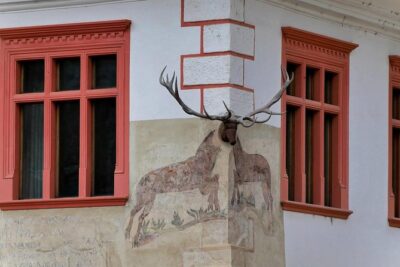
City Tour Sighisoara Legends & Landmarks A Walk Through Time
Read our review →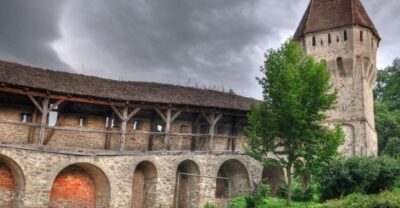
2-Day Transylvania from Bucharest: Brasov, Bran, Sighisoara
Read our review →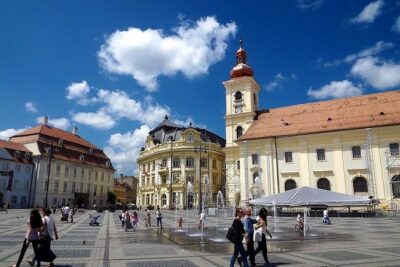
Secrets of the Citadels: Brașov, Viscri, Sighișoara and Sibiu
Read our review →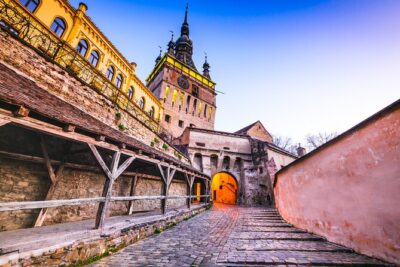
Sighisoara and Viscri Private Full-Day Tour from Brasov
Read our review →Browse the lists this tour appears in