
Reviewed · BUCHAREST TOURS
Bucharest: 3-Hour Walking Tour
Bucharest’s story comes into focus on foot, from the balcony where Nicolae Ceaușescu lost control of a crowd to the medieval court linked with Vlad Tepes, the ruler who inspired Dracula. This tour connects the city’s grand avenues, quiet courtyards, cafés, churches, and political landmarks in one compact walk.
I like the small-group format, capped at 12 people, and the way the route mixes famous buildings with places you might otherwise pass without understanding. I also like the practical touch of a warm, salty covrig, Romania’s beloved pretzel-like street snack, along with useful suggestions for food and further sightseeing.
The main consideration is pace. Three hours gives you a strong introduction, but Bucharest has plenty of layers, and one person felt the route had to skip some possible sights because of time. Wear proper walking shoes, and bring sun protection in summer.
Key points to know before booking
- Revolution Square sets the historical tone: Begin beside the Carol I statue and learn how the 1989 revolution changed Romania.
- Victory Avenue brings architecture into the story: Pass palaces, museums, Kretzulescu Church, the former Royal Palace, and the Romanian Athenaeum.
- Carturesti Carusel is more than a bookshop: Its grand interior makes it one of the city’s most memorable modern stops.
- Old Town supplies the atmosphere: Cobblestones, winding lanes, Stavropoleos Monastery, and Hanul Lui Manuc reveal several sides of Bucharest.
- A covrig keeps the history practical: You receive a traditional Romanian snack rather than only a lecture about food.
- The ending links Bucharest with Dracula: Finish at the Old Princely Court, once associated with Vlad Tepes.
Starting with revolution at Carol I’s statue
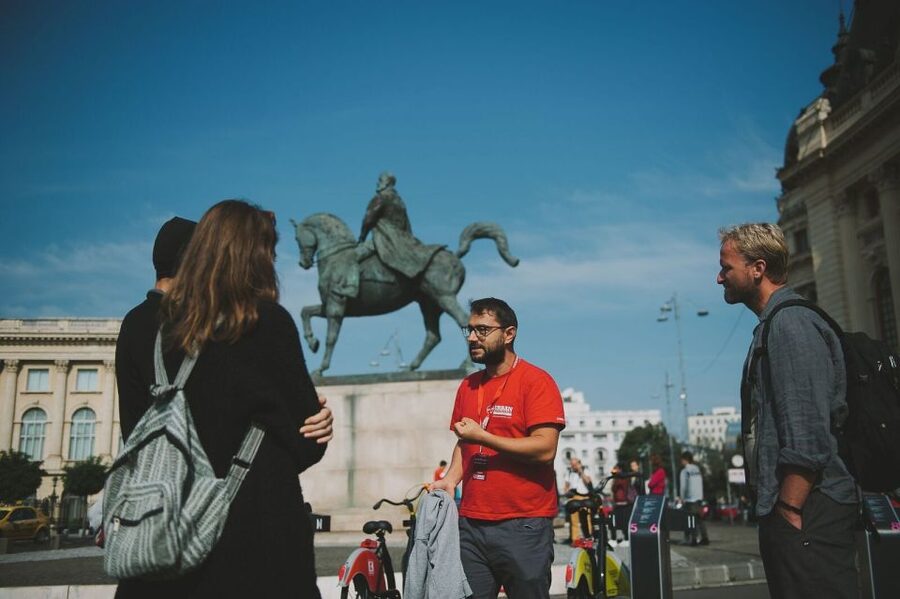
Meet your guide in Revolution Square, directly in front of the Carol I statue. It is the only horse statue in the square, which makes the meeting point easy to identify, especially if you are arriving in the center for the first time.
This square was once called Palace Square, and the change in name reflects its political weight. It has witnessed royal ceremony, communist rule, and the dramatic events of December 1989. Your guide explains the scene in which Nicolae Ceaușescu addressed a public rally from the nearby former Communist Party headquarters. The crowd turned against him, and the speech became a key moment in the Romanian revolution.
I find this a useful place to begin because the story is not kept at a distance. You are standing in the actual civic center where Romania’s political order began to crack. The square gives you a quick introduction to the forces that shaped modern Bucharest: monarchy, dictatorship, public protest, and national change.
The buildings around you also show how much the city has shifted over time. The former Royal Palace now houses the National Museum of Art of Romania, while the Romanian Athenaeum remains one of Bucharest’s most admired concert halls. The Athenee Palace Hilton, built in 1914, adds a more colorful note. It was once a favorite meeting place for spies, giving your guide an opening to discuss the city’s role in European politics and intrigue.
Do not expect a long indoor museum visit here. The value is in seeing the buildings from outside and learning how their uses and reputations fit together. If you want to visit the former Royal Palace or attend a concert at the Athenaeum, you will need separate time and arrangements.
More Walking Tours in Bucharest
- Bucharest: City Highlights Guided Walking Tour
★ 4.9 · 1,482 reviews - Bucharest Highlights Walking Tour
★ 5.0 · 469 reviews - Bucharest: Ghost Stories & Romanian Mythology Walking Tour
★ 4.9 · 287 reviews
Walking Victory Avenue one landmark at a time
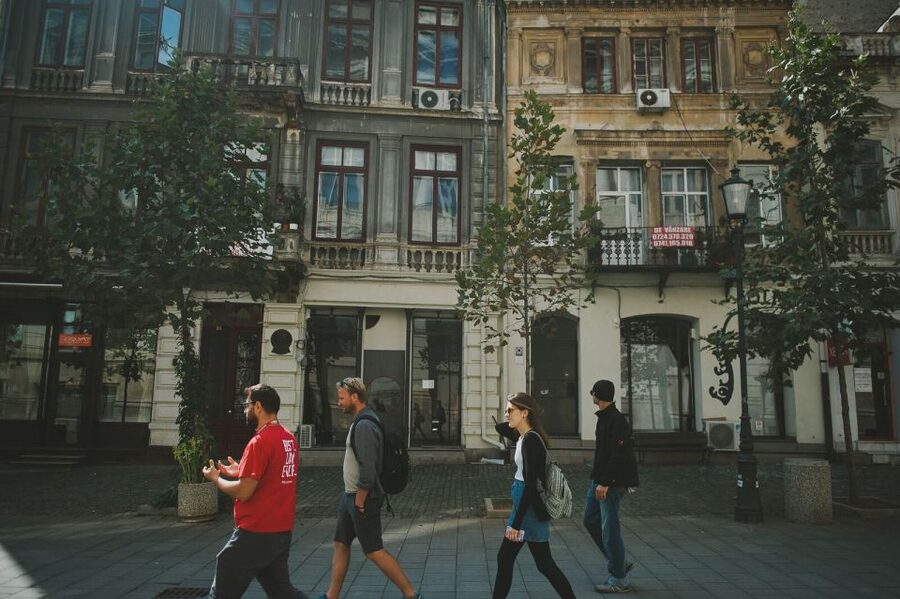
From Revolution Square, the route heads south along Victory Avenue, or Calea Victoriei. The name refers to Romania’s victory in the 1877 War of Independence, and the street has long served as one of Bucharest’s main ceremonial and commercial routes.
This part of the walk is especially useful if you like architecture but do not always know what to look for. You pass palaces, museums, churches, and other grand buildings while your guide explains their place in the city. The information is not limited to dates. Guides such as Mara, Andrea, Elena, Helena, and Ioana have been praised for making the politics, culture, and design easier to follow, often with humor and plenty of time for questions.
Kretzulescu Church is a key stop along the way. Its red-brick exterior and ornate details make it one of Bucharest’s best-known churches, and its position near Revolution Square creates a striking contrast between religious architecture and state buildings.
The street also lets you read Bucharest as a city caught between different influences. French design, royal ambition, Ottoman connections, local traditions, and communist planning all appear in the central district. You will not study every building in detail, but you get a useful framework for exploring more on your own later.
I would pay close attention to your guide’s recommendations here. Andrea, Mara, and other guides have offered suggestions for places to eat and additional sights, which can be handy if this is your first day in Bucharest. A walking tour is more valuable when it helps shape the rest of your visit, not just the three hours spent together.
Finding calm inside the Old Town

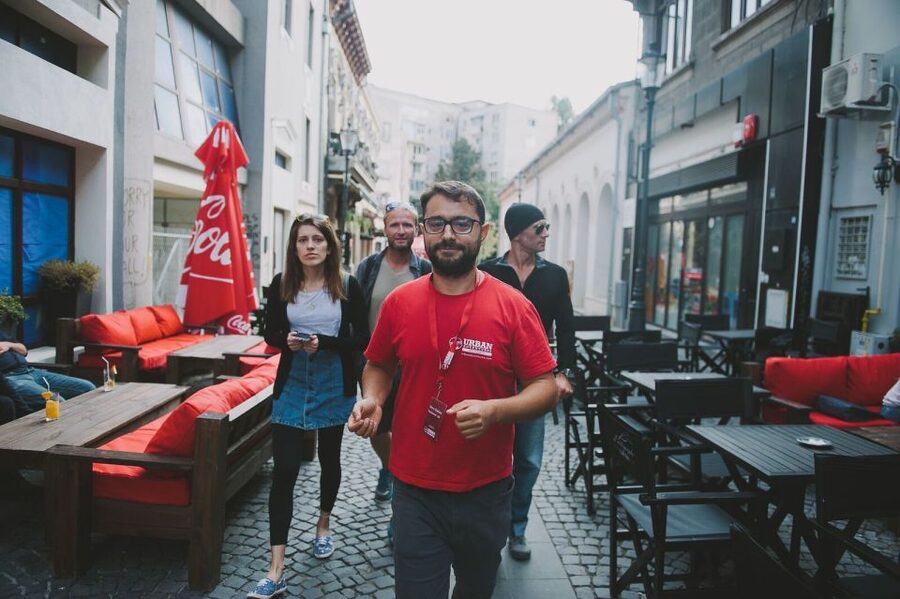
The route eventually turns into Bucharest’s Old Town, the city’s historic core and one of its most popular areas for eating, drinking, and evening walks. The streets are narrow and winding, with cobbles underfoot and a mix of bars, cafés, shops, and restaurants.
This is the section where comfortable shoes matter most. The walk is not described as difficult, but you are on your feet for three hours, and uneven paving can make poor footwear annoying. In summer, sunscreen and something to cover your head are sensible because the sun can be intense.
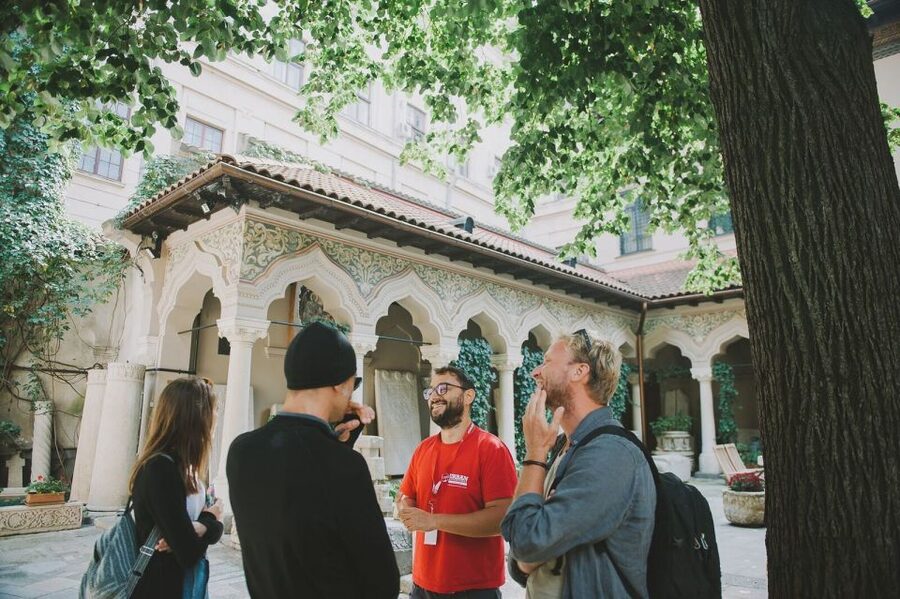
Old Town can feel lively and crowded, particularly around its popular streets, but the tour also points you toward quieter corners. Stavropoleos Monastery offers a peaceful courtyard with detailed decoration and a different mood from the surrounding commercial streets. It is a good reminder that the old center is not just a nightlife district.
Hanul Lui Manuc provides another change of mood. This historic inn, with its large wooden structure, gives you a sense of how Bucharest once served merchants and people moving between the Ottoman world, the Balkans, and Central Europe. Your guide can help you picture the old trading city rather than seeing only the modern restaurants that occupy parts of the district today.
The Old Town is also where the tour’s stories about East and West become most tangible. Ottoman pashas, Transylvanian princes, merchants, and local officials all passed through the wider city. The route does not pretend that Bucharest has one simple identity. Instead, it shows you how different powers and cultures left marks on the center.
Stepping inside Carturesti Carusel
Carturesti Carusel is one of the tour’s most photogenic stops. This bookstore occupies a restored historic building and is known for its elegant interior, curving balconies, white columns, and open central space. Calling it one of the most beautiful bookstores in the world may sound like a tall claim, but the visit gives you a chance to decide for yourself.
I like this stop because it breaks up the sequence of monuments. You are not only looking at Bucharest from the pavement. You get to step inside a working cultural space where books, design, and old architecture meet.
The stop is also practical. You can browse Romanian titles, pick up a small souvenir, or simply enjoy the building without committing to a museum visit. Personal shopping is not included, so anything you purchase is extra.
Allow yourself a moment to look upward. The interior is the point, and a quick glance at the shelves alone will miss much of what makes the bookstore memorable. Your guide can explain why the building matters and help connect it to the wider restoration of central Bucharest.
Same corner of the country, a completely different day out:
- Bucharest: Dracula’s Castle, Peles Castle, & Brasov Old Town
★ 4.5 · 17,858 reviews - Bucharest: Dracula Castle, Peles Castle & Brasov Old Town
★ 4.6 · 10,891 reviews - Bucharest: Dracula’s Castle, Peleș Castle & Brașov Day Trip
★ 4.5 · 5,919 reviews - Bucharest: Palace of Parliament Tickets and Guide
★ 4.3 · 3,182 reviews
Tasting a covrig, Romania’s everyday snack
Food is represented by a covrig, a Romanian snack similar to a soft pretzel. It is one of the country’s most common street foods, so this small tasting is a useful way to connect the walk with ordinary local life.
The included snack is modest, but that is part of its appeal. You are not being taken away for a long meal or asked to spend extra time at a restaurant. Instead, you get something simple to eat while continuing through the city.
Do not book this expecting a full food tour. Additional food and drinks are not included, and the experience focuses on Bucharest’s landmarks and stories. Some people have also paired a city walk with coffee or lunch elsewhere, but those costs and arrangements are separate.
The snack can be particularly welcome if your tour begins between meals. It also gives you a starting point for exploring Romanian food on your own. Ask your guide for local suggestions, as several guides, including Andrea and Anita, have been praised for useful restaurant advice.
Ending at Vlad Tepes’s former court
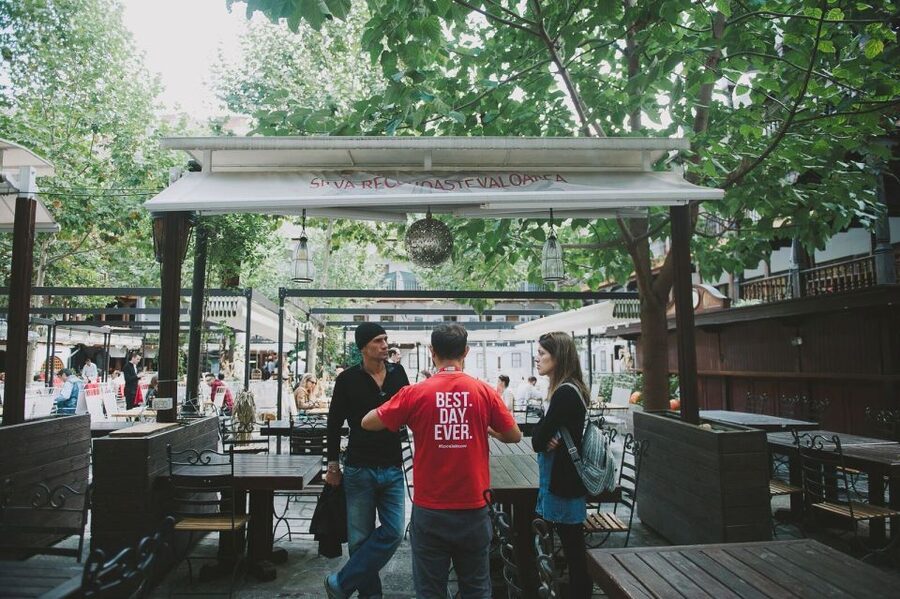
The final stop is the Old Princely Court, or Curtea Veche, whose ruins date to the 15th century. This was once the residence associated with Vlad Tepes, the Wallachian ruler who later became the inspiration for Dracula.
The connection is worth treating with some care. The real Vlad Tepes was a historical prince, while the Dracula of popular fiction is a later creation. The ruins give your guide a natural way to separate the documented ruler from the legend and to explain why Bucharest remains tied to his name.
Ending here works well because the site brings together several threads from the walk. You have seen royal and political buildings, commercial streets, religious spaces, and the old trading center. Now you finish with a place linked to medieval power and one of Romania’s most famous stories.
The tour finishes in front of the ruins, so you can continue exploring the Old Town afterward. Since the experience is focused on walking and outdoor explanations, plan a separate visit if you want more time at the archaeological site or any nearby museum. The tour gives you context, but it is not designed as an extended excavation or museum visit.
How the guides shape the experience
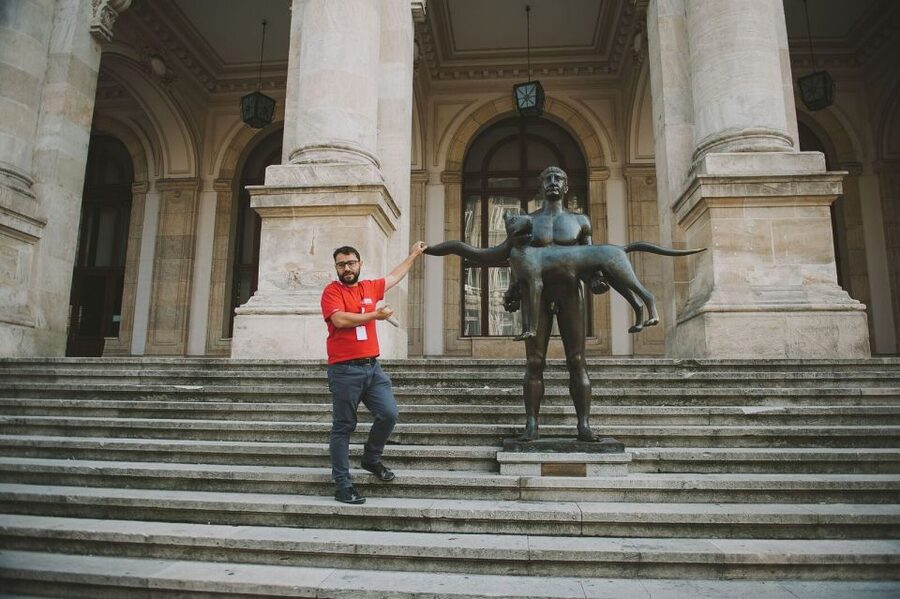
The guide is the most important variable in any walking tour, and the strong record here points to a clear pattern. Guides named Mara, Andrea, Elena, Helena, Ioana, Anita, Adrian, Daniel, and Andrei have been singled out for clear English, warmth, humor, patience, and strong command of Romanian history and culture.
That matters because Bucharest’s story can become confusing fast. Royal Romania, communist Romania, the 1989 revolution, medieval Wallachia, and modern city life do not naturally fit into a neat timeline. A good guide turns those periods into a conversation and lets you ask about the buildings you find most interesting.
Several of the guides have also used photos to help explain places and past events. That can be useful when a building has changed function or when the present-day street gives little hint of its earlier role.
The small group limit of 12 is another advantage. You are more likely to hear the guide clearly, ask questions, and receive restaurant or sightseeing suggestions suited to your interests. In some departures, the group may be much smaller. One person had a private-feeling walk as the only participant, while other groups had only three people.
That said, the exact guide and group size depend on your departure. You should book this for the route and format rather than expecting a particular named guide.
Is $53 good value for three hours?
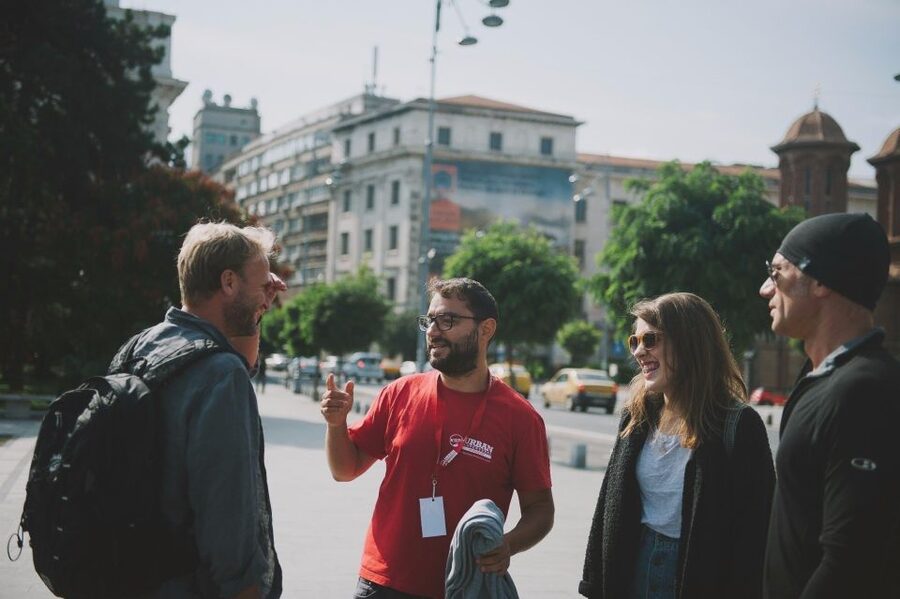
At $53 per person, the tour is not the cheapest way to walk around central Bucharest. You can see many streets and exterior landmarks on your own for nothing. The price makes more sense if you want a coherent explanation of what you are seeing, a local English-speaking guide, a small group, and a traditional snack.
The strongest value comes from orientation. In three hours, you connect Revolution Square, Victory Avenue, the Old Town, Carturesti Carusel, and the Old Princely Court. You also get a list of ideas for restaurants and further sights, which can save time during a short city break.
The price includes the guide and covrig. Additional food and drinks, souvenirs, and personal shopping are extra. No separate attraction admissions are listed as included, so you should not assume that this price covers entry to museums or other paid interiors.
I think the tour offers fair value for a first day in Bucharest, especially if you are staying near the center or have only a few days in the city. If you already know central Bucharest well, or prefer to wander without a fixed route, the cost may be harder to justify.
Who should book this Bucharest walk?
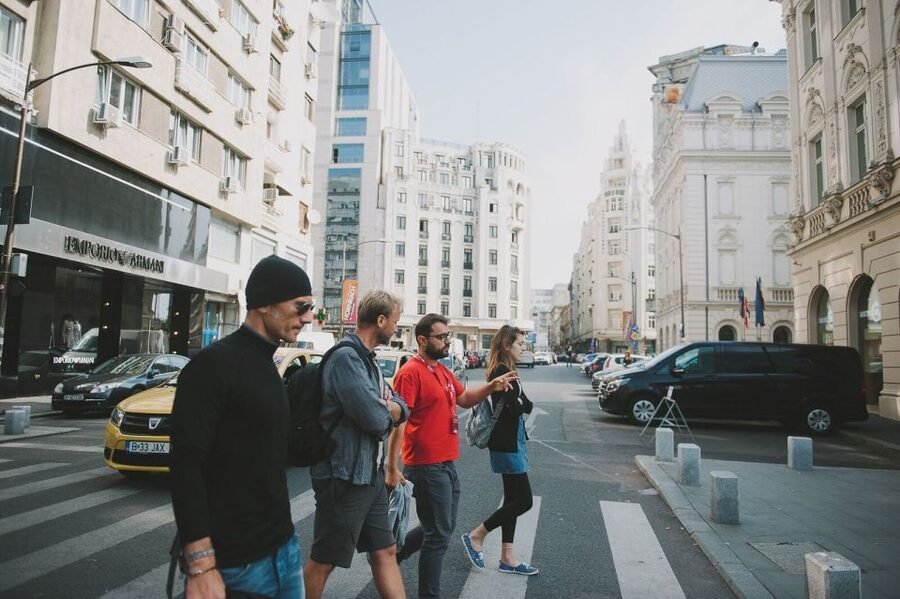
I would choose this tour for a first visit, particularly if you want Bucharest’s history explained without spending hours inside a museum. It suits couples, solo visitors, families with older children, and anyone who enjoys a city’s political and architectural story.
Children aged 6 to 11 can join at the listed child rate, and children under 6 can join free. You need to mention a child under 6 when booking. Keep in mind that the tour still involves three hours on foot, so younger children may need extra patience from the adults accompanying them.
This is also a good first-day activity. It gives you a useful map of the center and helps you decide where to return for a longer visit. The tour is delivered in English, and the guides have been noted for fluent, clear communication.
I would hesitate only if you want a detailed interior tour, a full meal, or a broad tour of Bucharest beyond the historic center. This experience concentrates on Revolution Square, Victory Avenue, and the Old Town. That focus is its strength, but it also means you will not cover every part of the capital.
Book at least one day ahead if your plans might change, since cancellation is free up to 24 hours before the start. You can also reserve now and pay later, which keeps your schedule flexible.
Should you book the 3-hour Bucharest Walking Tour?
Book it if you want a compact, story-led introduction to central Bucharest. The route has a good arc: revolution and royal power at the start, architecture along Victory Avenue, medieval trade in the Old Town, a covrig for a local taste, and Dracula’s historical predecessor at the end.
The main reason to choose it is the guide-led context. Bucharest rewards curiosity, but its buildings do not always explain themselves. A guide such as Mara, Andrea, Elena, or Ioana can help you see the politics, culture, and personal stories behind the façades.
Skip it if your priority is shopping, nightlife, or a full food experience. For most first-time visitors with comfortable shoes and three free hours, I think the $53 price is reasonable, especially when the group remains small and the guide offers useful ideas for the rest of your stay.
FAQ
Where does the Bucharest walking tour meet?
The meeting point is Revolution Square, in front of the Carol I statue. It is the only horse statue in the square.
How long does the tour last?
The walking tour lasts three hours. Starting times vary, so check availability for your chosen date.
What language is the tour offered in?
The tour is conducted in English by a live local guide.
What is included in the price?
The price includes an English-speaking local guide and one traditional Romanian snack, a covrig.
Are food and drinks included beyond the snack?
No. Additional food and drinks are not included. Souvenirs and personal shopping are also separate.
Is the tour suitable for children?
Yes. Children aged 6 to 11 can join at the listed child rate. Children under 6 can join free, but you must mention them when booking.
How large is the group?
The group can include a maximum of 12 people. Some departures may be smaller.
What should I bring?
Bring comfortable shoes, sunscreen, and something to cover your head in summer. The sun can be intense, and you will be walking for three hours.
More 3-Hour Experiences in Bucharest
- 3-Hour Guided Tour of Communist Bucharest
★ 4.9 · 303 reviews - Bucharest: 3-Hour Dark History Tour with a Local
★ 4.9 · 301 reviews - Bucharest: Alternative Sightseeing 2.5-3h-Hour Guided Tour
★ 4.9 · 80 reviews - Bucharest: Relics of Communism 3-Hour Walking Tour
★ 4.9 · 77 reviews
Just added around Bucharest
- Private Full Day Tour of Bucharest★ 5.0 · 3 reviews
- Veliko Tarnovo and Medieval Bulgaria Private Day Trip from Bucharest★ 5.0 · 3 reviews
- Bucharest VIP Bar Crawl in Lipscani ‘Old Town’★ 5.0 · 3 reviews
- Muddy Volcanoes and Salt Mine Private Tour★ 5.0 · 3 reviews
- Bucharest Private City Tour★ 5.0 · 3 reviews
- Legends & Stories from Transylvania -2 Castles & Brasov Old Town★ 5.0 · 3 reviews
- Transfagarasan Private Tour from Bucharest – 2 Days★ 5.0 · 3 reviews
- 7-Day Dracula Tour in Romania from Bucharest including ‘The Ritual of Killing of a Living Dead’★ 5.0 · 3 reviews
Bucharest Tours, compared.
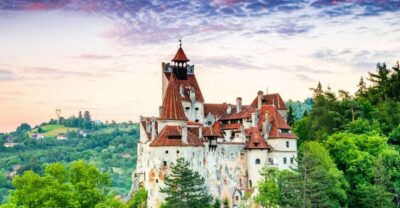
Dracula’s Castle, Peles Castle, & Brasov Old Town
Read our review →
Dracula Castle, Peles Castle & Brasov Old Town
Read our review →
Dracula’s Castle, Peleș Castle & Brașov Day Trip
Read our review →
Day Trip to Dracula Castle, Peles Castle & Brașov
Read our review →
Bucharest to Dracula Castle, Peles Castle and Brasov Guided Tour
Read our review →
Dracula’s Castle, Peles Castle and Brasov Day Trip from Bucharest
Read our review →Browse the lists this tour appears in