
Reviewed · COMMUNIST BUCHAREST TOURS
Communist Era Bucharest Tour
Bucharest’s Communist past is easiest to understand on foot, with the city’s huge boulevards and grand buildings in view while your guide explains what daily life was like behind them. This private three-hour tour links Parliament Palace and Socialist Victory Boulevard with personal stories about shortages, politics, family life, and the changes that came after 1989.
I like the private format, since you can ask direct questions and steer the conversation toward architecture, politics, or ordinary life. I also like the choice of morning or afternoon departure, plus hotel pickup in central Bucharest.
The main drawback is that some stops are brief, and the tour is more of an outdoor walking experience than a formal visit inside the Parliament Palace. One past participant also found the guide difficult to understand, while another felt the presentation of Communist Romania was too mild, so the guide’s interpretation may not suit every history enthusiast.
Key points to know before booking
- Private walking tour: Your group alone takes part, making it easy to ask personal and political questions.
- Personal memories add context: Guides Alina and Claire have shared first-hand accounts of growing up during Communist rule.
- Major landmarks in one route: See Unirii Square, Parliament Palace, Revolution Square, University Square, and central banks and theaters.
- Strong value at $30.72: The price covers about three hours of guiding, with pickup available from a centrally located hotel.
- Mostly outdoor sightseeing: Bring comfortable shoes and expect to view major buildings from the street.
- Flexible timing: You can select a morning or afternoon excursion, and the tour ends where it begins.
Why Communist Bucharest makes sense on foot
This is not simply a tour of old buildings. It is a walk through the physical changes made by Nicolae Ceaușescu’s government, then a closer look at the people who lived with those changes.
Communist Bucharest is full of scale. Wide avenues cut across the center. Monumental buildings occupy huge spaces. Decorative fountains, government offices, banks, theaters, and apartment districts all reflect an effort to reshape the capital according to a central plan.
That grand plan becomes more useful when your guide explains its human cost and daily reality. The tour connects national events with ordinary routines, including what people could buy, how families handled shortages, and how public life changed under Communist rule.
The route also gives you a useful introduction to Romania beyond the Communist period. Guides have discussed the post-Ottoman era, the reign of King Carol I, the interwar years, the Communist takeover, and life after the 1989 revolution. That wider frame matters, since Romania did not begin with Ceaușescu and did not stop changing when he fell.
More communist-era Bucharest walks:
- The Real tour of Communism
★ 5.0 · 666 reviews - Life under Communism
★ 5.0 · 358 reviews - 3-Hour Guided Tour of Communist Bucharest
★ 4.9 · 303 reviews
Starting at Manuc’s Inn in the Old Centre
The meeting point is outside the main entrance of Manuc’s Inn, at 62 Strada Franceză, in the Old Centre. Pickup is also offered from a centrally located hotel, which is helpful if you would rather begin without finding the meeting point yourself.
Starting here creates an interesting contrast. Manuc’s Inn belongs to an older Bucharest, while the Communist projects ahead belong to a very different vision of the capital. I like that the walk does not treat the Communist period as an isolated chapter. It places it in the middle of the city’s long political and architectural story.
The activity ends back at the meeting point. Since the route is on foot, wear shoes that can handle several hours of city walking. The stated fitness level is moderate, and the tour is near public transportation.
Unirii Square and the Socialist Victory Boulevard
The first major stop is Piața Unirii, one of central Bucharest’s key public spaces. It was reshaped as part of the Communist modernization program and has since been regenerated as a modern city center.
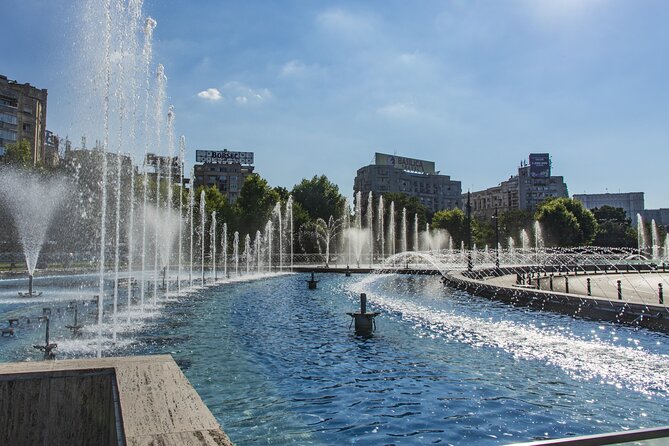
The most eye-catching feature today is the restored Unirii fountain system. These fountains give the square a lighter, more public feel than the hard political purpose behind the redevelopment. Your guide can help you see both layers: the square as it functions now and the planning decisions that created it.
From here, the route continues along Bulevardul Unirii, formerly known as the Boulevard of Socialist Victory. It was designed on a huge scale and is often compared with the Champs-Élysées of Bucharest.
You will see 17 artesian fountains, decorated to represent the four seasons. The tour allows only about five minutes at this point, so do not expect a long architectural study. Still, the boulevard is one of the clearest places to understand how Communist leaders used broad avenues, repeated patterns, and monumental scale to project power.
I find this part valuable because the architecture is not subtle. The road and fountains show the state trying to control the visual identity of the capital. Your guide’s explanation turns an impressive view into a political document.
Parliament Palace, the building that changed Bucharest
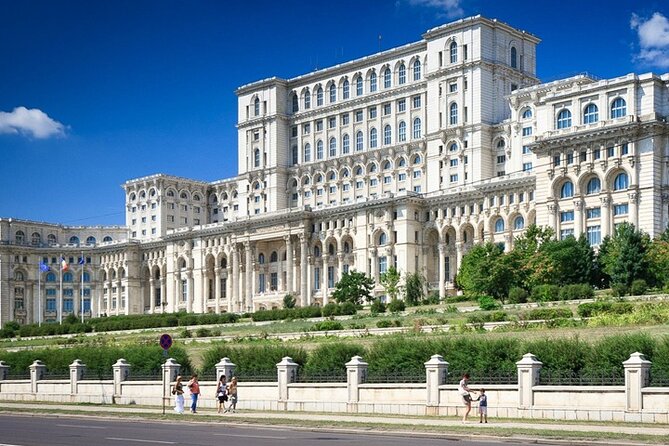
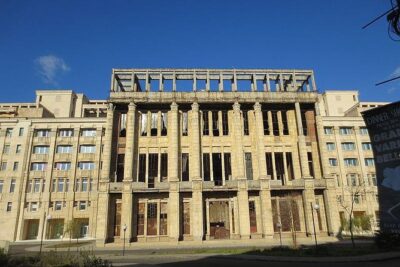
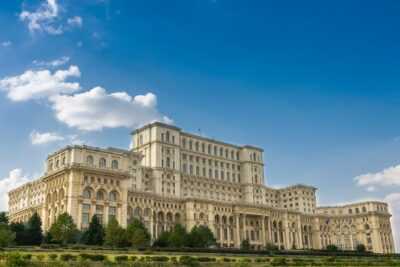
The route then reaches Nicolae Ceaușescu’s massive Parliament Palace, formerly called Casa Poporului, or House of the People. It is described as the heaviest building in the world and looms over the city center.
The building is the tour’s biggest visual shock. Even from outside, its size raises practical questions: how much labor and material went into it, what had to be cleared to make room, and why a government facing economic hardship chose such an enormous project.
You should understand one important point before booking: the supplied tour details describe seeing the building and hearing its history, not an interior admission. This experience is best for understanding the palace in its urban and political setting, rather than for touring its rooms.
The palace also helps explain why a walking route works well here. You can see how it relates to the boulevard and the surrounding city, rather than treating it as a separate attraction. The visual relationship between the building and the avenue is part of the story.
A few more Bucharest day trips to weigh up
- Bucharest: Dracula’s Castle, Peles Castle, & Brasov Old Town
★ 4.5 · 17,858 reviews - Bucharest: Dracula Castle, Peles Castle & Brasov Old Town
★ 4.6 · 10,891 reviews - Bucharest: Dracula’s Castle, Peleș Castle & Brașov Day Trip
★ 4.5 · 5,919 reviews - Bucharest: Palace of Parliament Tickets and Guide
★ 4.3 · 3,182 reviews
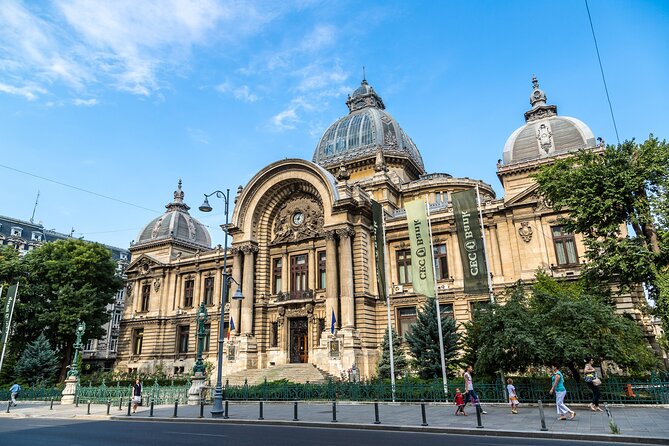
Victoria Avenue, banks, and the public face of power
The walk continues along part of Calea Victoriei, or Victoria Avenue. This central street is lined with attractive shops, but the guide uses it to explain what the area was like during the Communist years.
That contrast is useful. A street that now feels commercial and open had a different public role under the former regime. You are not only looking at surviving facades. You are considering how the same streets served different political systems.
The CEC Bank is another stop. It was known as the bank of the people during the Communist period. Then comes the National Bank of Romania, whose grand appearance and long institutional story add another layer to the route.
These stops are short, yet they prevent the tour from becoming only a sequence of political monuments. Banks, shops, and public institutions show how ideology reached into ordinary economic life. I appreciate that the route includes these buildings, since they give you a sense of how government power appeared in everyday Bucharest.
University Square and the Intercontinental Hotel
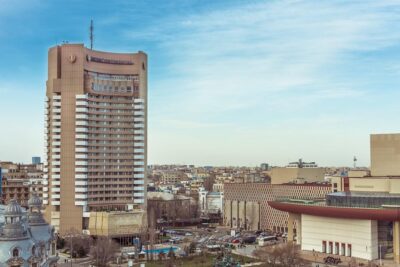
At University Square, you see the oldest and largest university in Bucharest. The area also introduces the Intercontinental Hotel, completed and opened in 1971.
The hotel is an interesting reminder that Communist Bucharest was not cut off from every form of modern architecture or international ambition. A prominent hotel could signal confidence and progress, even while people inside the country faced serious restrictions and shortages.
The nearby National Theatre also adds to the architectural story. Your guide explains how this iconic building went through several design changes during its relatively short history. That detail is useful because it shows that Communist-era buildings were not always fixed symbols. Some were altered, replaced, or reworked as political tastes changed.
This section of the walk is especially good for anyone interested in how a city’s identity is built through institutions. A university, hotel, and theater tell different stories from the Parliament Palace, but together they show how public life was organized and presented.
Revolution Square and the final speech of Ceaușescu
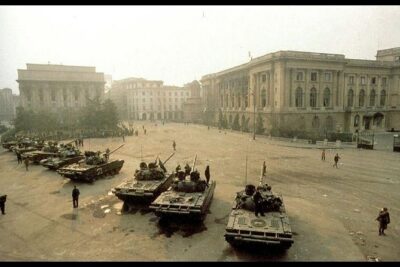
Piața Revoluției, or Revolution Square, is the emotional center of the tour. This is where the 1989 revolution began, and the square contains several memorials tied to those life-changing events.
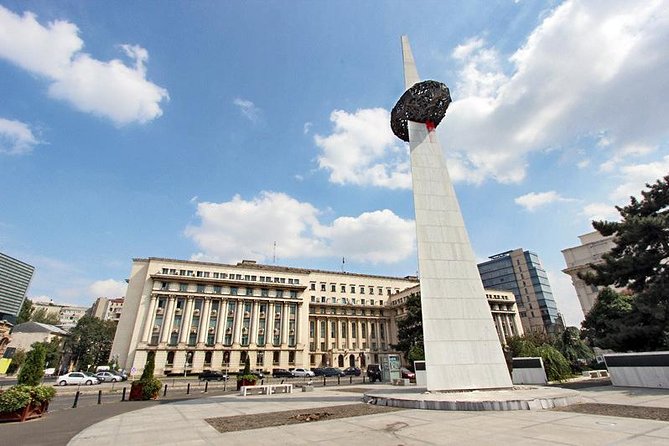
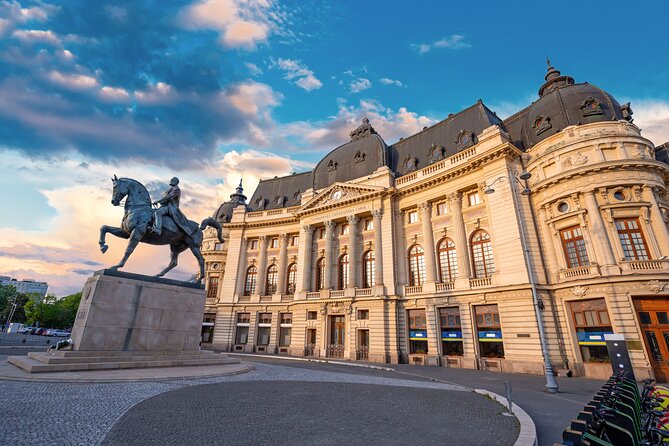
You will see the balcony where Ceaușescu gave his final speech, the former Communist Party headquarters, the Memorial of Rebirth, the equestrian statue of King Carol I, and the university library. The area offers strong photo opportunities, but it deserves more than a quick picture.
The balcony matters because it captures the sudden collapse of authority. Ceaușescu had addressed crowds from there as a leader who appeared secure. Soon afterward, the same public space became tied to the end of his rule.
The former party headquarters helps you understand the machinery behind that authority. The nearby memorials then shift attention toward the people who resisted and died. A good guide will help you hold both parts together: the spectacle of political power and the human cost of its collapse.
The stop is listed at about ten minutes. That is enough for an introduction, but you may want to return later if you prefer time to read plaques and examine the memorials quietly.
Iuliu Maniu and the Memorial of Rebirth
The Iuliu Maniu statue introduces an earlier chapter in Romania’s political history. Maniu served three times as prime minister and struggled against the early Communist years.
This is a worthwhile stop because it shows that opposition to Communist rule did not begin in 1989. The political conflicts after the Second World War shaped Romania long before the revolution that ended Ceaușescu’s government.
Nearby, the 25-meter Memorial of Rebirth commemorates the struggles and victims of the Christmas 1989 revolution. Its unusual design can prompt questions, and the guide’s explanation gives it meaning beyond its appearance.
I would pay attention here to the difference between a monument and a personal story. The memorial represents a national event. A guide such as Alina or Claire can connect it to family memories and explain how those events were understood by people living through them.
The final historic stop and the value of personal stories
The final stop is described as a more than century-old Bucharest site built for the people of the city, with gardens and an impressive historic building. It provides another chance for photographs and gives the walking route a calmer finish after the political weight of Revolution Square.
The supplied details do not identify this stop by name, so you should confirm it when booking if that location matters to you. Its role in the route is clear, though: it brings the walk back to civic life, public space, and the older city that existed before Communist redevelopment.
The strongest part of this experience is the guide’s ability to connect places with lived experience. Alina has been praised for explaining what Romania was going through and for placing events in their period context. Claire has shared memories from childhood and adolescence under Communist rule, while also discussing positive and negative sides of that experience.
That personal approach can make the tour far more useful than a standard date-and-building walk. You can ask what people believed, how families adapted, and how memories of the period differ. Several tours reportedly ran beyond the planned three hours because the conversation continued while walking. That suggests a flexible style, though you should not assume extra time is guaranteed.
A balanced look at the guide style
The guide is central to this experience. The most favorable descriptions point to warm, animated explanations, clear pride in Romania, and a willingness to answer personal questions. The historical coverage can extend from the royal period through the Communist takeover and into modern Romania.
The presentation also aims to include both good and bad aspects of Communist life, rather than offering a single slogan. That is useful for a complicated subject, especially if you want to understand why memories can vary within the same country.
Still, this balance may not suit everyone. One assessment found the Communist period presented as less negative than expected and objected to parts of the historical interpretation. Another noted difficulty understanding the guide, despite the large amount of information provided.
I would book this tour if you value conversation and local perspective more than a tightly scripted lecture. If you want a strictly academic account with extensive documentation, you may find the interpretation too personal or not critical enough. The private format gives you a chance to ask for clarification when a point seems disputed.
What $30.72 buys you
At $30.72 per person, the tour offers good value if you want a private introduction to Bucharest’s Communist past. The price includes about three hours of guiding, your own group rather than a mixed party, and pickup from a central hotel if arranged.
The value comes from the guide, not from admission tickets. The listed stops are public spaces, streets, statues, and exterior landmarks, and admission is free at the named stops. You are paying for local explanation, route planning, and the chance to ask questions that a self-guided walk cannot answer.
For two people, the total remains reasonable for a private experience. For a larger group, the per-person price becomes even more attractive, provided everyone is comfortable walking and discussing history together.
The tour is offered in English and has morning or afternoon options. Confirmation is normally sent at booking, although bookings made within one day of departure are subject to availability and may be confirmed later.
Free cancellation is available up to 24 hours before the start time for a full refund. Changes or cancellations inside that window are not accepted for a refund.
Who should book this Bucharest history walk?
I recommend it most strongly to you if:
- You want to understand Romania’s Communist period through buildings and personal accounts.
- You prefer a private guide to a large group.
- You enjoy asking questions and discussing difficult political subjects.
- You want to combine major landmarks with a broader history of Romania.
- You are comfortable with several hours of walking and mostly outdoor sightseeing.
It is also a good first or second-day activity in Bucharest. The route gives you a working map of the center and points out places you may want to revisit on your own, especially Revolution Square and the central boulevards.
You may want a different experience if your priority is entering Parliament Palace, since an interior visit is not specified. You should also think twice if you prefer a single, firmly stated interpretation of Communism. This tour appears designed for discussion and context, which can feel thoughtful to one person and insufficiently hard-edged to another.
Should you book the Communist Era Bucharest Tour?
Book it if you want Bucharest explained by someone who can connect the grand architecture with family memories and daily life. The private setting, central pickup, flexible timing, and $30.72 price make it an easy addition to a city break.
I would choose the tour early in your Bucharest stay, then return to the places that catch your interest. Go with comfortable shoes, an open mind, and a few questions about life under Ceaușescu. For a grounded introduction to Parliament Palace, Revolution Square, and the changing face of central Bucharest, this is a strong choice.
FAQ
How long is the Communist Era Bucharest Tour?
The tour lasts approximately three hours, although the guide may continue the conversation beyond that planned duration.
Is this a private tour?
Yes. Only your group participates, so you can ask questions and focus the discussion on your interests.
Is hotel pickup available?
Pickup is offered from centrally located hotels. You can also meet outside the main entrance of Manuc’s Inn at 62 Strada Franceză in Bucharest’s Old Centre.
Is the tour offered in English?
Yes. The experience is offered in English.
Does the tour include entry to Parliament Palace?
The provided tour details describe viewing Parliament Palace and learning about its history. They do not specify interior admission.
What should I wear or bring?
Comfortable walking shoes are recommended. You should also be prepared for a moderate level of physical activity, since the experience takes place mainly on foot.
Just added around Bucharest
- Private Full Day Tour of Bucharest★ 5.0 · 3 reviews
- Veliko Tarnovo and Medieval Bulgaria Private Day Trip from Bucharest★ 5.0 · 3 reviews
- Bucharest VIP Bar Crawl in Lipscani ‘Old Town’★ 5.0 · 3 reviews
- Bucharest Private City Tour★ 5.0 · 3 reviews
- Muddy Volcanoes and Salt Mine Private Tour★ 5.0 · 3 reviews
- Legends & Stories from Transylvania -2 Castles & Brasov Old Town★ 5.0 · 3 reviews
- Transfagarasan Private Tour from Bucharest – 2 Days★ 5.0 · 3 reviews
- 7-Day Dracula Tour in Romania from Bucharest including ‘The Ritual of Killing of a Living Dead’★ 5.0 · 3 reviews
Communist Bucharest Tours, compared.
Bucharest Essential Tour: Old Town, Calea Victoriei & Communism
Read our review →
Communism in Bucharest – Landmarks, Museum & Communist Appetizers
Read our review →
Browse the lists this tour appears in