
Reviewed · COMMUNIST BUCHAREST TOURS
Communism Walking Tour from Lenin to Ceausescu in Bucharest
Bucharest’s communist past is easiest to understand when you walk through the places where power was built, displayed, and finally challenged. This tour links the Palace of Parliament, Socialist Victory Boulevard, the Old Town, University’s Square, and the site of Nicolae Ceausescu’s final speech.
I like the way it pairs major sights with personal stories about daily life under communism, rather than treating the period as a list of dates. I also like the route’s shape: it begins with Ceausescu’s grandest building project and ends at Revolution Square, where the regime broke apart. The main consideration is that this is an English-language tour, so you’ll get less from it if you struggle to follow spoken English.
Key points at a glance
- A powerful start at the Palace of Parliament: Begin beside one of the world’s largest administrative buildings and the final grand project of Romania’s communist leadership.
- A route through forced urban change: See how old churches and neighborhoods were threatened or altered to make room for Socialist Victory Boulevard.
- The Old Town’s communist-era decline: Learn how an area now packed with restaurants and nightlife was neglected under the old regime.
- A clear account of the 1989 revolution: University’s Square and Revolution Square give the political story a physical setting.
- Guide-led storytelling: Alex and Lucia are named guides connected with the experience, with Alex especially noted for his humor, cultural knowledge, and ability to adapt to different groups.
- Good value for a short city walk: At $24 per person, the tour offers 2 hours and 30 minutes of guided context, with a maximum group size of 25.
Starting with Ceausescu’s grandest project

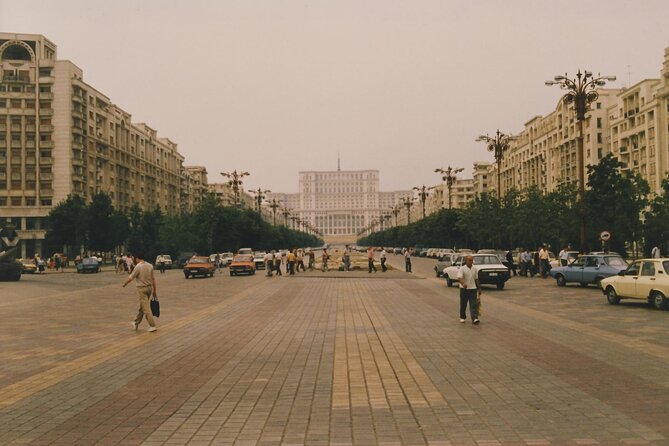
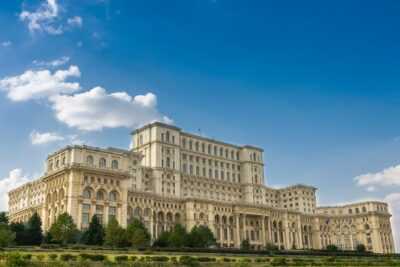
The walk begins at Bulevardul Unirii 5 at 10:30 a.m., in front of the Palace of Parliament. You won’t go inside as part of this experience, but the exterior alone gives the opening scene plenty of weight.
The building is described as the second-largest administrative building in the world. That scale is not a side note. It is the clearest physical expression of Nicolae Ceausescu’s taste for monumental projects and centralized power. From the outside, you can see why the building works so well as the first stop: it turns an abstract subject, communist ambition, into something concrete and difficult to ignore.
You have about 20 minutes here. That is enough time for your guide to explain the project and its place in the final years of communist rule, though not enough for an architectural tour of every detail. If you want to visit the interior separately, you’ll need to arrange that on your own.
This beginning also sets up one of the tour’s main ideas: Bucharest was not simply given new boulevards and giant buildings. Large parts of the city were changed to make them possible. The walk then moves toward those costs.
More Walking Tours in Bucharest
- Bucharest: City Highlights Guided Walking Tour
★ 4.9 · 1,482 reviews - Bucharest Highlights Walking Tour
★ 5.0 · 469 reviews - Bucharest: Ghost Stories & Romanian Mythology Walking Tour
★ 4.9 · 287 reviews
Antim Monastery and the price of Socialist Victory Boulevard
At Antim Monastery, the focus shifts from what was built to what almost disappeared. The monastery was part of Bucharest’s old city, and it was nearly demolished to clear space for the new Socialist Victory Boulevard.
That makes this a useful stop for understanding urban planning under a highly centralized system. A boulevard can look impressive in a photograph, but the guide helps you consider the homes, churches, and older streets that stood in its path.
You’ll spend around 15 minutes here. The stop is free, and the value comes from the explanation rather than from a long interior visit. If you are interested in architecture, city planning, or the way governments reshape capital cities, this short pause should be especially useful.
I like this part of the walk because it avoids a simple good-versus-bad tour structure. The route lets you see the scale of the building program while also asking what was lost to create it.
Patriarchal Palace and Romania’s political crossroads
The next stop is Palatul Patriarhiei, or the Patriarchal Palace. Its design was inspired by the Garnier Opera in Paris, giving you another example of Bucharest’s mixture of outside influence, royal ambition, religious importance, and political change.
The building is tied to both the beginnings of democracy in Romania and the early communist movement. That combination makes it more than a pretty facade. It helps connect the country’s political transitions across several periods instead of treating communism as an isolated chapter.
The planned stop lasts about 20 minutes. You should expect the guide to explain the place in relation to political events, not to provide a full art or architectural tour. The experience is strongest when you listen for the connections between buildings and changing systems of government.
Union Square and the boulevard of spectacle
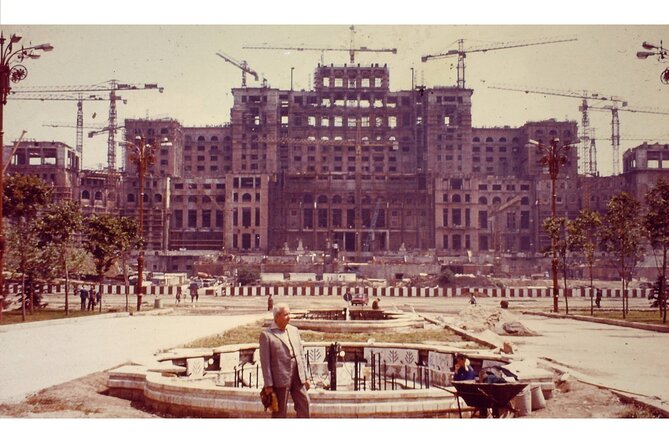
Piata Unirii was developed during the 1980s as part of Socialist Victory Boulevard. Today, its dancing fountains give the area a more cheerful public face, but the square also belongs to the same grand urban project introduced at the Palace of Parliament.
You have about 20 minutes here. This is a good point to notice how public spaces can change meaning. A square designed during the communist era can later become a popular gathering place and an ordinary part of city life, even while its original purpose remains visible in the surrounding scale and layout.
The fountains are one of the tour’s more modern sightseeing touches. They also provide a break from the heavier political material. Still, you should not expect a dedicated fountain show or a long free period. The guide’s interpretation remains the main reason for stopping.
More communist-era Bucharest walks:
- The Real tour of Communism
★ 5.0 · 666 reviews - Life under Communism
★ 5.0 · 358 reviews - 3-Hour Guided Tour of Communist Bucharest
★ 4.9 · 303 reviews - Bucharest Essential Tour: Old Town, Calea Victoriei & Communism
★ 5.0 · 142 reviews
Bucharest’s Old Town after neglect
The route then enters the Old Town, an area now associated with historic streets, restaurants, and evening activity. During the communist era, however, it was abandoned and came to symbolize the old regime.
That contrast is one of the most useful parts of the walk. You can look at the Old Town as a living district, but the guide asks you to picture a period when it was not cared for in the same way. The contrast helps explain why the area’s survival matters, even if some buildings have changed purpose over time.
The planned visit lasts about 15 minutes. You’ll likely get a broad explanation rather than a room-by-room account of particular buildings. I would pay attention to how the guide describes the area’s place in the city before, during, and after communism.
This stop also prevents the tour from becoming a parade of official buildings. You get a glimpse of everyday Bucharest and the older city that existed beneath the communist redevelopment plan.
University’s Square and the bloody revolution
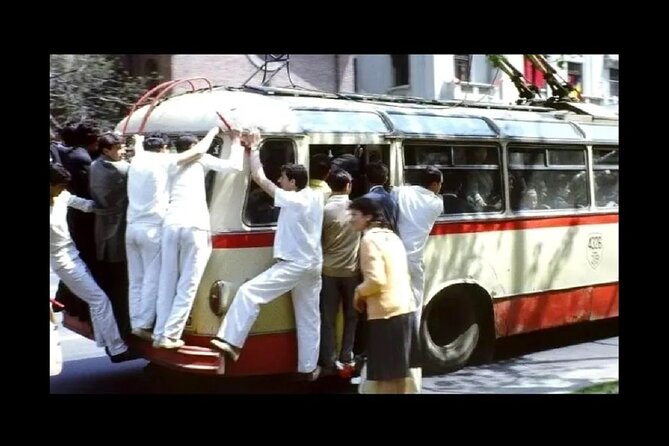
University’s Square brings the story to the 1989 revolution. Romania was the only country in the communist bloc where the regime ended in a bloody revolution, and many victims were shot in this square.
The subject is difficult, but the location gives it force. Instead of hearing only that protests spread and the government fell, you are standing in one of the places where the violence occurred. The tour connects the political collapse to an actual street setting, which can make the final days of the regime easier to grasp.
The stop lasts about 15 minutes. That is enough for an outline and a focused account, but you may want to read more afterward if you want a detailed chronology of the revolution. The tour is designed as a city walk, not a full academic course.
This is likely to be one of the most serious moments of the experience. If you are traveling with children or with a mixed-age family group, the guide’s tone and level of detail may matter. The experience has worked for a three-generation group, but the subject itself is not light.
From royal residence to Palace of the Republic
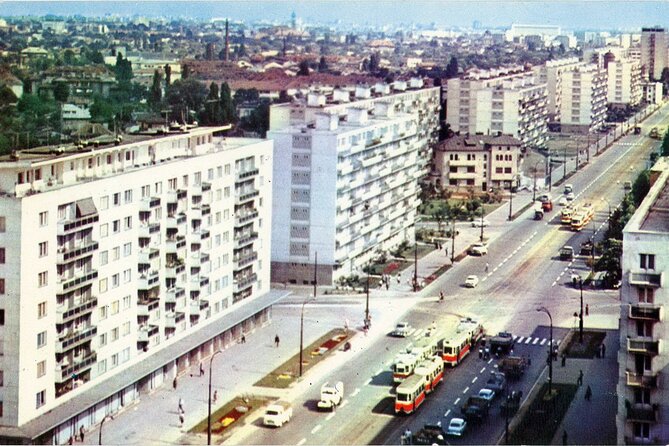
The route continues to the former Royal Palace, now home to the National Art Museum. It was once the winter residence of Romania’s royal family. In the first years of communist rule, it became the Palace of the Republic and a protocol building.
That change in use tells a compact story about the transfer of power. A royal residence was not merely preserved as a museum of the past. It was absorbed into the new political order and given a different public function.
You’ll spend around 15 minutes here. Admission to the stop is free, but this walk does not include a visit to the National Art Museum. If the museum interests you, plan a separate visit and allow extra time beyond the 2.5-hour walk.
For me, this stop adds balance. The tour is not only about Ceausescu’s later dictatorship. It also looks at the early communist effort to replace the monarchy and create new symbols of authority.
The Romanian Athenaeum and a five-lei landmark

A short five-minute stop at the Romanian Athenaeum provides a change of pace. It is one of Bucharest’s most representative buildings and is pictured on the five-lei banknote.
The brief timing tells you what to expect: a quick exterior explanation and a chance to appreciate the building’s role in the city’s visual identity. It is not a concert visit or an interior tour.
This stop works well near the end because it reminds you that Bucharest’s identity cannot be reduced to communist architecture. The city also has royal, cultural, religious, and older civic layers. The route puts those layers next to one another, which is one of its strongest features.
Revolution Square and Ceausescu’s final speech
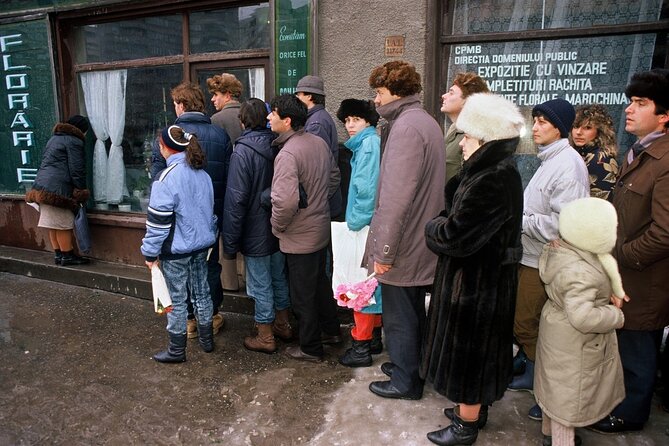
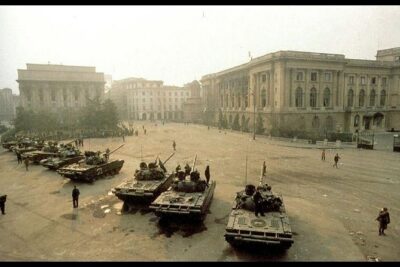
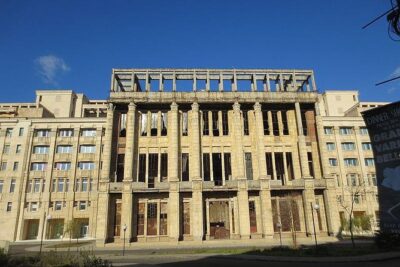
The walk ends at Revolution Square, after about 25 minutes focused on the main building associated with Ceausescu’s final public speech. This was the Central Committee of the Communist Party, and the square became the setting for the final collapse of his authority.
Ending here is a smart choice. You start with the Palace of Parliament, a symbol of communist power at its most forceful, and finish where that power began to fail in public. The route has a clear story arc without requiring a bus transfer or a return to the starting point.
The final stop is also practical. You finish at Piața Revoluției rather than returning to the Palace of Parliament, leaving you in a central part of Bucharest. The experience provider lists the endpoint as Revolution Square.
What guides Alex and Lucia add
The tour is offered in English, and the guide makes a major difference because much of the value comes from spoken explanation. Alex is specifically associated with lively storytelling, humor, scientific and cultural knowledge, and the ability to adjust to the group. That mix should suit you if you want history explained in a human way rather than delivered as a lecture.
Lucia is also named as a guide. One English-language participant who relied on Google translation had difficulty following the tour, which is an important practical warning. Translation tools may help with isolated words, but they are less useful when a guide is telling a connected story while the group is walking.
The maximum group size is 25 people. That is not an intimate private walk, but it is still small enough for a guide-led street tour to remain manageable. The supplied information does not promise radio headsets, so you should stay close enough to hear clearly, especially near traffic or busy public areas.
Is $24 a fair price?
At $24 per person, I see this as a solid value if you want historical context during your first days in Bucharest. You get 2 hours and 30 minutes with a local guide and a route covering nine significant stops. There are no food, drink, or museum admission costs included, but the major appeal is the interpretation of public places, most of which you can see without a ticket anyway.
You are paying for connections: why the boulevard was built, how the Old Town changed, how royal spaces were repurposed, and where the 1989 revolution unfolded. If you only want a list of landmarks, you can walk through several of these areas independently. If you want the political story tied together, the fee is easier to justify.
The group limit of 25 also helps keep the price reasonable. It is more affordable than a private guide, while still offering a planned route and a clear endpoint.
Timing, meeting point, and walking demands
The start time is 10:30 a.m. at Bulevardul Unirii 5, Bucharest. The endpoint is Revolution Square. The tour lasts approximately 2 hours and 30 minutes, and the supplied information describes it as suitable for most people.
You should wear comfortable shoes and be ready to walk between several central locations. No special fitness requirement is stated, but this is a walking tour rather than a seated presentation. Public transportation is nearby, and service animals are allowed.
The experience is offered in English only. Confirmation arrives at booking, and the tour requires a minimum number of participants. If that minimum is not met, the provider offers another date or experience, or a full refund.
Free cancellation is available up to 24 hours before the start time. Cancellations or changes made less than 24 hours before the start are not refunded or accepted, and the cut-off follows Bucharest local time.
Who should book this Bucharest walk?
I would choose this tour if you want to understand how communism changed Bucharest’s streets, buildings, and public memory. It suits first-time visitors who want a strong orientation, history-minded adults, and families with older children who can follow a serious discussion about dictatorship and revolution.
It also works well for people who prefer a chronological story told through places. The route moves from communist construction to urban clearance, then through political change, royal buildings, and the 1989 uprising.
You may want another option if your main interest is going inside buildings, visiting museums, or seeing communist-era apartments and private homes. The tour is largely an exterior walk, and the Palace of Parliament and National Art Museum are not included as interior visits.
Should you book the Communism Walking Tour?
Book it if you want a focused introduction to Romania’s recent past and like learning through streets and buildings. The Palace of Parliament, Old Town, University’s Square, and Revolution Square give the walk a strong physical structure, while guides such as Alex and Lucia bring the events closer to everyday life.
Skip it if you need a tour in another language or prefer quiet sightseeing with little political discussion. For most English-speaking visitors who want more than photographs of Bucharest’s grand buildings, $24 is a fair price for a clear, compact, and serious city walk.
FAQ
How long is the Communism Walking Tour from Lenin to Ceausescu?
The tour lasts approximately 2 hours and 30 minutes.
What time does the tour start?
The tour starts at 10:30 a.m.
Where does the tour begin?
It begins at Bulevardul Unirii 5, București 040101, Romania.
Where does the tour end?
The tour ends at Revolution Square, also called Piața Revoluției, in Bucharest.
What language is the tour offered in?
The tour is offered in English.
What is included in the price?
A local guide is included.
Are food and drinks included?
No. Food and drinks are not included.
How many people can join the tour?
The maximum group size is 25 people.
Is the tour suitable for most people?
Yes. The supplied information states that most people can participate. Service animals are also allowed, and the route is near public transportation.
Can I cancel for a full refund?
Yes, if you cancel at least 24 hours before the experience start time. Cancellations made less than 24 hours before the start are not refunded.
Just added around Bucharest
- Private Full Day Tour of Bucharest★ 5.0 · 3 reviews
- Veliko Tarnovo and Medieval Bulgaria Private Day Trip from Bucharest★ 5.0 · 3 reviews
- Bucharest VIP Bar Crawl in Lipscani ‘Old Town’★ 5.0 · 3 reviews
- Muddy Volcanoes and Salt Mine Private Tour★ 5.0 · 3 reviews
- Bucharest Private City Tour★ 5.0 · 3 reviews
- Legends & Stories from Transylvania -2 Castles & Brasov Old Town★ 5.0 · 3 reviews
- 7-Day Dracula Tour in Romania from Bucharest including ‘The Ritual of Killing of a Living Dead’★ 5.0 · 3 reviews
- Transfagarasan Private Tour from Bucharest – 2 Days★ 5.0 · 3 reviews
Communist Bucharest Tours, compared.
Bucharest Essential Tour: Old Town, Calea Victoriei & Communism
Read our review →
Communism in Bucharest – Landmarks, Museum & Communist Appetizers
Read our review →
Browse the lists this tour appears in