
Reviewed · COMMUNIST BUCHAREST TOURS
Contrasts of Communism – Small Group Walking Tour in Bucharest
The most useful thing about Contrasts of Communism is that it treats communism as lived experience, not just a list of dates and stern-looking buildings. In three hours, you move from the site of Nicolae Ceausescu’s final speech to the graves of people killed in 1989, then out to ordinary apartment blocks and back to the enormous Palace of Parliament.
I like the small maximum of eight people, which leaves room for questions and conversation. I also like the use of old photographs and public transportation, since you see both famous political sites and parts of Bucharest you could easily miss. The main consideration is physical: this is a real walking tour, with metro or bus travel mixed in, so eat breakfast and wear sensible shoes.
Key points at a glance
- Revolution Square: Hear how Ceausescu’s final speech unraveled and why this square became a symbol of the 1989 uprising.
- University’s Square: Visit KM0 of Romanian freedom of speech and connect the revolution to Romania’s present political life.
- Public transport beyond the center: Reach a working-class neighborhood where grey communist blocks meet colorful new street art.
- Memorial Cemetery: Walk among the graves of those killed during the revolution and learn personal stories behind the names.
- Carol I Park and Parliament: See two very different symbols of power, from a communist monument on a hill to Ceausescu’s vast administrative palace.
- Personal, question-friendly guiding: Elena leads the experience in English, often using photographs and family perspective to explain how communism affected daily life.
Why Bucharest’s communist story needs more than one square
Romania’s communist past is easy to reduce to Ceausescu, the Palace of Parliament, and a few bleak apartment blocks. That shortcut misses the tension between official slogans and private life, between the grand projects of the regime and the sacrifices made by ordinary people.
This tour follows that tension across the city. You hear about the dictatorship, but you also see where people resisted, where they died, how their memory is preserved, and how the city is changing after communism.
Elena brings a political science background and speaks excellent English. Her approach is conversational rather than a long speech delivered at each stop. That matters with a subject this complicated. You can ask about the cult of personality, the revolution, post-communist Romania, or the effect of the regime on families, and the discussion can follow your interests.
The group size is a real advantage. With no more than eight people, you are not trying to hear a guide over a crowd or wait while a large group crosses a road. The pace can also breathe a little. Several parts of the route allow time for photographs, questions, and quiet reflection.
More Walking Tours in Bucharest
- Bucharest: City Highlights Guided Walking Tour
★ 4.9 · 1,482 reviews - Bucharest Highlights Walking Tour
★ 5.0 · 469 reviews - Bucharest: Ghost Stories & Romanian Mythology Walking Tour
★ 4.9 · 287 reviews
Revolution Square and Ceausescu’s final speech
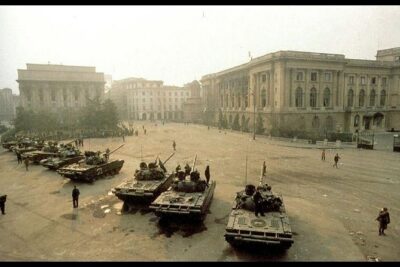
The tour begins near Strada Boteanu and heads to Revolution Square, one of the essential places for understanding modern Bucharest. This is where Ceausescu gave his last public speech in 1989, an event that began as a carefully staged display of support and ended with the crowd turning against him.
The value here is not simply seeing a famous location. It is understanding how a dictatorship tried to use public space and mass gatherings to project control. At this square, the official story and the real mood of the people collided in full view.
You will spend about 30 minutes here. Admission is free, and the stop gives Elena time to explain the rise and fall of the communist dictatorship. Old photographs are especially useful at this point. They help you compare the square as it looked during the revolution with the place you see today.
I would pay close attention to the way Elena explains events rather than treating 1989 as an isolated burst of drama. The revolution was shaped by years of repression, shortages, surveillance, propaganda, and frustration. The square gives you a starting point for those wider issues.
University’s Square and the first deaths for liberty
From Revolution Square, the route continues to University’s Square, described as KM0 of Romanian freedom of speech. This is where some of the first heroes of Bucharest’s revolution died on December 21, 1989.
The stop lasts about 30 minutes and shifts the focus from the dictator’s fall to the people who faced the danger directly. You are not only hearing what happened at the top of the political system. You are looking at a place where citizens gathered, spoke out, and paid a terrible price.
Elena also connects this location with Romania’s current political climate. That is an important part of the tour. A visit focused only on the past can leave you with a tidy museum version of history. Here, the conversation continues into the ways communist rule still shapes public memory, political arguments, and attitudes toward authority.
There is no admission fee, but the intellectual value is substantial. If you want a quick photo stop, this may feel slower than expected. If you want to understand why Bucharest’s political history still feels present, the extra explanation earns its time.
A working-class neighborhood beyond the postcard center
One of the tour’s most useful choices is leaving the central sights by public transportation. You travel to Eroii Revolutiei, an area that shows a more ordinary side of Bucharest.
The stop itself is about 15 minutes, but the journey is part of the experience. Depending on the exact route, public transport can include the metro, bus, or tram. This is not a ride designed to show off polished monuments. It gives you a look at how the city connects its historic center with residential districts.
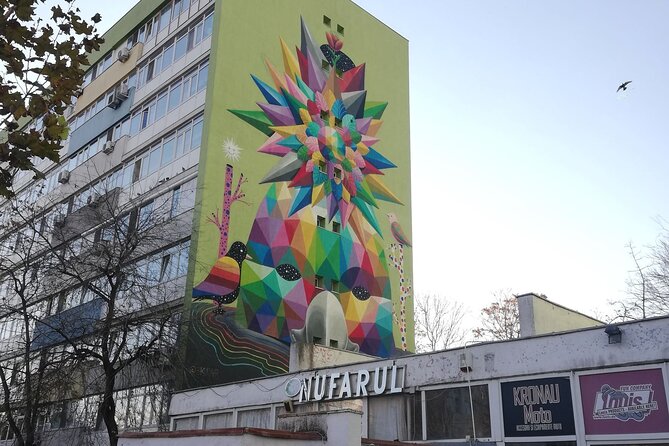
Here, grey apartment blocks from the 1970s are being reworked with colorful street art. The contrast is direct and easy to read. The blocks reflect the practical, uniform architecture associated with communist urban planning. The murals suggest new forms of expression, local identity, and a city willing to repaint parts of its past without pretending they never existed.
You should not expect a long art walk. The stop is brief. Its strength comes from the contrast between the neighborhood and the ceremonial spaces visited earlier. You see how communist planning affected everyday streets, not just government buildings and squares.
For me, this is one of the reasons the experience offers more than a standard central walking route. You get a sense of Bucharest as a lived-in city, not just a collection of historical backdrops.
More communist-era Bucharest walks:
- The Real tour of Communism
★ 5.0 · 666 reviews - Life under Communism
★ 5.0 · 358 reviews - 3-Hour Guided Tour of Communist Bucharest
★ 4.9 · 303 reviews - Bucharest Essential Tour: Old Town, Calea Victoriei & Communism
★ 5.0 · 142 reviews
The Memorial Cemetery and the human cost of 1989
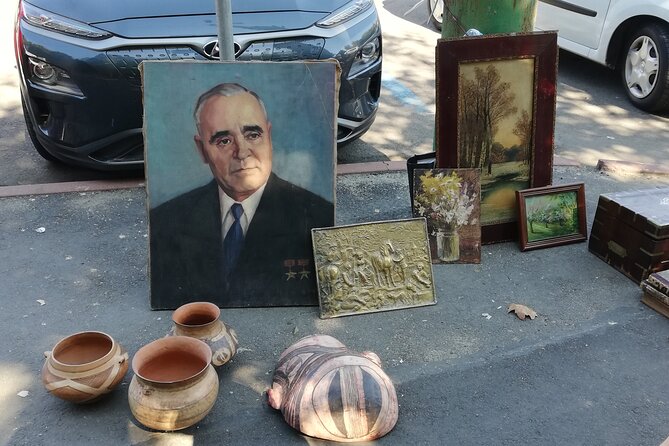
At Cimitirul Eroilor Revolutiei, the tone becomes quieter. The cemetery is dedicated to the people killed during the 1989 revolution, and you walk along its paths for about 30 minutes.
This stop asks you to slow down. The earlier locations explain political events in public spaces. Here, the focus moves toward individual lives and personal stories. Names and graves make the revolution less abstract.
That change in mood is important. Political history can become a sequence of leaders, speeches, and dates. A cemetery restores the human scale. You have time to listen, reflect, and understand that the end of the regime was not a clean political handover. People died during the struggle, and families carried those losses afterward.
The paths are quiet, but the subject is heavy. This is not the lightest morning activity, particularly if you prefer tours centered on architecture or food. I would welcome the pause, though, because it prevents the tour from turning the revolution into a dramatic city story without consequences.
Carol I Park and a monument to communist power
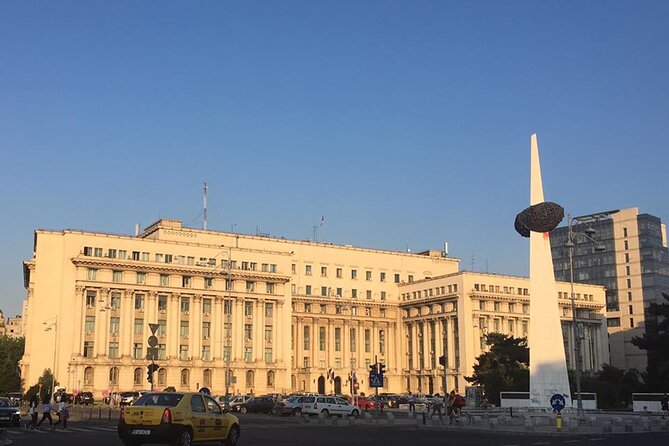
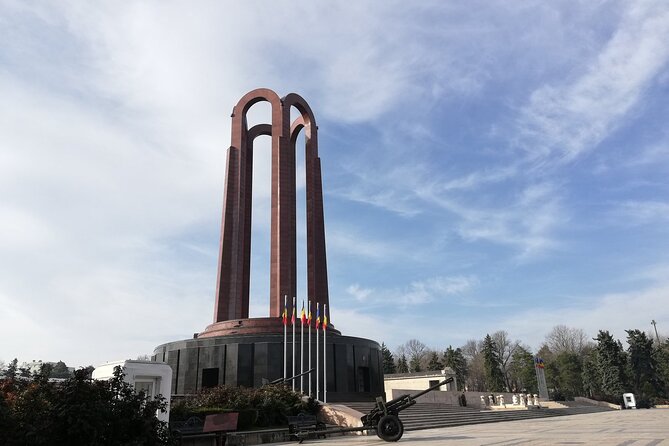
The route continues to Carol I Park, where a hill offers one of Bucharest’s higher views. You get a different perspective on the city and encounter the Monument of the Heroes for the Freedom of the Motherland.
The monument was built in honor of communist party leaders. Its location and design offer a clear lesson in how regimes use memorials to shape public memory. A monument can honor sacrifice, but it can also tell people which version of the past they are expected to accept.
The park stop takes around 30 minutes. It adds open space and a change of pace after the cemetery and residential district. The elevated view also helps you read Bucharest physically. Large boulevards, apartment districts, parks, and monumental government projects fit into one broad picture.
This part of the tour is particularly useful if you want to understand the link between politics and city planning. Communist power was not expressed only through speeches or police institutions. It was built into the scale of public spaces, the position of monuments, and the way streets could be arranged for ceremonies and control.
The Palace of Parliament, Ceausescu’s last great whim
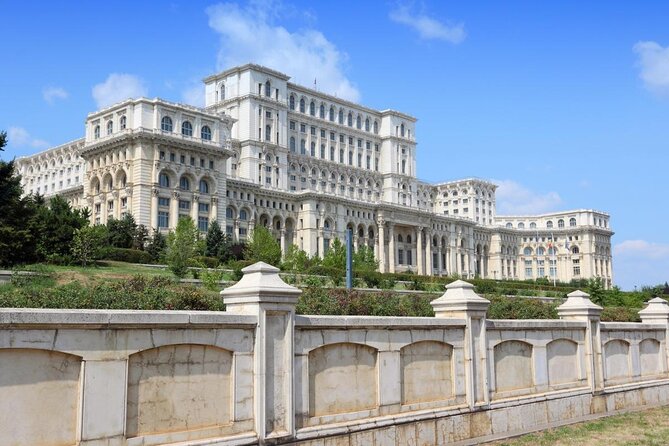
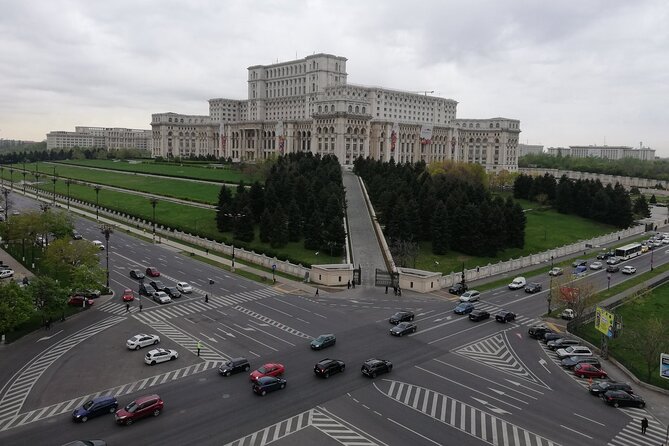
The Palace of Parliament is the tour’s biggest visual punch. You return toward the center and stand outside the second-largest administrative building in the world, a huge project associated with Ceausescu’s final years in power.
The stop lasts about 30 minutes. Admission to the building is not included, so this experience is an exterior visit rather than an interior tour. That distinction matters if you are comparing it with a Parliament visit that includes security checks and indoor rooms.
Even from outside, the building explains a great deal about the regime. Its scale is difficult to separate from the economic and social pressures placed on Romania during its construction. The palace was not simply a large office complex. It was part of a grand vision of state power and a personal project tied to Ceausescu’s cult of personality.
Elena’s explanation helps place the building in the wider story rather than letting it become a giant photo opportunity. You can consider who the building was meant to impress, what it displaced, and why its presence remains uncomfortable as well as impressive.
I would not book this tour solely to see the palace. You can view it from the outside on your own. The value comes from seeing it after Revolution Square, University’s Square, the cemetery, and Carol I Park. By then, the building reads as the final expression of a system you have been following through the city.
Unirii Boulevard and the fountains built for display
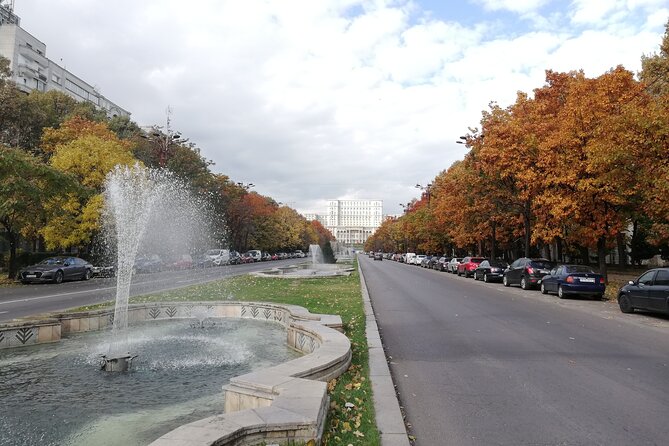
The tour ends near the dancing fountains on Unirii Boulevard, close to Parliament and Bucharest’s Old Town. This boulevard was designed as a grand approach and a kind of home-court advantage intended to humble visiting world leaders.
The final 15-minute stop ties together the themes of scale, display, and political theater. Wide boulevards and fountains can look celebratory, but they also reveal how the city was arranged to project strength. The design tells you how the regime wanted power to appear when seen by outsiders.
Ending here works well because you are left near places you may want to explore afterward. You can continue toward the Old Town, remain near Parliament, or use the location as a central point for the rest of your day.
The fountains may be a highlight for some people and a quick photo stop for others. The explanation of why the boulevard was built gives the view more meaning than it would have on its own.
Three hours, public transport, and the walking effort
The experience lasts about three hours, but the route covers several parts of Bucharest. You walk between central stops, use public transportation to reach the neighborhood and other areas, and spend time standing outdoors while listening.
A moderate level of fitness is recommended. One direct practical tip is to eat a good breakfast before starting. You do not need to treat this like a strenuous hike, but it is more demanding than a short central stroll.
Wear comfortable shoes and prepare for changing surfaces and pauses at outdoor sites. Since the tour requires good weather, rain or poor conditions can affect the schedule. If the experience is canceled for that reason, you are offered another date or a full refund.
The tour is offered in English and uses a mobile ticket. Confirmation is sent within 48 hours of booking, subject to availability. Service animals are allowed, and the starting point is near public transportation at Strada Boteanu 3.
What Elena adds to the experience
The guide is a major part of the value here. Elena is described as friendly, patient, and clear, with strong English and a willingness to handle questions across Romanian history and politics.
She uses historical photographs to show how places looked before, during, or shortly after the communist period. That simple tool can change the experience. Instead of hearing that a square was important, you can picture crowds, buildings, uniforms, and the visual language of the time.
Elena also brings family perspective to the subject. Her mother lived through the communist period, and that personal connection helps explain how policy reached kitchens, schools, workplaces, and families. Personal context should not replace facts, but it can make official history easier to understand.
The tour also appears adaptable in tone and pace. You can ask questions, take rest stops, and spend more time on subjects that matter to you. One guide response identifies Martha as another host, so availability may not always mean Elena personally leads every departure. If Elena is important to your decision, check the guide details when booking.
The small group makes the discussion feel more like a guided conversation than a performance. That suits this topic, since many of the best questions will concern moral choices, memory, and the gap between public propaganda and private reality.
Is $42.05 a fair price?
At $42.05 per person, the tour is not the cheapest way to walk around central Bucharest. It is also not simply a three-hour stroll. The price includes a guide, a small group capped at eight people, historical interpretation, public transport between districts, and access to sites that are free but difficult to connect into one clear story by yourself.
You are paying mainly for context and route design. Revolution Square, University’s Square, the Palace of Parliament, and Unirii Boulevard are easy to locate. The working-class neighborhood, cemetery, monument, and links between them take more planning.
The value is strongest if you are new to Romanian history or want to understand why Bucharest looks the way it does today. It is also strong for solo visitors, since the small group gives you company without the scale of a large coach excursion.
The price is less compelling if you only want a quick overview or have already studied the 1989 revolution in detail. In that case, you might prefer visiting the major sights independently. For most first-time visitors interested in recent history, the time saved and the connections provided justify the cost.
Who should book this Bucharest walk?
I would choose this experience if you:
- Want the Romanian perspective on life under communism.
- Prefer a small group to a large tour with headphones or a loudspeaker.
- Like asking questions instead of listening to a fixed script.
- Want to see residential Bucharest as well as central monuments.
- Are interested in how the 1989 revolution still affects society and politics.
- Have enough time and energy for steady walking with public transport.
I would hesitate if your main interest is only the interior of the Palace of Parliament, since admission is not included. I would also think twice if you want a relaxed sightseeing loop with minimal walking or if a cemetery and revolution history feel too solemn for your holiday mood.
Should you book Contrasts of Communism?
Yes, if you want Bucharest to make more sense after you leave. The route gives you the dictator’s public stage, the places where people resisted, the graves of those who died, the ordinary blocks shaped by communist planning, and the grand buildings designed to project power.
Book it early if your dates are fixed, since it is often reserved around 17 days ahead. Choose this tour for the discussion, not just the landmarks. Elena’s photographs, personal insight, excellent English, and willingness to answer questions are central to the experience.
At $42.05, it offers good value for a three-hour small-group introduction to Romania’s recent past. Bring comfortable shoes, eat first, and allow the story to move at its own pace. You will finish near Parliament and the Old Town with a clearer sense of why Bucharest can feel grand, wounded, ordinary, and new all at once.
FAQ
How long does the Contrasts of Communism tour last?
The tour lasts approximately three hours.
Where does the tour begin?
The meeting point is Boteca 13, Strada Boteanu 3, Bucharest 010027, Romania.
Where does the tour end?
The tour ends at Bulevardul Unirii 25, near Parliament and Bucharest’s Old Town.
How many people can join the tour?
The maximum group size is eight people.
Is the Palace of Parliament admission included?
No. The tour includes an exterior stop at the Palace of Parliament, but admission is not included.
Is public transportation part of the experience?
Yes. The route uses public transportation to reach areas away from the central tourist zone. The transport may include the metro, bus, or tram.
What happens if bad weather cancels the tour?
If poor weather causes cancellation, you will be offered a different date or a full refund. You can also cancel for a full refund if you cancel at least 24 hours before the start time.
Just added around Bucharest
- Private Full Day Tour of Bucharest★ 5.0 · 3 reviews
- Veliko Tarnovo and Medieval Bulgaria Private Day Trip from Bucharest★ 5.0 · 3 reviews
- Bucharest VIP Bar Crawl in Lipscani ‘Old Town’★ 5.0 · 3 reviews
- Muddy Volcanoes and Salt Mine Private Tour★ 5.0 · 3 reviews
- Bucharest Private City Tour★ 5.0 · 3 reviews
- Legends & Stories from Transylvania -2 Castles & Brasov Old Town★ 5.0 · 3 reviews
- 7-Day Dracula Tour in Romania from Bucharest including ‘The Ritual of Killing of a Living Dead’★ 5.0 · 3 reviews
- Transfagarasan Private Tour from Bucharest – 2 Days★ 5.0 · 3 reviews
Communist Bucharest Tours, compared.
Bucharest Essential Tour: Old Town, Calea Victoriei & Communism
Read our review →
Communism in Bucharest – Landmarks, Museum & Communist Appetizers
Read our review →

Browse the lists this tour appears in