
Reviewed · BUCHAREST TOURS
Bucharest: 3-Hour Dark History Tour with a Local
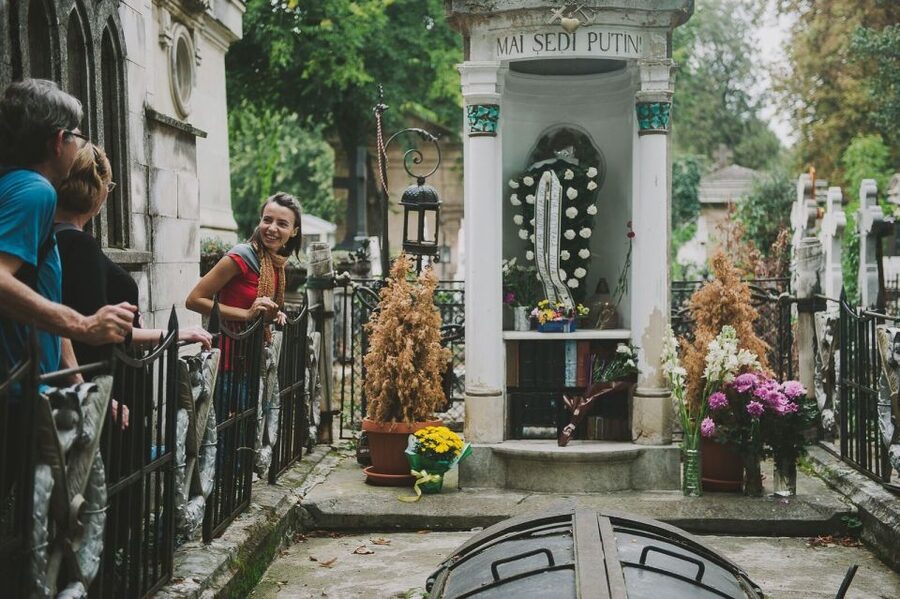
Bellu Cemetery is the surprising heart of this Bucharest tour. You wander among ornate tombs, old family vaults, stray cats, and stories that move from tragic love to murder and folklore. From there, the walk connects cemetery history with the bloodshed of the 1989 Revolution, communist repression, interwar sex work, and a notorious 1970s killer.
I like the way the tour uses real city locations instead of treating dark history as a collection of spooky tales. I also like the small-group format, with no more than 12 people, and the way guides such as Alex, Elena, Andra, Irina, and Vlad add personal stories and local context.
The main drawback is physical and emotional: this is a long walking tour covering grim subjects, and much of it takes place outdoors. Cold weather can be especially uncomfortable, since you stop to listen rather than walk constantly. Bring sturdy shoes and warm layers.
Key points to know before booking
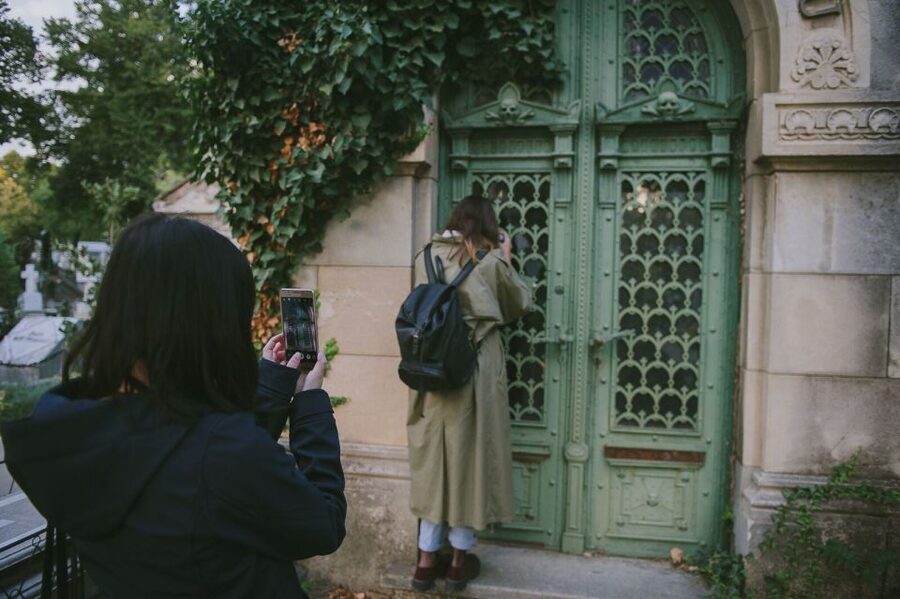
- Bellu Cemetery is the star stop: Expect elaborate funerary art, unusual stories, old graves, and a quiet look at Bucharest’s past.
- The tour links several eras: You move from the old cemetery and interwar Bucharest to the 1989 Revolution and the hardships of communist rule.
- It is not only a ghost tour: The focus is Romania’s political and social history, with crime and folklore woven into the walk.
- The guides shape the experience: Alex, Elena, Andra, Irina, Vlad, Bogi, and others are praised for clear storytelling, humor, and personal insight.
- You use the metro twice: Tickets are included, so you do not need to arrange local transport between the main sections.
- Plan for three hours outside: Comfortable shoes matter, and winter visitors should wrap up very warmly.
Why Bucharest’s darker side works as a walking tour
Bucharest can feel hard to read at first. Grand buildings, aging facades, broad boulevards, quiet courtyards, and communist-era blocks often sit close together. A standard sightseeing walk can show you what a building is, but it may not explain the fear, violence, and social change that shaped the city.
This tour takes a different route through Bucharest. It treats the city as evidence. A cemetery reveals class, religion, architecture, and family life. University Square shows how public protest can turn a familiar urban space into a place of danger. Revolution Square connects political symbols with the final days of Nicolae Ceaușescu’s dictatorship.
That approach gives you a better sense of Romania than a string of dates. You hear about the Securitate, Romania’s secret police, and the prisons, labor camps, and torture used against critics. You also hear about ordinary survival under communism, which is often more useful than a simple list of political leaders.
The tone is serious, but the tour is not presented as a grim lecture. Guides use humor, folklore, architecture, and personal memories to keep the three hours moving. Alex is repeatedly praised for noticing small details such as bullet holes, street art, and local plants. Elena is praised for asking about your interests and connecting the history to Romanian culture and daily life.
More History Tours in Bucharest
- Bucharest: Small Group History, Art & Secrets Tour
★ 4.7 · 152 reviews - Guided Walking Tour of Historical Bucharest
★ 5.0 · 84 reviews - Bucharest Jewish Heritage | Holocaust Memorial | Private Car Tour
★ 5.0 · 38 reviews
Meeting the guide at the National Theatre
The tour begins at the main entrance of the Ion Luca Caragiale National Theatre on Bulevardul Nicolae Bălcescu 2. This is a practical meeting point near the center and should be easy to locate, but arrive with enough time to identify the correct entrance.
The group limit is 12 people. That is small enough for questions and conversation without making the tour feel like a private outing. Several people have had private or nearly private departures when few places were booked, but you should not count on that. The advertised format is a small group, not a guaranteed private tour.
Your guide speaks English. The guide may be Alex, Elena, Andra, Irina, Vlad, Bogi, or another member of the local team. The individual personality can shape the afternoon, but the common thread is clear delivery, strong interest in Romanian history, and a willingness to answer questions.
A useful feature is the informal style. The best version of this tour feels like a local showing you difficult parts of the city while explaining why they matter. Guides have also offered restaurant, cafe, food, and wider Bucharest suggestions after the formal route ends.
Six cemeteries on one Bucharest street
One early section takes you to a street that accommodates no fewer than six cemeteries. This unusual concentration gives the tour a strong start because you see how different communities and historical events are recorded in a small area.
Among the cemeteries are the Cemetery of the Victims of the Revolution in 1989, the Jewish Cemetery, the Cemetery of the Russian Soldiers, and Bellu Cemetery. Each points to a different chapter of Bucharest’s past, from religious identity to war, political violence, and the city’s old elite.
The route does not treat the cemeteries as interchangeable stops. The contrast matters. A cemetery can tell you who belonged to a city, who died defending a cause, and how families wanted to be remembered. It also gives you a physical pause from the traffic and noise of central Bucharest.
You should expect to walk and stand while listening. There is no indication that this part is difficult in a technical sense, but uneven paths and several hours on your feet make comfortable footwear a sensible choice.
Bellu Cemetery, a gallery of funerary art
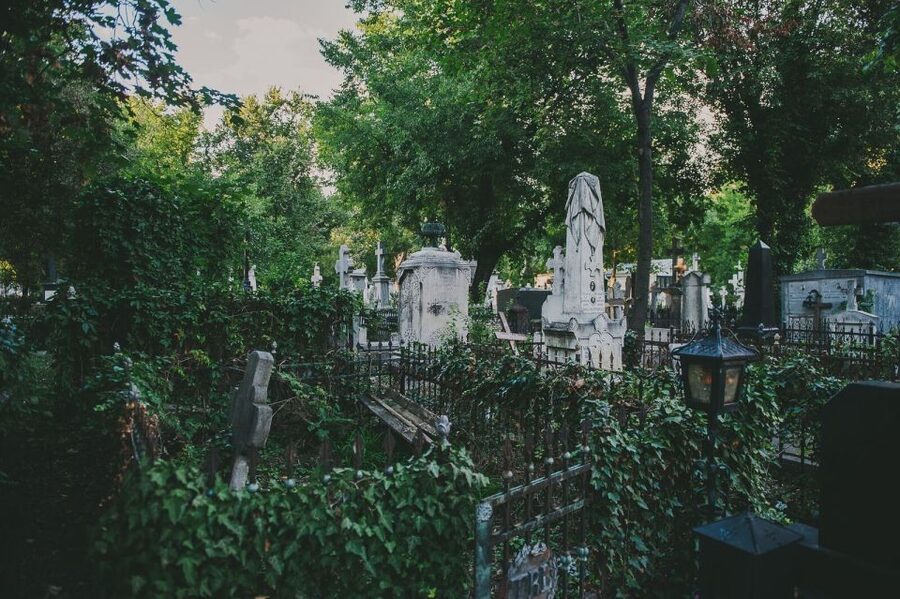
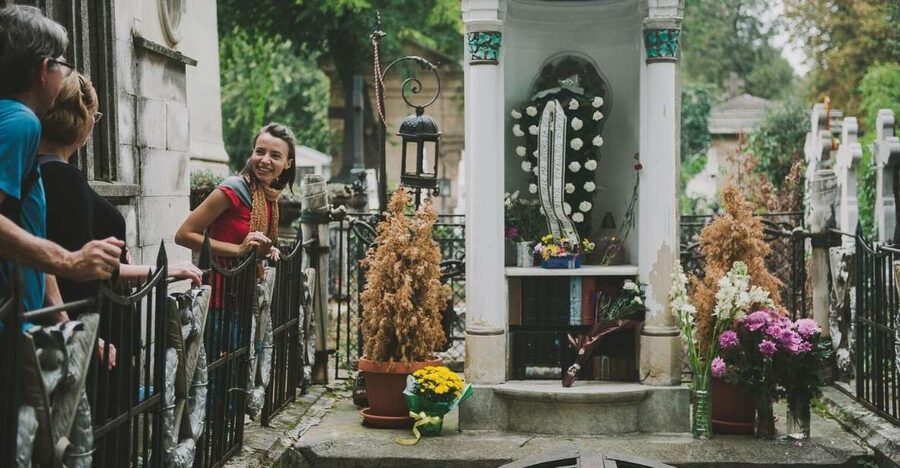
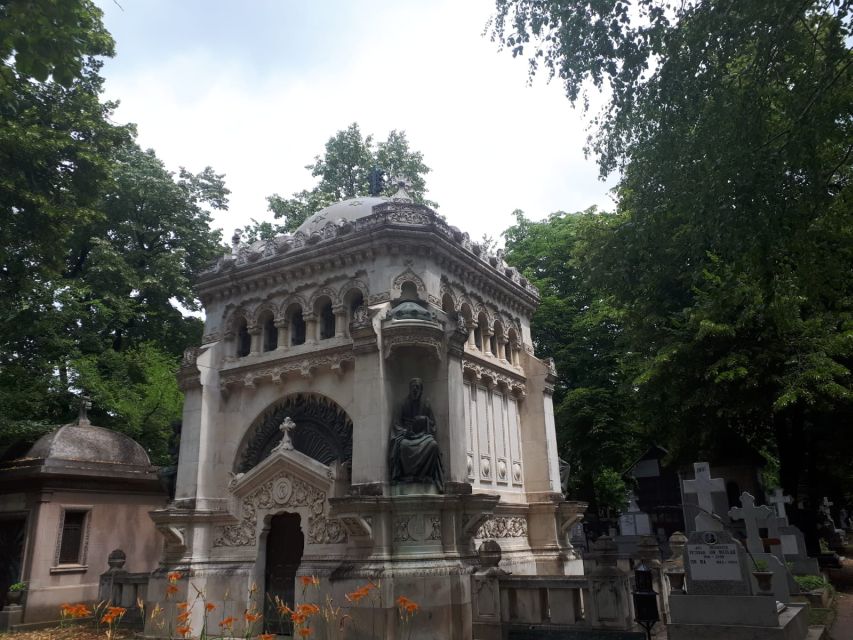
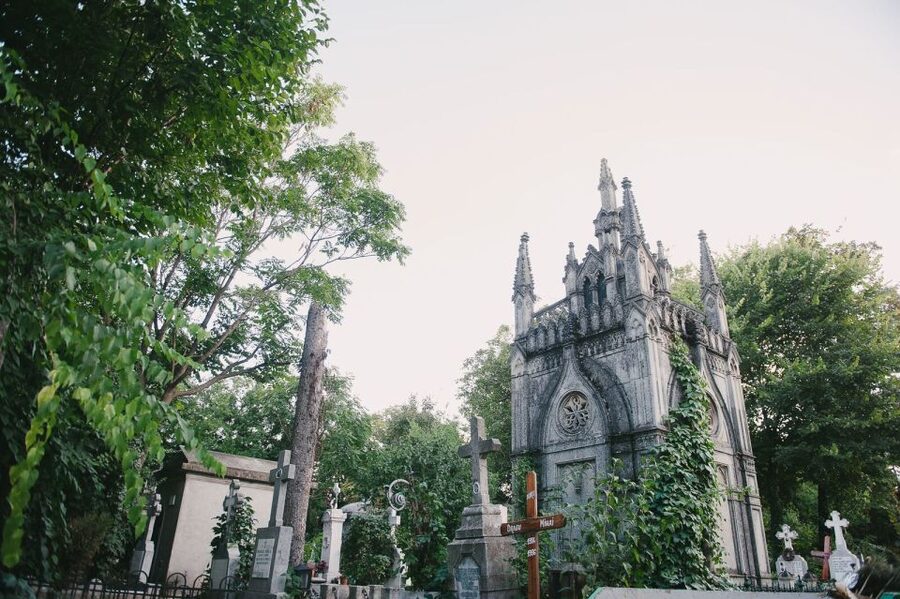
Bellu Cemetery is a national historical monument and the most distinctive stop on the route. It is often described as feeling more like an open-air gallery than a conventional cemetery, thanks to its tombs, chapels, statues, and decorative stonework.
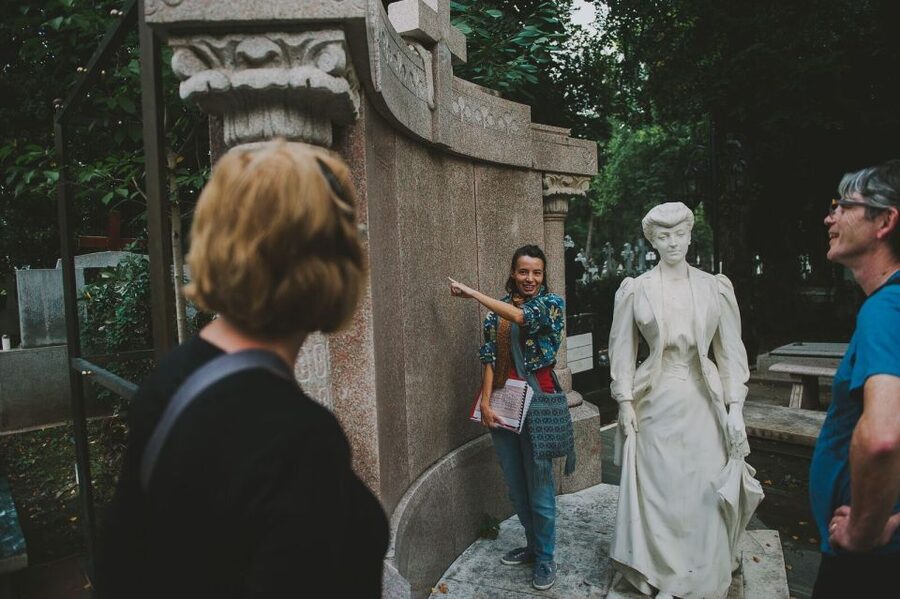
The appeal is not simply visual. Your guide explains the people behind the monuments and the stories attached to them. The material ranges from sad love stories to sinister mysteries, with Romanian beliefs about death and folklore adding another layer.
This is where the tour’s local guide matters most. A cemetery can be fascinating for ten minutes and confusing after that if you do not know where to look. Guides point out architectural details and explain why particular graves matter. Alex is especially praised for his attention to small features, while Elena has brought warmth and humor to the stop.
You might also see the cemetery’s resident cats and dogs. Several guides, especially Elena, have a caring relationship with the animals and may feed or greet them. This is a minor detail, but it gives the visit a more human feel. The animals are not the purpose of the tour, and the cemetery remains a place of mourning, yet the encounter can make the setting feel lived in rather than staged.
The only caution is that this portion may not suit you if cemeteries make you uncomfortable. It is atmospheric, but it is also an active burial ground, so respectful behavior is essential.
More history walks around Bucharest:
- Private Bucharest: History & Food with Traditional Meal
★ 5.0 · 34 reviews - Bucharest Historical Food Tour in Old Center
★ 5.0 · 21 reviews - Half-Day Jewish Heritage Walking Tour in Bucharest
★ 5.0 · 20 reviews - Bucharest: Sweet Delights History and Desserts Walking Tour
★ 5.0 · 18 reviews
University Square and the blood of 1989
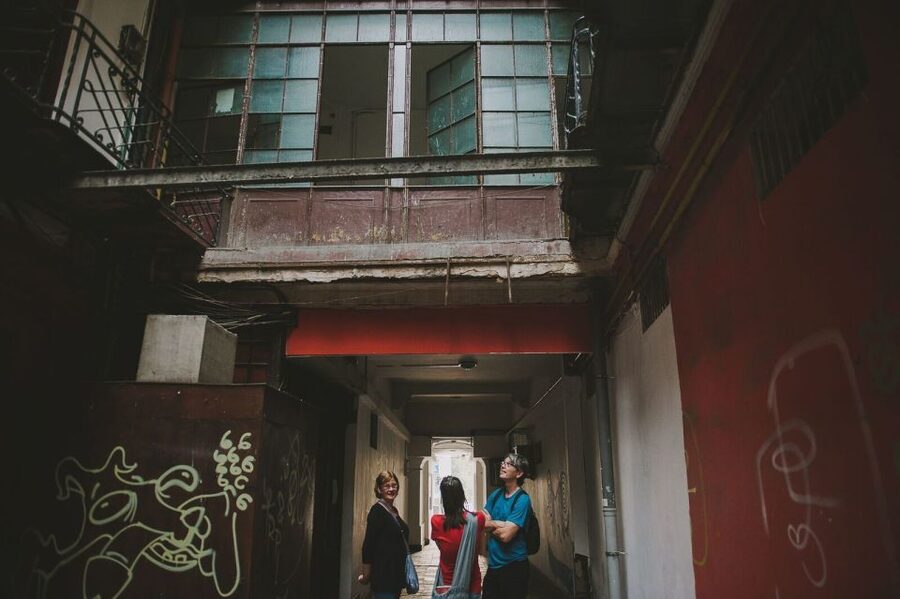
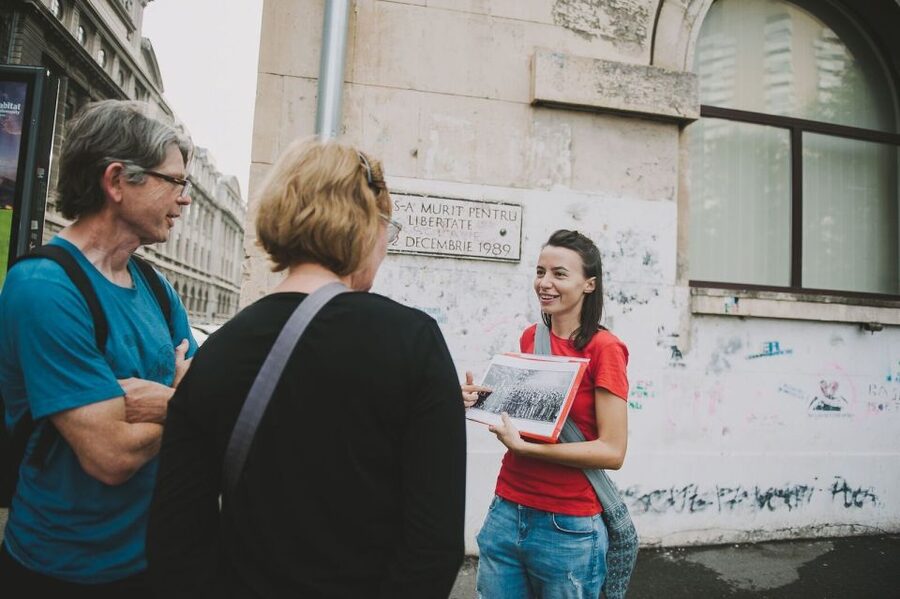
The tour then moves to University Square, one of Bucharest’s most important public spaces. It played a major role during the 1989 Revolution and during anti-communist student protests in the 1990s.
This stop helps you understand how a square becomes political. The location is not important only because events happened there. It shows how people use central public space to gather, protest, resist, and challenge authority.
The 1989 Revolution ended Ceaușescu’s rule, but the story did not become simple overnight. Your guide places the events within the wider experience of communist Romania, including surveillance, fear, censorship, and the risks faced by people who criticized the regime.
Several guides have added personal memories of life under communism. That kind of first-person context can make abstract terms such as shortages, secret police, and political repression easier to understand. You learn not only what happened at the top of government, but how the system affected daily choices.
Do not expect a full political seminar. Three hours cannot cover every stage of Romanian communism or the entire 1989 Revolution. What the tour can do is give you a strong framework, then point you toward places and subjects worth exploring later.
A glimpse of interwar Bucharest’s sex trade
The route also looks back to the period when Bucharest was often called Little Paris. The city had a sophisticated social scene during the interwar years, but behind that image was a working sex trade and a less polished urban life.
You visit what remains of a former interwar brothel. The stop is not presented as a sensational attraction. Instead, it gives you a way to think about the people, businesses, and social rules that existed alongside the city’s cafes, grand buildings, and cultural life.
The stories of famous prostitutes in interwar Bucharest add a personal scale to the subject. They show how women could become well known within a specific neighborhood or social world, even while working in a trade shaped by money, reputation, and unequal power.
This part will appeal to you if you enjoy social history more than famous monuments. It also helps balance the political material. Bucharest’s dark past is not only dictatorship and murder. It includes exploitation, hidden businesses, changing social attitudes, and the gap between a city’s elegant image and the lives taking place behind closed doors.
The remains of the former brothel are not described as a preserved museum interior, so keep your expectations modest. The value comes mainly from the explanation and the context rather than a grand physical exhibit.
The Vampire of Bucharest
One of the tour’s most unsettling stories concerns a serial killer nicknamed the Vampire of Bucharest, who terrorized the city at the beginning of the 1970s.
The story fits the tour’s darker theme, but it also connects crime with the era in which it happened. You hear how Bucharest responded to a killer during communist rule, a period when authorities tightly controlled public information and criticism.
This is a good example of why the experience is more than a supernatural walk. The nickname brings a folklore flavor, but the subject is a real criminal case and the fear it caused. Your guide uses it to show another side of 1970s Bucharest, far removed from official images of an orderly socialist society.
If you want a tour focused mainly on vampires, haunted buildings, or invented legends, this may not be the right choice. The crime story is one strand in a wider account of Bucharest’s history.
Revolution Square and life under Ceaușescu
The final major location is Revolution Square, where the 1989 Revolution began in Bucharest. This is the place to connect the earlier discussion of University Square with the collapse of Ceaușescu’s dictatorship.
Your guide explains the machinery used to silence opposition: prisons, forced labor camps, torture, and the Securitate. The goal is not to make the past seem exotic. It is to show how terror entered ordinary life and why people endured hardship simply to get through each day.
This section can be emotionally heavier than the cemetery stories. You may hear about fear of being watched, punishment for criticism, and the lack of freedom under the communist regime. Guides keep the material approachable, but they do not turn it into a light entertainment segment.
I find this final stop useful because it gives the tour a clear historical endpoint. The cemetery introduces death and memory. The interwar section shows social life before communism. University Square and Revolution Square then bring you to the modern political crisis that changed Romania.
Walking, metro rides, and what the three hours feel like
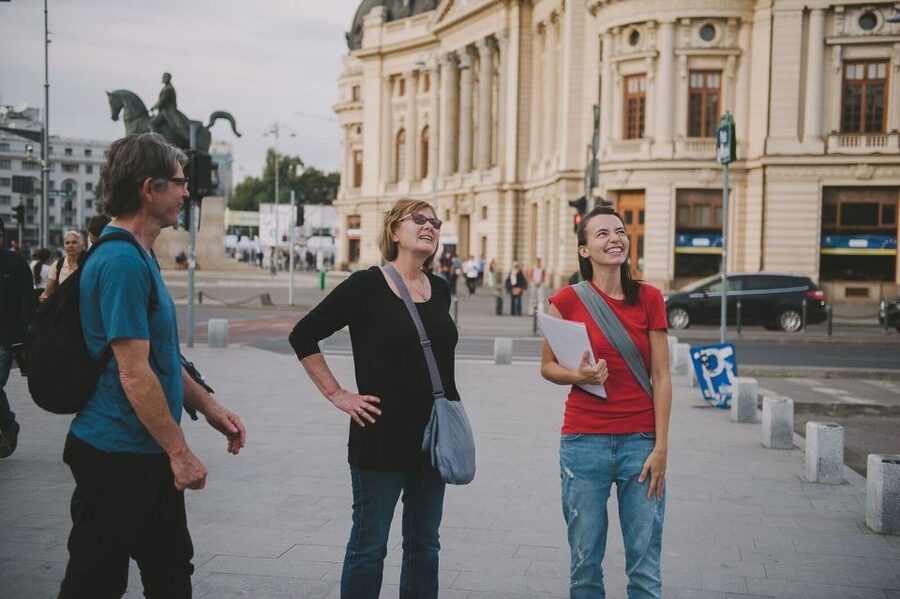
The tour lasts three hours and combines walking with two metro rides. Metro tickets are included, which is a small but worthwhile convenience. You do not need to work out the route between distant sections or find change for public transport.
The walking is substantial. One person described the tour as a long walk, while another praised the regular stops and attention to comfort. These comments point to the practical reality: you cover a lot of ground, but the pace includes time to listen and ask questions.
Wear comfortable shoes. In warm weather, bring water, though a traditional Romanian street snack is included. The snack may be a chocolate bar or another traditional treat, and some guides have also provided water or extra food. Additional meals and drinks are not included.
Winter needs special planning. Several departures took place in cold weather, and the clear advice is to wrap up very warmly. You can become chilled while standing still at a cemetery or square, even if the walking itself keeps you moving.
The route is not described as wheelchair accessible, and no accessibility details are provided. If mobility is a concern, ask the operator before booking rather than assuming the route will work for you.
Is $55 good value for Bucharest?
At $55 per person, this is not the cheapest way to walk around Bucharest. The price makes more sense if you value interpretation, local transport, and access to places that are easy to miss on your own.
You are paying for three hours with an English-speaking local guide, two metro rides, and a traditional snack. The more important value is the connection between the stops. Bellu Cemetery, University Square, the interwar brothel site, and Revolution Square could be visited separately, but the tour gives them a shared story.
The small group limit also helps. A group of up to 12 leaves room for questions, and guides have tailored parts of the walk to specific interests in architecture, folklore, food, or political history.
I would not book it as your only introduction to Bucharest if you want a broad tour of palaces, churches, markets, and everyday neighborhoods. I would book it after, or alongside, a general city walk. It fills in the difficult chapters that standard sightseeing often skips.
Free cancellation up to 24 hours before the start and reserve-now, pay-later booking make it easier to fit into a changing schedule. The tour is for people aged 16 and older, so it is not suitable for younger children.
Who will enjoy this Bucharest history tour?
This experience suits you if you like political history, crime stories, cemeteries, architecture, folklore, and candid conversations about national memory. It is particularly useful if you want to understand the 1989 Revolution beyond a few dates in a guidebook.
It also works well for repeat visitors. The route focuses on places and details that may not appear on a standard central Bucharest itinerary. One guide has highlighted bullet holes, street art, local plants, and other small signs that are easy to pass without context.
You may want to skip it if you dislike long walks, outdoor tours, or stories about murder and state violence. The title is accurate: the material includes death, torture, political terror, prostitution, and a serial killer.
The guides are a major part of the value. Alex is praised for passionate storytelling and close attention to detail. Elena is known for warmth, humor, cultural insight, and care for the cemetery animals. Andra is praised for clear explanations and wit, while Irina and Vlad are noted for their strong command of Romanian history and their friendly, personal style.
Should you book the Dark History Tour?
Book it if you want Bucharest to make more sense, not just look interesting. The tour turns cemeteries, squares, old buildings, and metro rides into a connected story about death, power, fear, protest, and survival.
I would especially recommend it for adults and older teenagers who have already seen the main sights and want something less predictable. At $55, it is worthwhile when you want a small group, a local English-speaking guide, and context you are unlikely to get from simply walking between monuments.
Skip it if you are after a gentle sightseeing loop or a tour built only around spooky legends. This is a serious history walk with atmospheric moments, not a haunted-house show. Bring good shoes, dress for the weather, and give yourself three hours to listen carefully.
FAQ
How long does the Bucharest Dark History Tour last?
The tour lasts three hours. Check the available start times when booking.
Where does the tour begin?
It begins at the main entrance of the Ion Luca Caragiale National Theatre, at Bulevardul Nicolae Bălcescu 2, Bucharest.
What language is the tour in?
The tour is conducted in English by a live local guide.
Is Bellu Cemetery included?
Yes. Bellu Cemetery is one of the main stops, along with other cemeteries on the same street.
Are public transport tickets included?
Yes. Metro tickets for the tour are included in the price.
Can children join the tour?
No. Participants must be at least 16 years old.
More 3-Hour Experiences in Bucharest
- 3-Hour Guided Tour of Communist Bucharest
★ 4.9 · 303 reviews - Bucharest: Alternative Sightseeing 2.5-3h-Hour Guided Tour
★ 4.9 · 80 reviews - Bucharest: 3-Hour Walking Tour
★ 4.9 · 77 reviews - Bucharest: Relics of Communism 3-Hour Walking Tour
★ 4.9 · 77 reviews
Just added around Bucharest
- Private Full Day Tour of Bucharest★ 5.0 · 3 reviews
- Veliko Tarnovo and Medieval Bulgaria Private Day Trip from Bucharest★ 5.0 · 3 reviews
- Bucharest VIP Bar Crawl in Lipscani ‘Old Town’★ 5.0 · 3 reviews
- Muddy Volcanoes and Salt Mine Private Tour★ 5.0 · 3 reviews
- Bucharest Private City Tour★ 5.0 · 3 reviews
- Legends & Stories from Transylvania -2 Castles & Brasov Old Town★ 5.0 · 3 reviews
- Transfagarasan Private Tour from Bucharest – 2 Days★ 5.0 · 3 reviews
- 7-Day Dracula Tour in Romania from Bucharest including ‘The Ritual of Killing of a Living Dead’★ 5.0 · 3 reviews
Bucharest Tours, compared.
Dracula’s Castle, Peles Castle, & Brasov Old Town
Read our review →
Dracula Castle, Peles Castle & Brasov Old Town
Read our review →
Dracula’s Castle, Peleș Castle & Brașov Day Trip
Read our review →
Day Trip to Dracula Castle, Peles Castle & Brașov
Read our review →
Bucharest to Dracula Castle, Peles Castle and Brasov Guided Tour
Read our review →
Dracula’s Castle, Peles Castle and Brasov Day Trip from Bucharest
Read our review →Browse the lists this tour appears in